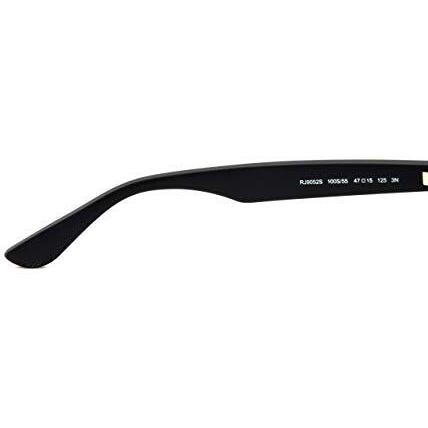
Sunglasses Ray-ban Rj9052s junior new wayfarer col. 100s55 Child Square Black


Sponsored This site contains affiliate links for which we may receive compensation. More information
 SmartBuyGlasses
Sponsored Ray-Ban Kids RJ9052S New Wayfarer 100S55 Kids' Sunglasses Black Size 47
121.00 CAD
Price updated on: 10-02-2026 08:48:39
121.00 CAD
Price updated on: 10-02-2026 08:48:39 | Identifiers | |
|---|---|
| MPN | Ray-Ban 0RJ9052S100S55 |
| Model | Ray-Ban Rj9052s |
| Dimensions / Weight | |
| Key Features | |
|
Arm material The type of material used to construct the frame of a product, such as metal, plastic, acetate or composite blends. This attribute helps users understand durability, weight, appearance and suitability for specific applications.
|
plastica |
|
Bridge size The width of the bridge section of a product, typically expressed in millimeters or inches. It indicates how wide the central part that connects two halves (e.g., lenses, panels, or components) is, which can affect fit, stability, and compatibility with other parts.
|
15 |
|
Caliber and nose The combined measurement of a glasses lens diameter (in millimeters) and the nose bridge width (also in millimeters). It is expressed as two numbers separated by a hyphen, e.g., "55-18". The first number indicates the lens diameter, while the second indicates the width of the bridge that rests on the nose.
|
47-15 |
|
Case type The form or style of a protective enclosure for electronic devices, such as laptops, tablets, phones, or other gadgets. It indicates whether the case is a hard shell, soft sleeve, backpack, messenger bag, folio, flip cover, or any other design that protects and carries the device.
|
pouch |
|
Eye size The horizontal measurement of the eye opening, typically expressed in millimeters. It indicates the width of the pupil or lens area and is used to select eyewear frames that fit comfortably.
|
47 |
|
Frame type The structural design of a product’s outer shell or enclosure, such as the shape and coverage of eyewear frames, camera housings, or protective casings. It indicates whether the frame is full‑rim, half‑rim, rimless, frameless, or has a specific mounting style. This attribute helps users understand how the product is supported and protected.
|
Encircled |
|
Gender Indicates the gender or sex classification associated with a product, such as male, female, unisex, or children’s categories. This attribute helps consumers identify items tailored for specific genders or suitable for all.
|
Unisex |
|
Geofit Indicates the geographic market or distribution region for a product, such as Global, Asian, or other regional classifications. The value is a free‑text label that can be empty when no specific region applies.
|
Global |
|
Gradable Indicates whether a product is gradable, meaning it can be assigned a grade or rating. The value is typically "Yes" for gradable items and "No" for non‑gradable ones; other entries such as "ND" (not determined) or null represent unknown or unspecified status.
|
No |
|
Gradient lenses Indicates whether the product features lenses that change color or opacity when exposed to light, such as photochromic or transition lenses.
|
No |
|
Graduabile Indicates whether the product can be graduated or adjusted, such as a size or angle that can be modified by the user.
|
Yes |
|
Lens color Represents the visual tone or hue of a lens, including solid colors, gradients, mirrored finishes, or polarized coatings. It helps users identify and compare lenses based on their appearance.
|
Blue mirror |
|
Lens properties A single descriptive term that characterizes the optical feature of a lens, such as whether it is standard, polarized, photochromic, or has multiple coatings. The value is a free‑text label that can be used to filter and compare lenses across products.
|
standard |
|
Lenses color The visual hue or tint of a lens surface, such as solid, gradient, mirrored, or polarized. It helps users identify the appearance and style of eyewear lenses.
|
Grey |
|
Mirror lenses Indicates whether a device supports port‑mirroring, allowing traffic on one network port to be duplicated and sent to another for monitoring or diagnostic purposes.
|
Yes |
| Photochromic lenses | No |
|
Polarized Indicates whether the product’s lenses are polarized, reducing glare and improving visual clarity in bright conditions.
|
No |
|
Protection factor Represents the numerical value indicating how many times a product can amplify or multiply a base measurement, such as optical zoom or other magnification effects. The value is expressed without units and can be any positive number, including decimals.
|
3 |
|
Reference A unique identifier that distinguishes a product variant from its base model or other variants within the same product line. It is used to track different configurations, colors, sizes, special editions, or regional versions of a product.
|
RJ9052S 100S/55 47-15 |
|
Shape The overall geometric configuration of a product’s outer enclosure or packaging, such as rectangular, square, round, oval, cylindrical, or other common silhouettes. This attribute helps users quickly identify and compare items based on their visual appearance.
|
square |
|
Size The overall dimension or measurement that identifies the size of a product, such as a frame, garment, electronic component, or container. It can be expressed as a single numeric value (e.g., 47 mm), a range (e.g., 50–60 cm), a volume (e.g., 700 ml), or a descriptive label like "One Size". The attribute helps customers compare and select items that fit their needs.
|
Junior |
|
Style A textual description of the fashion or design category that a product belongs to, such as "casual", "formal", "athletic", or "vintage". This attribute helps users identify the overall aesthetic and intended use of the item.
|
Square, Wrap |
|
Temple size The linear measurement of the temple (eyelid) arm of a frame or eyewear, expressed in millimeters. It indicates how long the arm extends from the hinge to the outer edge and is used by manufacturers and customers to assess fit and compatibility with different eye shapes.
|
125 mm |
|
Weight The mass of the product expressed in a standard unit such as grams or kilograms. It represents how heavy the item is and can be used for shipping calculations, handling instructions, or consumer information.
|
22 g |

Ray-Ban is a brand of sunglasses and eyeglasses founded in 1937 by American optical manufacturer Bausch & Lomb. The brand is best known for its Wayfarer and Aviator styles.


