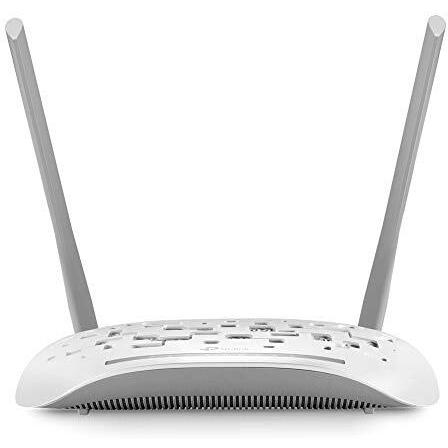
TP-Link W8961N Wireless N ADSL2+ Modem Router



Sponsored This site contains affiliate links for which we may receive compensation. More information
Find other available options:

| Identifiers | |
|---|---|
| MPN | TP-LINK TL-W8961N |
| Dimensions / Weight | |
| Key Features | |
| 3G/4G USB modem compatibility | No |
|
Adsl2 Indicates whether the device is capable of using the ADSL2+ technology, an advanced form of ADSL that provides higher data rates and improved connection stability.
|
Yes |
|
Antenna gain The amount of signal amplification provided by an antenna, expressed in decibels relative to an isotropic radiator (dBi). This value indicates how much the antenna concentrates radio energy in a particular direction and helps users compare coverage or range potential across devices.
|
Under 10dbi |
|
Antenna gain level maximum The highest directional signal amplification a device’s antenna can provide, expressed in decibels relative to an isotropic radiator (dBi). It indicates the maximum gain achievable by the antenna and helps users compare coverage or range potential across devices.
|
5 |
|
Antenna type The classification of an antenna used in a device, indicating its physical configuration or mounting style such as external, internal, integrated, directional, omnidirectional, or multi‑antenna setups (e.g., "2x2", "4 x External"). It helps buyers understand how the antenna is attached and what signal coverage it may provide.
|
Outside |
|
Application A concise statement of the intended or most suitable use cases for a product, such as the type of environment (indoor or outdoor), activity (gaming, office work, media consumption) or general application category. It helps customers quickly determine whether the item fits their needs.
|
Indoor |
|
Buttons The total count of physical and programmable button controls available on a device, such as a router, switch, or mouse. This value indicates how many distinct actions the user can trigger directly from the hardware.
|
On/OffWPSWi-Fi On/Off |
|
Cables included A list of the cable types that are supplied with the product, such as USB, HDMI, VGA, DisplayPort, LAN (RJ‑45), SATA, audio or other relevant connectors.
|
LAN (RJ-45), Phone (RJ-11) |
| Cabling technology | 100 Base |
|
Certification A list of official certifications or compliance marks that the product has received from regulatory bodies, safety organizations, or industry standards groups. Each entry represents a distinct certification such as CE, FCC, RoHS, UL, or WEEE, and may include additional details like version numbers or specific test reports.
|
CE, FCC, RoHS |
|
Colour The colour or combination of colours that a product is available in, expressed as common names such as "Black", "Silver" or comma‑separated lists like "Black, White". It indicates the visual appearance of the item for consumers.
|
Grey, White |
|
Device type The general classification of a product, such as tablet, smartphone, router, or computer. It indicates the primary function or form factor that helps buyers quickly identify and compare similar items.
|
Wireless router |
|
Dimensions (H x W x D) The overall size of a product expressed as height × width × depth in a linear unit such as centimeters or inches. This attribute indicates the physical footprint of the item and helps customers determine whether it will fit into a desired space, shipping container, or storage area.
|
195 * 130 * 35 mm |
|
Ethernet LAN interface type Indica el tipo o estándar de la conexión Ethernet que posee un producto, como Gigabit Ethernet, 10 GbE, 2.5 GbE, Fast Ethernet, etc. Los valores suelen ser textos descriptivos sin unidades numéricas y pueden incluir varias opciones separadas por comas cuando el dispositivo soporta más de una velocidad.
|
Fast Ethernet |
|
Ethernet LAN ports Represents the total count of Ethernet LAN (RJ‑45) interfaces available on a product. The value is an integer indicating how many physical Ethernet ports are present, regardless of speed or generation.
|
4 |
|
Harmonized System HS code The Harmonized System (HS) code is a standardized numerical identifier used internationally to classify traded goods. It consists of up to six digits, where each pair of digits represents progressively more specific product categories. The HS code facilitates customs duties, trade statistics, and regulatory compliance by providing a common language for describing products across borders.
|
85176990 |
| Networking standards | IEEE 802.3,IEEE 802.3u |
|
Number of products included The total count of individual product units that are part of a single purchase or bundle. It indicates how many separate items are available for use, sale, or shipping within the package.
|
1 |
|
Operating Frequency The radio frequency at which a device or component operates, expressed in hertz (Hz). It indicates the specific frequency band used for transmission or reception and helps users determine compatibility with network standards.
|
2.4 GHz |
|
Package type The form of packaging used for a product, such as box, blister pack, bag, or pallet. It indicates how the item is contained and protected during shipping and storage.
|
Box |
|
Port forwarding Indicates whether the device supports configuring port forwarding rules to allow external traffic to reach specific internal services or devices. The value can be a simple yes/no, or a list of supported features such as Virtual Server, UPnP, DMZ, Port Triggering, ALG, etc.
|
Virtual servers, DMZ, access control |
|
Ports A list describing the physical connectors or interfaces present on a product, including their type (e.g., USB, RJ‑45, HDMI) and the quantity for each type. Each entry is a short phrase such as "4 x USB 3.0" or "2 x RJ‑45", allowing users to see at a glance what ports are available and how many of each. This attribute captures both the port category and its count in a single string, making it suitable for products that offer multiple port types with varying numbers.
|
4 RJ45 10/100Mbps ports1 RJ11 port |
|
Power source type The main electrical supply that powers the device, such as mains electricity (AC), battery, USB power, PoE, or a combination of these options.
|
DC |
|
Security algorithms A list of cryptographic and authentication methods that a device can use for secure communication or data protection. Each entry represents a distinct algorithm or protocol, such as encryption ciphers (e.g., AES, WEP), authentication mechanisms (e.g., RADIUS, WPA‑PSK), or network security protocols (e.g., HTTPS, SSL/TLS). The values are typically separated by commas and may include both technical identifiers and consumer‑friendly labels.
|
64-bit WEP,128-bit WEP,WPA-PSK,WPA2-PSK |
|
Transmit power The maximum power level at which a device can transmit radio signals, expressed in the appropriate unit such as decibels relative to one milliwatt (dBm) or milliwatts (mW). It indicates the strength of the transmitted signal and is used to assess coverage range and regulatory compliance.
|
20 |
|
Type of case The general form or configuration of a product’s outer enclosure, such as desktop, rack‑mount, backpack, or other case styles. It indicates how the item is intended to be used or installed and helps buyers compare products with similar physical layouts.
|
Desktop |
|
Wireless standards A comma‑separated list of the wireless networking protocols and frequency bands that a device can connect to, such as IEEE 802.11a, IEEE 802.11b, IEEE 802.11g, Wi‑Fi 4 (802.11n), Wi‑Fi 5 (802.11ac) or Wi‑Fi 6 (802.11ax). The values may include both the technical name and a consumer‑friendly label, and they represent all standards that the product claims to support.
|
IEEE 802.11n, 802.11g, 802.11b |

TP-Link is a brand of networking products that was founded in 1996. The company is headquartered in China, and manufactures a wide range of networking products, including routers, switches, and adapters. TP-Link has a large global presence, and is one of the most popular networking brands in the world.