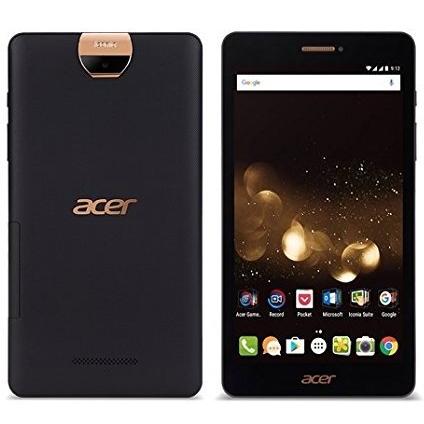
Acer Iconia Talk S 7-Inch Tablet with Intel Atom X5 Processor, 2 GB RAM, 16 GB eMMC Storage, and Android 6.0 OS (Black/Gold)
Sponsored This site contains affiliate links for which we may receive compensation. More information
Find other available options:

| Identifiers | |
|---|---|
| Model | Acer NT.LCCEE.007 |
| MPN | Acer NT.LCCEE.007 |
| Dimensions / Weight | |
| Key Features | |
|
4g standard A list of the cellular network standards that a device supports for 4G connectivity, such as LTE, LTE‑TDD, LTE‑FDD, LTE‑A, and other variants. The values are typically separated by commas and may include both technical identifiers and consumer‑friendly labels.
|
LTE |
|
AC adapter included Indicates whether the product comes with an AC power adapter included in the package. A value of "Yes" means a charger is supplied, while "No" indicates that no charger is provided and the user must obtain one separately.
|
Yes |
| AC adapter power | 10 W |
|
Accelerometer Indicates whether the device is equipped with an accelerometer sensor, which measures acceleration forces along one or more axes.
|
Yes |
|
Aspect ratio The proportion between the width and height of a display, image or video, expressed as two numbers separated by a colon (e.g., 16:9). It indicates whether content is designed for widescreen, square, or other aspect ratios.
|
16:9 |
|
Battery capacity The total amount of electrical energy a battery can store, expressed as a numeric value with an appropriate unit such as mAh or Ah. It indicates how long the device can operate between charges and allows users to compare power supplies across products.
|
3400 mAh |
|
Battery technology The chemical composition or classification of a battery, such as lithium‑ion, lithium‑polymer, nickel‑metal hydride, sealed lead acid, alkaline, zinc‑air, etc. It indicates the type of electrochemical reaction that stores and delivers energy in the device.
|
Lithium Polymer (LiPo) |
| Bluetooth | Yes |
|
Bluetooth version The specific version of the Bluetooth standard supported by the product, indicating its capabilities for wireless communication and compatibility with other devices. Values may be numeric (e.g., 4.2, 5.0) or include additional descriptors such as "+HS" or feature lists.
|
4.0 |
|
Built-in microphone Indicates whether the product includes at least one built‑in microphone. A value of "Yes" means that the device has an integrated microphone, while "No" indicates it does not.
|
Yes |
|
Card reader integrated Indicates whether the device includes a built‑in card reader that can read removable memory cards such as SD, microSD, MMC or similar formats.
|
Yes |
|
Certification A list of official certifications or compliance marks that the product has received from regulatory bodies, safety organizations, or industry standards groups. Each entry represents a distinct certification such as CE, FCC, RoHS, UL, or WEEE, and may include additional details like version numbers or specific test reports.
|
WEEE |
|
Compatible memory cards List of the memory card types that a device can read or write, such as MicroSD (TransFlash), SD, MMC, CompactFlash, and others. Each value represents a format that the device’s slot or reader supports for storage expansion.
|
MicroSD (TransFlash),MicroSDHC |
|
Depth The linear measurement of an object from front to back or top to bottom, expressed in a physical unit such as millimeters, centimeters, inches, etc. It indicates how deep the item is and can be used for fitting, compatibility, or spatial planning.
|
191.7 mm |
|
Device type The general classification of a product that describes its primary function or form factor, such as tablet, smartphone, laptop, router, camera, or other electronic device types.
|
Full-size tablet |
| Display Diagonal | 17.8 cm (7") |
|
Display resolution The pixel dimensions of a display or image, expressed as width by height (e.g., 1920x1080). It indicates how many pixels are used to render visual content and is commonly used for monitors, TVs, smartphones, cameras, and digital images.
|
1280 x 720 pixels |
|
Display technology The type of display panel used in a visual device, such as LED‑backlit LCD, IPS, TN, VA, OLED, or AMOLED. It indicates the underlying technology that determines image quality, color accuracy, viewing angles, response time and power consumption.
|
IPS |
|
Form Factor Specifies the physical configuration or design of a product, such as ATX, Micro‑ATX, Mini‑ITX, tower, case with cover, etc. It describes how the device is built and what mounting or expansion options it supports.
|
Slate |
|
Front camera Indicates whether the product is equipped with a front-facing camera. The value can be "Yes" or "No", representing the presence or absence of this camera.
|
Yes |
|
Headphone out Indicates whether the product has a dedicated headphone output for connecting headphones or earphones. The value may be "Yes" or "No", or it can specify the type of connector such as "3.5 mm jack", "USB‑C", or other descriptive terms.
|
No |
|
Height The vertical dimension of a product measured from its lowest to highest point. It is expressed in a physical unit such as millimetres, centimetres or inches and applies to any item where height is relevant, including books, electronics, furniture and other objects.
|
9.4 mm |
|
Internal memory The total amount of internal memory available in a device, expressed as a data size such as megabytes (MB) or gigabytes (GB). It indicates how much information the component can hold for active processes and affects multitasking performance.
|
2 GB |
|
Internal memory type The type of memory physically installed inside a device, such as DDR4 SDRAM, LPDDR3, or other RAM variants. It indicates the architecture and generation of the internal memory modules that the product uses or supports.
|
LPDDR3-SDRAM |
|
Internal storage capacity The total amount of digital storage available inside a device for holding files, applications and other data. It is expressed as a numeric value with an appropriate unit such as GB, MB or TB, allowing users to compare how much information the device can store.
|
16 GB |
|
Keyboard included Indicates whether a keyboard is supplied with the product as part of its standard package. A value of "Yes" means a keyboard is included, while "No" indicates it is not provided and must be purchased separately.
|
No |
|
LED backlight The illumination source used behind a display panel, such as LED, WLED, CCFL or LCD. It determines the brightness, energy efficiency and color accuracy of the screen.
|
Yes |
|
Maximum memory card size The largest capacity of a removable memory card that the device can support, expressed as a digital storage size (e.g., megabytes or gigabytes). It indicates the maximum amount of data that can be stored on an inserted card and is useful for comparing devices with different card slot capabilities.
|
128 GB |
|
Mobile network connection Indicates whether a device can connect to the Internet using a cellular network such as 3G, 4G, LTE or 5G. A value of "Yes" means the product has the necessary hardware and software to access mobile data; "No" indicates that this capability is not present.
|
Yes |
|
Mobile network generation The cellular network generation supported by a device, such as 2G, 3G, 4G, or 5G. It indicates the overall technology tier that determines data speeds and coverage characteristics.
|
4G |
|
Platform The primary software platform that the product runs on, such as Android, iOS, Windows, macOS, or Linux. It indicates which operating system is required for installation or operation and helps users identify compatibility with their devices.
|
Android |
| Position location | Yes |
|
Processor architecture The processor architecture indicates the underlying instruction set and design family of a CPU, such as ARM Cortex‑A53 or MIPS64. It helps users understand compatibility with software, performance characteristics, and hardware requirements.
|
ARM Cortex-A53 |
|
Processor family The processor family identifies the group or series of CPU models that share a common architecture, design, and performance characteristics. It helps users compare processors across brands and generations by indicating the underlying technology used in the chip.
|
Mediatek |
|
Processor frequency The fundamental operating frequency of a processor, expressed in hertz (Hz). It indicates the speed at which the CPU runs under normal conditions and is typically reported in gigahertz (GHz) or megahertz (MHz). This value helps users compare performance potential across different models.
|
1.3 GHz |
|
Processor model Identifies the exact model of the central processing unit used in a device, including brand and numeric designation such as "Intel Core i5-8250U" or "AMD Ryzen 7 3700X". This value allows users to distinguish between different processor families, generations, and performance levels.
|
MT8735 |
|
Rear camera Indicates whether the product is equipped with a rear-facing camera. The value can be "Yes" or "No", representing the presence or absence of this camera.
|
Yes |
|
Rear camera type The type of rear camera configuration on a device, such as single, dual, triple or quad cameras. It indicates how many lenses are mounted at the back and can help users understand the photographic capabilities.
|
Single camera |
|
RoHS compliance Indicates whether the product is manufactured in accordance with the RoHS (Restriction of Hazardous Substances) directive, which limits the use of certain hazardous materials in electrical and electronic equipment.
|
Yes |
|
Storage media The type of storage medium used in the product, such as SSD, HDD, eMMC, Flash, or hybrid combinations. It indicates whether the device uses solid‑state, magnetic, or other forms of memory and helps users understand the underlying technology.
|
Flash |
|
Top Wi-Fi standard A list of the wireless networking protocols and frequency bands that a device can connect to, such as IEEE 802.11a, IEEE 802.11b, IEEE 802.11g, Wi‑Fi 4 (802.11n), Wi‑Fi 5 (802.11ac) or Wi‑Fi 6 (802.11ax). The values are typically separated by commas and may include both the technical name and a consumer‑friendly label.
|
Wi-Fi 4 (802.11n) |
|
Touch Technology Indicates whether a device’s display can detect multiple simultaneous touch points, enabling gestures such as pinch‑to‑zoom or multi‑finger scrolling. The value is "Yes" if the screen supports multi‑touch input and "No" otherwise.
|
Multi-touch |
|
Weight The mass of the product expressed in a standard unit such as grams or kilograms. It represents how heavy the item is and can be used for shipping calculations, handling instructions, or consumer information.
|
260 g |
|
Wi-Fi standards A list of the wireless networking protocols and frequency bands that a device can connect to, such as 802.11a, 802.11b, 802.11g, Wi‑Fi 4 (802.11n), Wi‑Fi 5 (802.11ac) or Wi‑Fi 6 (802.11ax). The values are typically separated by commas and may include both the technical name and a consumer‑friendly label.
|
IEEE 802.11a,IEEE 802.11b,IEEE 802.11g,IEEE 802.11n |
|
Width The horizontal measurement of a product, expressed in a linear unit such as millimetres or inches. It indicates how wide the item is from one side to the other and is used for sizing, fitting, and compatibility purposes.
|
101 mm |

Acer is a Taiwanese multinational hardware and electronics corporation, specializing in the production of personal computers, tablet computers, smartphones, and servers. Acer's products include desktop PCs, laptop PCs, tablets, servers, storage devices, displays, and smartphones.


