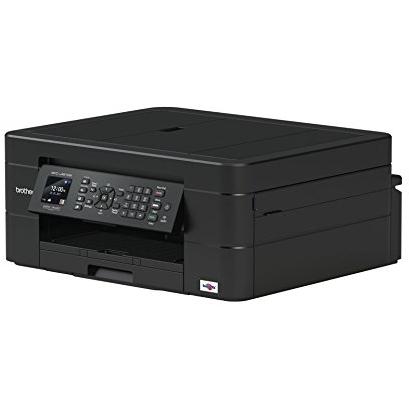
Brother MFC-J491DW Multifunction Inkjet Printer



Sponsored This site contains affiliate links for which we may receive compensation. More information
Find other available options:

| Identifiers | |
|---|---|
| Model | Brother MFCJ491DW |
| MPN | Brother MFCJ491DW |
| Dimensions / Weight | |
| Key Features | |
|
Built-in display Indicates whether the product includes a built‑in screen or display unit that can be used directly for viewing content, such as a monitor on a laptop, an integrated display on a device, or a built‑in screen on appliances. A value of "Yes" means the product has such a display; "No" means it does not.
|
Yes |
|
Built-in processor Indicates whether the product contains a built‑in central processing unit (CPU) that can execute instructions without requiring an external processor module. A value of "Yes" means the device has such a CPU; "No" means it does not.
|
Yes |
|
Card reader integrated Indicates whether the device includes a built‑in card reader that can read removable memory cards such as SD, microSD, MMC or similar formats.
|
No |
|
Copier resize The percentage by which a document is scaled when printed, copied or scanned. A value of 100% means the output size matches the original; values below 100% reduce the size and values above 100% enlarge it.
|
25 - 400% |
|
Copying Indicates whether the device can perform copy functions and the type of copying it supports (e.g., colour or monochrome). The value is a free‑text label that describes the copying feature available on the product.
|
Color copying |
|
Depth The linear measurement of an object from front to back or top to bottom, expressed in a physical unit such as millimeters, centimeters, inches, etc. It indicates how deep the item is and can be used for fitting, compatibility, or spatial planning.
|
341 mm |
|
Direct printing Indicates whether the device can print directly from mobile devices, network shares or other sources without requiring additional drivers or software installation. A value of "Yes" means the printer supports direct printing technologies such as AirPrint, Mopria Print Service, or similar solutions; a value of "No" indicates that direct printing is not supported.
|
Yes |
|
Display The visual technology used by the product’s screen, such as LCD, LED, OLED, TFT or analog. It indicates the underlying display panel that determines image quality, color reproduction and power consumption.
|
LCD |
|
Display Diagonal The measurement of a display’s diagonal, expressed in inches or centimeters. It represents the overall visual area available for content and is commonly used to compare monitors, televisions, laptops, tablets, and other electronic devices.
|
4.5 cm (1.77") |
|
Duplex printing Indicates whether the device can automatically print on both sides of a sheet in a single pass. A value of "Yes" means duplex printing is supported; a value of "No" indicates that only single‑sided printing is available.
|
Yes |
|
Energy Star certified Indicates whether the product has been certified by Energy Star, a recognized standard for energy efficiency in appliances and electronics.
|
Yes |
|
Ethernet LAN Indicates whether the product has an Ethernet interface for wired network connectivity, allowing data transmission over RJ‑45 or compatible cables.
|
No |
|
Fax Memory The amount of memory available for storing fax documents, expressed either as a number of pages or as a digital storage size (e.g., megabytes). It indicates how many faxes can be queued or archived before the device requires clearing or additional storage.
|
170 pages |
| Faxing | Mono faxing |
|
Height The vertical dimension of a product measured from its lowest to highest point. It is expressed in a physical unit such as millimetres, centimetres or inches and applies to any item where height is relevant, including books, electronics, furniture and other objects.
|
172 mm |
|
Input colour depth The number of distinct colours that a device can capture or process from an input source, expressed as an integer value such as "48 bit" or "24 bit". This metric indicates the richness and fidelity of colour reproduction for scanned images or captured media.
|
30 bit |
|
Internal memory The total amount of internal memory available in a device, expressed as a data size such as megabytes (MB) or gigabytes (GB). It indicates how much information the component can hold for active processes and affects multitasking performance.
|
128 MB |
|
Market positioning A classification that indicates the target audience or use case for a product, such as Business, Gaming, Home & Office, Education, etc. It helps customers quickly identify which products are best suited to their needs.
|
Home & Office |
|
Maximum Copy Resolution The highest pixel resolution that a printer can produce, expressed as width by height (e.g., 600x1200). It indicates the finest detail achievable in printed documents and images.
|
1200 x 600 DPI |
| Maximum ISO A-series paper size | A4 |
|
Maximum resolution The maximum pixel dimensions of a display or image, expressed as width by height (e.g., 1920x1080). It indicates the highest resolution that a device can output or support and is commonly used for monitors, TVs, smartphones, cameras, and digital images.
|
1200 x 6000 DPI |
|
Mobile Printing Technologies A comma‑separated list of mobile printing services or protocols that a device can use to send print jobs from smartphones, tablets or other mobile devices. Typical values include Apple AirPrint, Google Cloud Print, Mopria Print Service and similar cloud‑based solutions.
|
Apple AirPrint,Mopria Print Service |
|
Modem Speed The maximum data transfer rate that a modem can achieve, expressed in kilobits per second (Kbit/s) or other common abbreviations such as Kbps. This value represents the theoretical peak throughput of the device under optimal conditions and allows users to compare the speed capabilities of different modems.
|
14.4 Kbit/s |
|
Optical scanning resolution The pixel dimensions of a scanner’s optical sensor, expressed as width by height (e.g., 1200×2400). It indicates how many pixels can be captured per scan and determines the sharpness and detail of scanned images.
|
1200 x 2400 DPI |
|
Output colour depth The number of distinct colours that a device’s output can represent, expressed as an integer followed by the unit "bit" (e.g., 24 bit). This metric indicates the richness and fidelity of colour reproduction for images or video sent to the device.
|
24 bit |
|
Package depth The linear measurement from front to back or top to bottom of a product’s packaging, expressed in a physical unit such as millimeters, centimeters, inches, etc. It indicates how deep the packaged item is and can be used for fitting, compatibility, or spatial planning.
|
249 mm |
|
Package Height The vertical dimension of a product’s packaging measured from its lowest to highest point. It is expressed in a physical unit such as millimetres, centimetres or inches and helps customers assess how tall the package will be when stored or shipped.
|
457 mm |
|
Package width The horizontal measurement of a product’s packaging, expressed in a linear unit such as millimetres or inches. It indicates how wide the package is from one side to the other and helps customers assess fit for storage, shipping, or display.
|
447 mm |
|
Paper input type The type of paper input mechanism available in a printer or copier, such as a standard tray, cassette, sheet‑fed feeder, manual feed, or roll. It indicates how the device accepts and feeds paper for printing, scanning or copying.
|
Paper tray |
|
Paper tray media types A list of the paper or media types that a printer’s input trays can accept, such as envelopes, labels, plain paper, recycled paper, and transparencies. The values are free‑text strings separated by commas, allowing users to see which materials are compatible with the device.
|
Plain paper |
| Power consumption (off) | 0.2 W |
| Power consumption (StandBy) | 3.5 W |
|
Print technology The type of printing process or technology used by the product, such as laser, inkjet, thermal, LED, or other specialized methods.
|
Inkjet |
|
Printing Indicates whether the printer can produce colour output or is limited to monochrome (black‑and‑white) printing. Typical values are "Colour printing" for devices that support full colour, "Mono printing" for black‑only devices, and "No" when colour capability is not available.
|
Color printing |
| Scan technology | CIS |
|
Scan to A list of destinations or methods to which a device can send scanned documents, such as email, FTP, cloud services, USB storage, or local PC. Each option represents a supported transfer protocol or target location for the scanned output.
|
E-mail,File,Image,OCR |
|
Scanner type The functional configuration of a scanner, indicating how documents are fed into the device. Common types include flatbed scanners with automatic document feeders (ADF), sheet‑fed scanners, single‑pass or dual‑pass ADFs, and specialized modes such as 1D/2D barcode readers. This attribute helps users understand whether the scanner can handle single pages, multiple pages automatically, or specific scanning formats.
|
Flatbed & ADF |
|
Scanning Indicates whether the product can perform scanning operations and what type of scans it supports (e.g., color or monochrome). The value is a free‑text label that may include terms such as "Color scanning", "Mono scanning" or simply "Yes/No" to denote availability.
|
Color scanning |
|
Security algorithms A list of cryptographic and authentication methods that a device can use for secure communication or data protection. Each entry represents a distinct algorithm or protocol, such as encryption ciphers (e.g., AES, WEP), authentication mechanisms (e.g., RADIUS, WPA‑PSK), or network security protocols (e.g., HTTPS, SSL/TLS). The values are typically separated by commas and may include both technical identifiers and consumer‑friendly labels.
|
64-bit WEP,128-bit WEP,WPA-PSK,WPA2-PSK |
|
Standard interfaces A list of the physical or logical interfaces that a device can use to connect with other devices, such as USB, Ethernet, Bluetooth, Wi‑Fi, RS‑232, RJ‑45, Parallel, and similar standards.
|
USB 2.0,Wireless LAN |
|
Total input capacity The maximum amount of material that can be fed into the device in a single operation, expressed as a numeric value followed by an appropriate unit such as sheets, pages or volume.
|
100 sheets |
|
Total number of input trays The total count of input trays or feeders available in a printer, copier, or multifunction device. It indicates how many separate compartments can automatically feed paper into the machine for printing, scanning, or copying tasks.
|
1 |
|
Total output capacity The maximum number of individual pages that a product—such as a book, magazine, or printed publication—can contain. It represents the total count of physical sheets, regardless of layout or formatting, and is useful for assessing the length or volume of the material.
|
50 sheets |
|
USB port Indicates the presence and quantity of USB connectors on a product. The value is typically an integer representing how many USB ports are available, regardless of type or version.
|
Yes |
|
Weight The mass of the product expressed in a standard unit such as grams or kilograms. It represents how heavy the item is and can be used for shipping calculations, handling instructions, or consumer information.
|
8.3 kg |
|
Wi-Fi Indicates whether the product has built‑in Wi‑Fi capability, allowing it to connect to wireless networks without requiring external adapters or dongles.
|
Yes |
|
Wi-Fi standards A list of the wireless networking protocols and frequency bands that a device can connect to, such as 802.11a, 802.11b, 802.11g, Wi‑Fi 4 (802.11n), Wi‑Fi 5 (802.11ac) or Wi‑Fi 6 (802.11ax). The values are typically separated by commas and may include both the technical name and a consumer‑friendly label.
|
802.11b,802.11g,Wi-Fi 4 (802.11n) |
|
Width The horizontal measurement of a product, expressed in a linear unit such as millimetres or inches. It indicates how wide the item is from one side to the other and is used for sizing, fitting, and compatibility purposes.
|
400 mm |

Brother is a Japanese brand that produces a wide range of electronics, including printers, sewing machines, and scanners. The company has a strong reputation for quality and innovation, and its products are popular among consumers and businesses alike.


