Dell U3818DW



Sponsored This site contains affiliate links for which we may receive compensation. More information

Find other available options:

| Identifiers | |
|---|---|
| MPN | Dell 091T052 |
| Dimensions / Weight | |
| Key Features | |
|
3D Indicates whether the product has built‑in support for 3‑dimensional (3D) content or displays. A value of "Yes" means the device can render or display 3D images, videos, or games; a value of "No" means it does not have native 3D capability.
|
No |
|
AC input frequency The frequency of the alternating current supplied to the device, expressed in hertz (Hz). It indicates the acceptable operating range for the electrical mains that powers the product.
|
50 - 60 Hz |
|
AC input voltage The alternating current voltage range that the product accepts from its power source, expressed in volts (V). It indicates the minimum and maximum supply voltages compatible with the device.
|
100 - 240 V |
|
AMD FreeSync Indica si un monitor o una tarjeta gráfica es compatible con la tecnología Adaptive Sync de AMD, denominada FreeSync. Un valor "Sí" significa que el dispositivo soporta esta funcionalidad, mientras que "No" indica su ausencia.
|
No |
|
Annual energy consumption The total amount of electrical energy a product consumes in one year, expressed in kilowatt‑hours (kWh). This figure represents the expected yearly operating cost and allows consumers to compare the long‑term efficiency of appliances or electronics.
|
69 kWh |
|
Aspect ratio The proportion between the width and height of a display, image or video, expressed as two numbers separated by a colon (e.g., 16:9). It indicates whether content is designed for widescreen, square, or other aspect ratios.
|
21:9 |
|
Audio input Indicates whether the product includes a dedicated audio input port (e.g., 3.5 mm jack, RCA, optical). A value of "Yes" means an audio input is present; "No" means it is absent.
|
No |
|
Audio Output Indicates whether the product provides an audio output capability, such as speakers or a line‑out port. A value of "Yes" means the device can produce sound, while "No" indicates no built‑in audio output is available.
|
Yes |
|
Backlight type The illumination source used behind a display panel, such as LED, WLED, CCFL or LCD. It determines the brightness uniformity, power consumption and color performance of the screen.
|
LED |
|
Built-in camera Indicates whether the product includes a built‑in camera that can capture images or video directly, without requiring an external device. A value of "Yes" means the device has such a camera; "No" means it does not.
|
No |
| Built-in USB Hub | Yes |
|
Cable lock slot Indicates whether the product includes a slot for inserting a cable lock, such as a Kensington or similar security device.
|
Yes |
|
Cables included A list of the cable types that are supplied with the product, such as USB, HDMI, VGA, DisplayPort, LAN (RJ‑45), SATA, audio or other relevant connectors.
|
AC, DisplayPort, HDMI, USB, USB Type-C |
|
Certification A list of official certifications or compliance marks that the product has received from regulatory bodies, safety organizations, or industry standards groups. Each entry represents a distinct certification such as CE, FCC, RoHS, UL, or WEEE, and may include additional details like version numbers or specific test reports.
|
EDID, NFPA 99 |
|
DDC/CI Indicates whether the product includes a power‑saving feature that reduces energy consumption when the device is idle or in low‑activity states.
|
Yes |
|
Display Diagonal The measurement of a display’s diagonal, expressed in inches or centimeters. It represents the overall visual area available for content and is commonly used to compare monitors, televisions, laptops, tablets, and other electronic devices.
|
95.2 cm (37.5") |
|
Display number of colours The total count of distinct colours that a display can render, typically expressed as a numeric value (e.g., 16.78 million). This attribute indicates the colour depth and richness of the visual output; higher numbers generally mean more accurate and vibrant images.
|
1.073 billion colours |
|
Display resolution The pixel dimensions of a display or image, expressed as width by height (e.g., 1920x1080). It indicates how many pixels are used to render visual content and is commonly used for monitors, TVs, smartphones, cameras, and digital images.
|
3840 x 1600 pixels |
|
Display technology The type of display panel used in a visual device, such as LED‑backlit LCD, IPS, TN, VA, OLED, or AMOLED. It indicates the underlying technology that determines image quality, color accuracy, viewing angles, response time and power consumption.
|
LCD |
|
Displayport Version The specific version of the DisplayPort standard that a product supports, such as "1.4", "2.0" or "2.1b". This value indicates the capabilities and compatibility of the DisplayPort interfaces on the device.
|
1.2 |
|
DisplayPorts quantity The total count of physical or virtual display output connections available on a device, such as HDMI, DisplayPort, DVI, VGA, or USB‑C ports that support video output.
|
1 |
|
DVI port Indicates how many DVI connectors are present on the product. The value is a simple integer representing the total count of DVI ports, regardless of type or version.
|
No |
|
Energy efficiency scale The energy efficiency scale indicates the relative performance of a product in terms of electricity consumption, expressed with letters ranging from A+++ (most efficient) to G (least efficient). It allows consumers to compare expected operating costs and environmental impact across similar items.
|
A++ to E |
|
Feet colour The colour or combination of colours that the feet of a product are available in, expressed as common names such as "Black", "Silver" or comma‑separated lists like "Black, White". It indicates the visual appearance of the feet for consumers.
|
Grey |
|
HD type The pixel dimensions of a screen’s display expressed as width by height (e.g., 1920×1080). It indicates the number of pixels that can be shown on the monitor or device, affecting image sharpness and clarity.
|
UltraWide Quad HD+ |
|
HDCP Indicates whether a device supports HDCP (High‑bandwidth Digital Content Protection), allowing it to play or display protected digital content on compatible screens and audio/video equipment.
|
Yes |
|
HDMI A list of the HDMI ports available on the product, each entry indicating the number of ports and their specific HDMI version or additional features (e.g., "2 x HDMI 2.0b", "1 x HDMI 1.4 with CEC"). This attribute helps users understand both the quantity and capabilities of the HDMI connections.
|
Yes |
|
HDMI ports quantity The total count of HDMI connectors available on the product, regardless of version or location. The value is a simple integer indicating how many physical HDMI ports can be used for audio‑video transmission.
|
2 |
|
HDMI version The specific version of the HDMI standard that a product supports, such as "2.0", "2.1" or "1.4b". This value indicates the capabilities and compatibility of the HDMI interfaces on the device.
|
2.0 |
|
Headphone out Indicates whether the product has a dedicated headphone output for connecting headphones or earphones. The value may be "Yes" or "No", or it can specify the type of connector such as "3.5 mm jack", "USB‑C", or other descriptive terms.
|
No |
|
Height adjustment The ability of a product to change its vertical dimension, typically measured in millimetres, centimetres or inches. It indicates whether the user can raise or lower the item and, if so, by how much. This attribute applies to monitors, desks, furniture, stands and other equipment that offer adjustable height.
|
Yes |
|
Horizontal scan range The range of frequencies, expressed in kilohertz (kHz), over which a device can process or display horizontal signals or scan lines. It indicates the minimum and maximum operating frequencies for horizontal scanning operations.
|
25 - 115 kHz |
|
Input current The electrical current that a device draws from its power source, expressed in amperes (A). It indicates how much current the product consumes during normal operation and helps determine compatibility with power supplies or USB ports.
|
3 A |
|
Market positioning A classification that indicates the target audience or use case for a product, such as Business, Gaming, Home & Office, Education, etc. It helps customers quickly identify which products are best suited to their needs.
|
Business |
|
Maximum refresh rate The highest number of times per second that a display can update its image, expressed in hertz (Hz). It indicates the maximum refresh capability of the device and is useful for comparing visual performance across monitors, TVs, laptops, and other screen‑based products.
|
60 Hz |
|
Non-operating altitude The altitude interval (in meters) at which a product or component ceases to function correctly due to environmental factors such as reduced atmospheric pressure, temperature changes, or other elevation‑related effects. The value is expressed as a minimum–maximum range and applies to any device that has documented limits for operation above or below certain heights.
|
5000 - 12191 m |
| Nvidia g-sync | No |
|
On/off switch Indicates whether the product includes an on/off switch that allows the user to power it on or off manually.
|
Yes |
|
Operating altitude The range of altitudes (in meters) at which a product or component can operate reliably without performance degradation due to changes in atmospheric pressure, temperature, or other altitude‑related effects.
|
0 - 5000 m |
|
Package depth The linear measurement from front to back or top to bottom of a product’s packaging, expressed in a physical unit such as millimeters, centimeters, inches, etc. It indicates how deep the packaged item is and can be used for fitting, compatibility, or spatial planning.
|
1045 mm |
|
Package Height The vertical dimension of a product’s packaging measured from its lowest to highest point. It is expressed in a physical unit such as millimetres, centimetres or inches and helps customers assess how tall the package will be when stored or shipped.
|
524 mm |
|
Package weight The mass of the product’s packaging expressed in a standard unit such as grams or kilograms. It indicates how heavy the package is and can be used for shipping calculations, handling instructions, or consumer information.
|
19.7 kg |
|
Package width The horizontal measurement of a product’s packaging, expressed in a linear unit such as millimetres or inches. It indicates how wide the package is from one side to the other and helps customers assess fit for storage, shipping, or display.
|
277.9 mm |
|
Panel mounting interface The pair of horizontal and vertical dimensions in millimetres that a product supports for VESA mounting (e.g., "100 × 100 mm"). This value indicates the exact hole spacing required by a mounting bracket to secure the device. It is used for monitors, TVs, projectors and other display equipment that can be wall‑mounted or attached to stands.
|
100 x 100 mm |
|
Panel type The underlying display panel technology used in a visual device, such as IPS, TN, VA, OLED, AMOLED, or other variants. It indicates the type of liquid crystal arrangement or organic light‑emitting structure that determines image quality, color accuracy, viewing angles and power consumption.
|
IPS |
|
Picture-in-Picture Indicates whether a device can display a primary content stream while simultaneously showing another content stream in an overlay window (Picture‑in‑Picture). This feature is relevant for televisions, monitors, and computers that support simultaneous viewing of two video sources.
|
Yes |
|
Pixel density The number of pixels per inch on a display, expressed as points‑per‑inch (ppi). This metric indicates how sharp and detailed the screen appears, allowing comparison across monitors, smartphones, tablets, and other pixelated devices.
|
111 ppi |
|
Pixel pitch Represents the physical size of a single pixel on a display, expressed as width and height in a length unit (e.g., millimeters). This attribute allows comparison of the physical resolution of screens or imaging devices that use metric units to describe the smallest visible point.
|
0.229 x 0.229 mm |
|
Plug and play Indicates whether the product can be used immediately after installation without requiring additional configuration or drivers.
|
Yes |
| Power consumption (off) | 0.3 W |
| Power consumption (StandBy) | 0.5 W |
|
Quick start guide Indicates whether a quick‑start guide is provided with the product. A value of "Yes" means that a brief, introductory manual or overview is included to help users get started quickly; "No" indicates that no such guide is supplied.
|
Yes |
|
Response time The time interval between a stimulus and the corresponding response of a device or system, expressed in units such as milliseconds (ms). It indicates how quickly the product reacts to input or processes data, which is critical for performance-sensitive applications like displays, gaming monitors, and interactive devices.
|
8 ms |
|
RMS rated power The root‑mean‑square (RMS) power rating of a device, expressed in watts (W). It represents the average electrical power that the product can deliver or consume under normal operating conditions.
|
18 W |
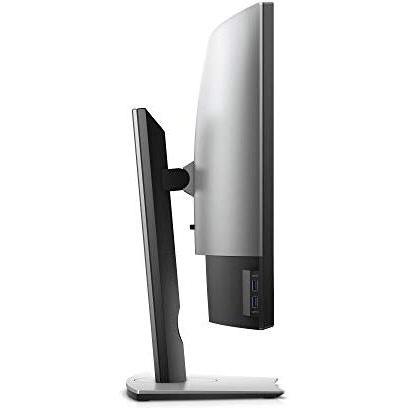
| Screen shape | Curved |
|
Stand included Indicates whether a product comes with an attached stand or base included in the package. A value of "Yes" means the stand is supplied, while "No" indicates that no stand is provided and the user must obtain one separately.
|
Yes |
|
Swivel angle range The maximum angular range a device can rotate or tilt, expressed as a numeric interval in degrees (e.g., "-45 to 45°"). It indicates how far the product can pivot left/right or up/down from its neutral position.
|
-30 - 30° |
|
Swivelling Indicates whether a product, such as a monitor or other device, can rotate around its vertical axis to adjust viewing angle. A value of "Yes" means the item supports swiveling; "No" means it does not.
|
Yes |
|
Thin Client installed Indicates whether a device is configured as a thin client, meaning it relies on a remote server for processing while using only a local display interface. A value of "Yes" means the thin‑client setup is ready for use; "No" indicates that the configuration has not been applied or is not present.
|
No |
|
Tilt angle range The minimum and maximum angles, expressed in degrees, that a monitor can be tilted or adjusted vertically while maintaining acceptable performance or usability. It indicates the tilt limits for displays such as monitors, stands, or other adjustable equipment.
|
-5 - 21° |
|
Tiltable Indicates whether the product can be tilted or adjusted in angle to improve viewing comfort or ergonomics.
|
Yes |
|
Tv tuner integrated Indicates whether a product includes an integrated television tuner that can receive broadcast signals directly without requiring an external receiver. The value is "Yes" or "No", representing the presence or absence of this feature.
|
No |
|
USB Hub Version The specific USB standard version supported by the hub, expressed as a generation and revision (e.g., "3.2 Gen 1" or "3.0"). This indicates the maximum data transfer rate and compatibility with connected devices.
|
3.2 Gen 1 (3.1 Gen 1) |
|
USB Type-C DisplayPort Alternate Mode Indicates whether the product supports the USB‑Type C DisplayPort Alternate Mode, allowing a USB‑C port to transmit video signals via the DisplayPort protocol.
|
Yes |
|
User Guide on CD-ROM Indicates whether a CD‑ROM containing the product’s user guide is supplied with the item. A value of "Yes" means that the manual is included on a physical disc, while any other value (e.g., "No") indicates that no CD‑ROM is provided.
|
Yes |
|
Vertical scan range The range of vertical scan frequencies that a display device can support, expressed in hertz (Hz). It indicates the minimum and maximum refresh rates at which the screen updates vertically, affecting visual smoothness and stability.
|
24 - 85 Hz |
|
VESA mounting Indicates whether a product is compatible with the VESA mounting standard and, if so, specifies the supported VESA pattern(s) in millimetres (e.g., "100 × 100 mm"). The value can be "Yes", "No" or a list of one or more VESA patterns.
|
Yes |
|
Viewable size diagonal The overall visual area of a monitor’s display measured along its diagonal, expressed in inches or centimeters. It indicates how large the screen appears to the user and is commonly used to compare monitors, televisions, laptops, tablets, and other electronic devices.
|
95.3 cm |

Dell is a computer technology company that was founded by Michael Dell in 1984. The company is headquartered in Texas and is one of the largest technology companies in the world. Dell manufactures and sells personal computers, servers, data storage devices, network switches, software, and computer peripherals.


