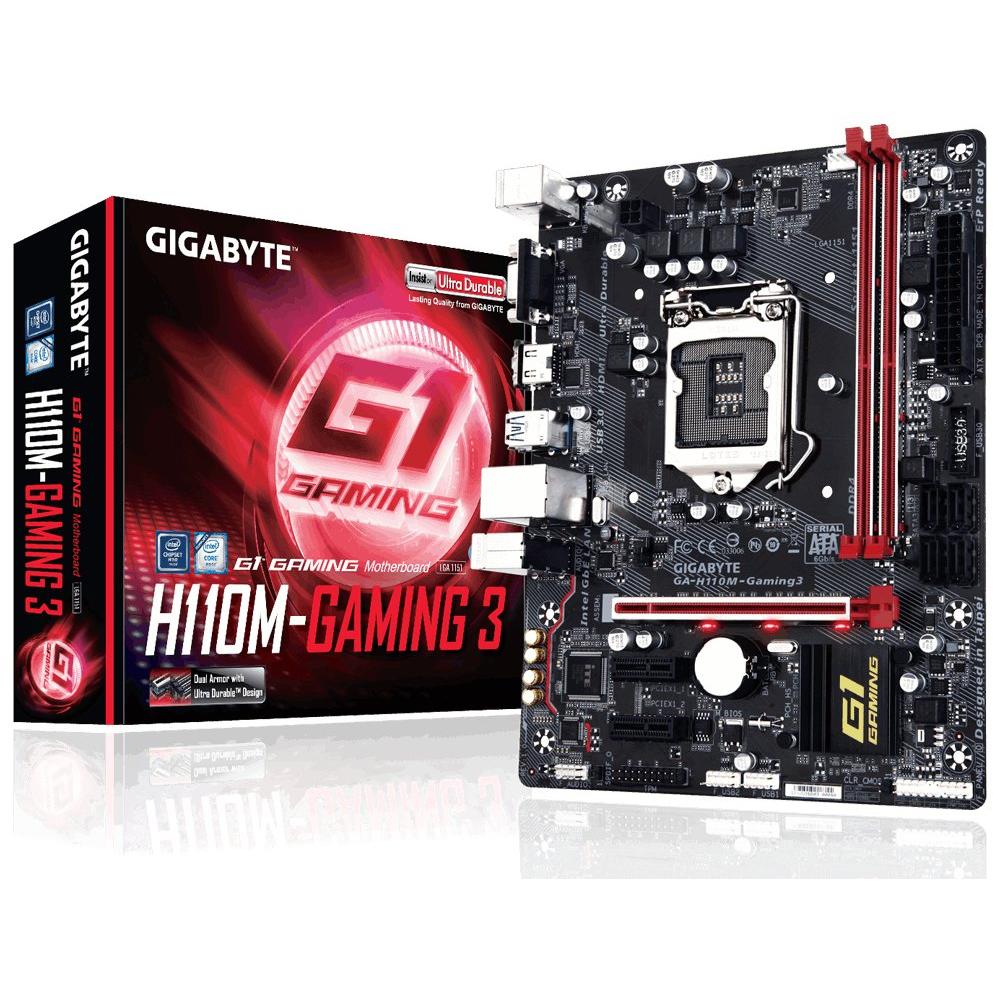
GA‑H110‑M‑Gaming 3 (Intel H110)



Sponsored This site contains affiliate links for which we may receive compensation. More information
Find other available options:

| Identifiers | |
|---|---|
| Model | Gigabyte GA-H110M-GAMING3 |
| MPN | Gigabyte GA-H110M-GAMING3 |
| Dimensions / Weight | |
| Key Features | |
|
ACPI version The version of the Advanced Configuration and Power Interface (ACPI) standard that a product supports or implements. It indicates the level of power‑management features, hardware configuration capabilities, and operating‑system compatibility available on the device.
|
5.0 |
|
AMD CrossFire Support Indicates whether the product supports AMD CrossFire technology, which allows multiple graphics cards to work together for improved performance. The value is a textual description such as "2-Way CrossFire", "3-Way CrossFire", "Supported" or "Not Supported".
|
Not Supported |
|
Audio A list of the audio codecs, channel configurations, and related technologies that a product can play or output. Each value may combine a codec name (e.g., Dolby Digital, DTS‑HD), a channel count (e.g., 5.1, 7.1), and optional qualifiers such as "High Definition" or "Virtual Surround" to describe the exact audio capability of the device.
|
Realtek ALC892 7.1 HD Audio |
|
Audio output channels Indicates the total number of independent audio channels that a product can produce or process, including sub‑channels such as those used in surround sound configurations (e.g., 5.1, 7.2). The value may be an integer or a decimal to represent fractional channel groups.
|
7.1 channels |
| BIOS memory size | 64 Mbit |
|
BIOS type The firmware interface used by a computer system to initialize hardware and load the operating system, such as UEFI or legacy BIOS. It indicates whether the motherboard supports modern features like secure boot, fast startup, or compatibility with older operating systems.
|
EFI AMI |
|
Chipset The chipset is the collection of integrated circuits that manages communication between a computer’s CPU, memory, and peripheral devices. It defines the supported processor families, available I/O interfaces, and overall system capabilities, allowing users to understand compatibility and feature sets for motherboards or other hardware components.
|
Intel H110 |
|
Clear CMOS jumper Indicates whether the product includes a clear‑CMOS jumper, a small connector that allows resetting the CMOS memory to factory defaults. A value of "Yes" means the jumper is present and can be used for troubleshooting or configuration reset; "No" indicates it is absent.
|
Yes |
|
Compatible processor series List of processor families that the product can support, such as Intel Celeron, Intel Core i5, AMD Ryzen 3, etc. Each value represents a distinct CPU family or brand that is compatible with the hardware platform.
|
Intel® Core™ i3, Intel Core i5, Intel Core i7 |
|
Component for Specifies the type of device or system that the product is intended to be used with, such as a PC, server, notebook, surveillance system, or other electronic equipment. The value represents a single category and can be used to filter or group products by their target platform.
|
PC |
| CPU fan connector | Yes |
|
CPU Socket The physical connector used by a processor to attach to a motherboard or other compatible platform, such as LGA 1151, BGA 1440, Socket AM4, or LGA 1200. This attribute indicates the exact socket designation required for proper CPU installation and compatibility with other hardware components.
|
1151 |
|
Depth The linear measurement of an object from front to back or top to bottom, expressed in a physical unit such as millimeters, centimeters, inches, etc. It indicates how deep the item is and can be used for fitting, compatibility, or spatial planning.
|
174 mm |
|
Ethernet interface type A list of the Ethernet standards that a product supports, such as Fast Ethernet (10/100 Mbps), Gigabit Ethernet (1 Gbps), 2.5 GbE, 10 GbE, and other variants. Each value is a free‑text label describing one supported interface; multiple values are separated by commas when the device offers more than one speed or generation.
|
Fast Ethernet,Gigabit Ethernet |
|
Ethernet LAN Indicates whether the product includes an Ethernet LAN interface for wired network connectivity, allowing data transmission over RJ‑45 or compatible cables.
|
Yes |
|
Expansion slots The total count of physical expansion slots available on a device for installing additional modules or peripherals such as PCI‑Express cards, M.2 drives, USB adapters, or other expansion hardware. It indicates how many separate slots can be used simultaneously or swapped between the product and other devices.
|
2 x PCIe 3.0 x1 1 x PCIe 3.0 x16 |
|
Form factor Specifies the physical configuration or design of a product, such as ATX, Micro‑ATX, Mini‑ITX, tower, case with cover, etc. It describes how the device is built and what mounting or expansion options it supports.
|
MicroATX |
|
Front panel connector Indicates whether the product includes a connector on its front panel. The value can be "Yes" or "No", representing the presence or absence of this port.
|
Yes |
| HDMI ports quantity | 1 |
|
Linux operating systems supported List of Linux operating systems that the product can run or support, including specific versions and architectures when relevant. Each value represents a distinct Linux distribution or kernel version supported by the hardware or software.
|
Yes |
|
Maximum internal memory The largest amount of internal random‑access memory that a device can support, expressed as a data size such as megabytes or gigabytes. It indicates the maximum capacity for active processes and multitasking performance.
|
32 GB |
|
Memory channel The number of memory channels supported by a motherboard or processor, indicating how many independent data paths are available for RAM modules. Common values include "Single", "Dual (2)", "Quad (4)" and similar descriptors. This attribute helps users understand the potential memory bandwidth and upgrade options for a system.
|
Dual (2) |
|
Memory channels The configuration of memory channels supported by a device, indicating how many independent memory paths the system can use for data transfer (e.g., Dual‑channel, Quad‑channel). This attribute helps users understand the potential bandwidth and performance characteristics of the memory subsystem.
|
Dual-channel |
|
Memory slots type The form factor of the memory module that a product can accept, such as DIMM or SO‑DIMM. It indicates whether the device uses standard desktop RAM modules (DIMM) or smaller laptop‑style modules (SO‑DIMM).
|
DIMM |
|
Memory speed The maximum operating frequency of a memory module, expressed in hertz (Hz). It indicates how many cycles per second the RAM can perform and is typically reported as MHz or GHz. This value helps users compare performance potential across different memory types and system configurations.
|
DDR4 - 2133 |
|
Memory type The classification of the memory technology used in a device, such as DDR4 SDRAM, LPDDR3, GDDR6, or other variants. It indicates the architecture and generation of the RAM modules installed or supported by the product.
|
DDR4 |
|
Memory Type ECC Indicates whether the memory module supports Error‑Correcting Code (ECC) technology, which can detect and correct single-bit errors during operation.
|
Non-ECC |
|
Memory Type R/U The type of memory module used in a computer system, indicating whether it is Registered (R) or Unbuffered (U). This attribute helps determine compatibility with motherboards and the expected performance characteristics of the RAM.
|
UDIMM (Unbuffered) |
|
Microphone in Indicates whether the product includes at least one built‑in microphone. A value of "Yes" means that the device has an integrated microphone, while "No" indicates it does not.
|
Yes |
|
Motherboard chipset family The chipset family identifies the group of integrated circuits that manage communication between a computer’s CPU, memory, and peripheral devices on a motherboard. It indicates the supported processor families, available I/O interfaces, and overall system capabilities, helping users assess compatibility and feature sets for motherboards or other hardware components.
|
Intel |
|
Network Interface Type The type of network connection supported by the product, such as wired Ethernet (e.g., Gigabit LAN, 2.5 Gbps LAN) or wireless Wi‑Fi standards (e.g., 802.11ac, 802.11ax). It indicates whether the device can connect to a local area network via cable, wirelessly, or both, and may include the maximum speed supported.
|
Wired Gigabit LAN (10/100/1000) |
|
Non-ECC Indicates whether the memory module does not support error‑correcting code (ECC). A value of Yes means the module lacks ECC protection, while No means it includes ECC functionality.
|
Yes |
|
NVIDIA SLI Support Indicates the type of NVIDIA SLI (Scalable Link Interface) support available for a graphics card or motherboard, such as single‑card operation, two‑way SLI, three‑way SLI, four‑way SLI, NVLink combinations, or no SLI capability. The value is a textual description that can be used to inform users whether multiple NVIDIA GPUs can be linked together and what configuration is supported.
|
Supported |
|
On-Board Graphics Connectors A list of the physical connector types available on a device’s onboard graphics output, such as HDMI, DisplayPort, DVI‑D, or VGA. This attribute helps users identify which video ports are directly integrated into the motherboard or system board for connecting displays.
|
D-Sub (VGA) HDMI |
|
Power source type The type of electrical supply that powers the device, such as mains electricity, batteries, USB power, or a combination of these options.
|
ATX |
|
Primary GPU Interface The physical or logical interface used by a graphics processing unit to connect with the rest of the system, such as PCI Express (PCIe) variants. It indicates the technology that enables data transfer and power delivery between the GPU and the motherboard.
|
PCIe 3.0 (x16) |
|
Processor socket The physical connector used by a processor to attach to a motherboard or other compatible platform. Common examples include LGA 1151, BGA 1440, Socket AM4, and LGA 1200. This attribute indicates the exact socket designation required for proper CPU installation and compatibility.
|
LGA 1151 (Socket H4) |
|
QPI Speed The maximum data transfer rate of the QuickPath Interconnect (QPI) interface, expressed in gigatransfers per second (GT/s). This value indicates the bandwidth available for communication between processors and other system components.
|
N/A |
|
SATA Support A list of SATA interface variants that the product supports, such as SATA III (SATA3), SATA II, or M.2 SATA. Each value indicates a specific SATA standard that the device can use for connecting storage devices.
|
SATA3 |
|
Supported memory clock speeds The operating frequencies that a processor or memory module can run at, expressed in megahertz (MHz) or gigahertz (GHz). This attribute lists all supported clock rates, allowing users to understand the performance range of the component.
|
2133 MHz |
|
Supported storage drive interfaces List of physical or logical interfaces that allow an internal storage drive to communicate with the system, such as SATA, M.2 PCIe, U.2, SAS, NVMe, or other standard connections.
|
Serial ATA III |
|
TPM connector Indicates whether the product includes a physical port that can accept a Trusted Platform Module (TPM) chip, enabling hardware‑based security features such as secure boot and encrypted storage.
|
Yes |
|
Water Cooled Indicates whether a product uses water as its cooling medium. A value of "Yes" means the device incorporates a liquid‑cooling system that circulates water to dissipate heat, while "No" indicates it relies on air or other cooling methods.
|
No |
|
Wi-Fi Indicates whether the product has built‑in Wi‑Fi capability, allowing it to connect to wireless networks without requiring external adapters or dongles.
|
No |
|
Width The horizontal measurement of a product, expressed in a linear unit such as millimetres or inches. It indicates how wide the item is from one side to the other and is used for sizing, fitting, and compatibility purposes.
|
226 mm |

Gigabyte is a Taiwanese computer hardware company that produces motherboards, graphics cards, and other computer hardware. The company was founded in 1986 and is now one of the largest computer hardware companies in the world.


