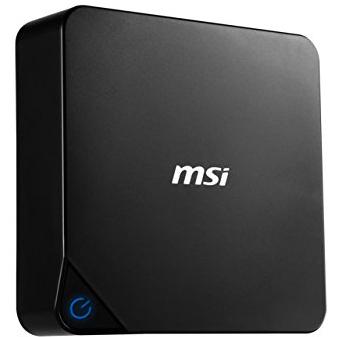
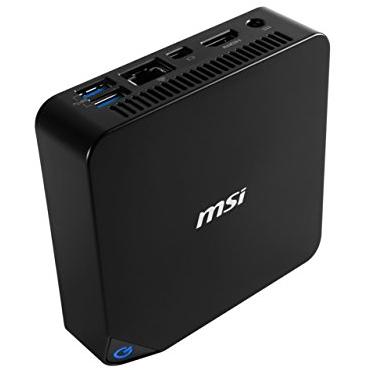
MSI IntelliCube 5500 Mini PC


Sponsored This site contains affiliate links for which we may receive compensation. More information
Find other available options:

| Identifiers | |
|---|---|
| Model | MSI CUBI-060BEU |
| MPN | MSI CUBI-060BEU |
| Dimensions / Weight | |
| Key Features | |
| Bluetooth | Yes |
|
Bus Type The interface or communication bus that a component uses to connect with other parts of a system, such as PCI Express, USB, SATA, or legacy buses like FSB and QPI. It indicates the protocol and physical connection used for data transfer between devices.
|
DMI2 |
|
Cable lock slot Indicates whether the product includes a slot for inserting a cable lock, such as a Kensington or similar security device.
|
Yes |
|
Cable lock slot type The specific type of cable lock interface that a device provides for securing cables, such as Kensington, Noble, IBM or other standard locking mechanisms.
|
Kensington |
|
Cabling technology The type of cable or connector technology used by the product, such as Ethernet standards (e.g., 10/100Base‑T, 1000BASE‑T, 10GBase‑T) or other networking cable types. It indicates the physical medium and protocol supported for data transmission.
|
10/100/1000Base-T(X) |
|
Card reader integrated Indicates whether the device includes a built‑in card reader that can read removable memory cards such as SD, microSD, MMC or similar formats.
|
No |
|
Chassis type The physical configuration or shape of a computer chassis, such as tower, rack‑mount (e.g., 1U, 2U), desktop, mini‑PC, or other compact designs. It indicates the overall size and mounting style that determines compatibility with motherboards, power supplies, and case accessories.
|
Small Desktop |
|
Configurable TDP-down frequency The operating frequency of a processor when the system reduces power consumption to improve energy efficiency, expressed in hertz (Hz). It indicates the minimum guaranteed clock speed that the CPU can run at during low‑power modes and helps users understand how the device balances performance with battery life or thermal limits.
|
600 MHz |
| DC-in jack | Yes |
|
Depth The linear measurement of an object from front to back or top to bottom, expressed in a physical unit such as millimeters, centimeters, inches, etc. It indicates how deep the item is and can be used for fitting, compatibility, or spatial planning.
|
111 mm |
| Discrete graphics adapter model | Not available |
|
Display included Indicates whether the product includes a built‑in screen or display unit that can be used directly for viewing content, such as a monitor on a laptop, an integrated display on a device, or a built‑in screen on appliances. A value of "Yes" means the product has such a display; "No" means it does not.
|
No |
|
DVI port Indicates how many DVI connectors are present on the product. The value is a simple integer representing the total count of DVI ports, regardless of type or version.
|
No |
|
ECC supported by processor Indicates whether the processor in a device supports Error Correcting Code (ECC) memory, allowing detection and correction of single-bit errors during data storage or transfer.
|
No |
|
Embedded options available Indicates whether the product includes embedded options such as firmware features, hardware modules or configuration settings that are built into the device and available for use without external accessories.
|
No |
| Energy Star certified | Yes |
| Enhanced intel speedstep technology | Yes |
|
Ethernet LAN Indicates whether the product includes an Ethernet LAN interface for wired network connectivity, allowing data transmission over RJ‑45 or compatible cables.
|
Yes |
|
Execute disable bit Indicates whether the processor’s Execute Disable bit is enabled, allowing the CPU to prevent execution of code from memory regions marked as non-executable.
|
Yes |
|
FSB Parity Indica se la memoria del computer è configurata con parità FSB (Front Side Bus). Un valore "Sì" significa che la memoria utilizza la tecnologia di parità, mentre un valore "No" indica l'assenza di questa funzionalità.
|
No |
|
Graphics & IMC lithography The minimum feature size that can be etched onto a semiconductor chip, expressed in nanometers (nm). It indicates the manufacturing technology generation and influences performance, power consumption, and integration density of the processor.
|
14 nm |
|
HDD size The physical width of a hard disk drive expressed in inches or centimeters. It indicates the standard size that determines which enclosures, bays, and mounting hardware are compatible with the drive.
|
2.5" |
| HDMI ports quantity | 1 |
|
Height The vertical dimension of a product measured from its lowest to highest point. It is expressed in a physical unit such as millimetres, centimetres or inches and applies to any item where height is relevant, including books, electronics, furniture and other objects.
|
35 mm |
|
Idle states A list of the various low‑power or standby modes that a device can enter to conserve energy when not actively performing tasks.
|
Yes |
|
Intel 64 Indicates whether the processor is compatible with the Intel® 64 architecture, enabling it to run operating systems and applications designed for x86‑64 processors.
|
Yes |
|
Intel clear video technology Indicates whether the product incorporates Intel’s Clear Video HD technology, a hardware feature that enhances video playback and capture quality by providing smoother motion, reduced artifacts, and improved color accuracy.
|
Yes |
|
Intel Demand Based Switching Indicates whether the product incorporates Intel’s Demand‑Based Switching technology, which dynamically adjusts power delivery to components based on workload demands, improving energy efficiency and performance.
|
No |
|
Intel Dual Display Capable Technology Indicates whether the product can simultaneously drive two independent displays, allowing users to extend or duplicate visual output across multiple screens.
|
No |
|
Intel enhanced halt state Indicates whether the processor includes Intel’s Enhanced Halt State feature, which allows the CPU to enter a low‑power idle mode when not actively executing instructions, thereby reducing energy consumption without compromising performance.
|
Yes |
|
Intel Fast Memory Access Indicates whether the product supports Intel’s Fast Memory Access feature, which allows the processor to access system memory more quickly and efficiently for improved performance.
|
Yes |
|
Intel FDI Technology Indicates whether the product incorporates Intel’s Flexible Display Interface (FDI) technology, which enables high‑bandwidth video output and efficient power management for display connections.
|
Yes |
|
Intel flex memory access Indicates whether the product supports Intel’s flexible memory access feature, which allows dynamic allocation and sharing of memory resources between the CPU and other components to improve performance and power efficiency.
|
Yes |
|
Intel Identity Protection Technology version Indicates the specific version number of Intel’s Identity Protection Technology that a product supports or implements. The value is typically a numeric string such as "1.00" or "0.00", representing the major and minor revision of the feature set.
|
1.00 |
|
Intel rapid storage technology Indicates whether the product supports Intel Rapid Storage Technology, a software and firmware solution that enables RAID configurations, improves storage performance, and provides data protection features for compatible drives.
|
No |
|
Intel trusted execution technology Indicates whether the product incorporates Intel’s Trusted Execution Technology, a security feature that creates isolated execution environments to protect sensitive code and data from tampering or unauthorized access.
|
No |
|
Intel TSX-NI Indicates the specific version of Intel Transactional Synchronization Extensions – No Interlock (TSX‑NI) supported by a processor, which determines its capability for efficient transaction processing and concurrency control.
|
No |
|
Intel TSX-NI version The specific version of Intel Transactional Synchronization Extensions – No Interlock (TSX‑NI) supported by the processor, indicating its capability to handle transactional memory operations efficiently.
|
0.00 |
|
Internal memory type The type of memory physically installed inside a device, such as DDR4 SDRAM, LPDDR3, or other RAM variants. It indicates the architecture and generation of the internal memory modules that the product uses or supports.
|
DDR3L-SDRAM |
|
Maximum internal memory The largest amount of internal random‑access memory that a device can support, expressed as a data size such as megabytes or gigabytes. It indicates the maximum capacity for active processes and multitasking performance.
|
8 GB |
|
Maximum internal memory supported by processor The largest amount of internal random‑access memory (RAM) that a processor can address and support, expressed as a data size such as megabytes or gigabytes. It indicates the upper limit of memory capacity for active processes and multitasking performance on devices using this CPU.
|
16 GB |
|
Maximum number of PCI Express lanes The total count of PCI Express lanes available on a device or component, indicating the maximum number of high‑speed communication channels that can be used simultaneously for peripherals such as graphics cards, storage devices, and networking adapters.
|
12 |
|
Memory channels The configuration of memory channels supported by a device, indicating how many independent memory paths the system can use for data transfer (e.g., Dual‑channel, Quad‑channel). This attribute helps users understand the potential bandwidth and performance characteristics of the memory subsystem.
|
Dual-channel |
|
Memory clock speed The maximum operating frequency of a memory module, expressed in hertz (Hz). It indicates how many cycles per second the RAM can perform and is typically reported as MHz or GHz. This value helps users compare performance potential across different memory types and system configurations.
|
1600 MHz |
|
Memory clock speeds supported by processor The set of operating frequencies that a processor can run at, expressed in hertz (Hz). Values are typically listed as individual frequencies or ranges separated by commas, indicating the base clock and any boost or turbo options available for the CPU.
|
1333,1600 MHz |
|
Memory types supported by processor A list of the types of memory modules that a device can use, such as DDR4 SDRAM, LPDDR3, or other compatible standards. Each entry represents a distinct memory technology supported by the hardware.
|
DDR3L-SDRAM,LPDDR3-SDRAM |
|
Microphone in Indicates whether the product includes at least one built‑in microphone. A value of "Yes" means that the device has an integrated microphone, while "No" indicates it does not.
|
No |
|
Motherboard chipset The model of the motherboard’s chipset, indicating the family of supported processors and integrated features such as I/O interfaces, memory support, and peripheral connectivity.
|
Intel SoC |
|
On-board graphics adapter The model name or number of the integrated graphics adapter built into a device, such as a laptop, desktop, or motherboard. It identifies the specific GPU variant used for rendering and video processing, allowing users to compare visual performance and compatibility across products.
|
Yes |
|
On-board graphics adapter base frequency The clock speed at which the integrated graphics processor runs under normal conditions, expressed in hertz (Hz). It indicates how many cycles per second the GPU performs and is useful for comparing visual performance across devices that use an on‑board graphics solution.
|
300 MHz |
|
On-board graphics adapter DirectX version The version number of the DirectX graphics API supported by a device, indicating its graphical capabilities and compatibility with software that relies on specific DirectX features.
|
11.2 |
|
On-board graphics adapter family The family or series of the integrated graphics processor built into a device, such as Intel HD Graphics, Intel UHD Graphics, AMD Radeon Vega, ARM Mali, etc. It identifies the general GPU line that determines performance characteristics and compatibility with software.
|
Intel® HD Graphics |
|
On-board graphics adapter ID The unique identifier of the integrated graphics adapter built into a device, typically expressed as a hexadecimal string such as "0x5916" or a numeric code like "1916". This value allows users and systems to distinguish between different GPU models and versions across laptops, desktops, and motherboards.
|
0x1616 |
|
On-board graphics adapter model The model name or number of the integrated graphics adapter built into a device, such as a laptop or motherboard. It identifies the specific GPU variant used for rendering and video processing, allowing users to compare visual performance and compatibility across products.
|
Intel® HD Graphics 5500 |
|
Operating system installed The operating system that is installed on the device, indicating the software platform that manages hardware resources and provides services for applications. It can be a commercial OS such as Windows or macOS, an open‑source distribution like Linux, or a proprietary firmware used in embedded devices.
|
No |
|
Optical drive type The type of optical drive included in a device, such as DVD‑RW, DVD‑Writer, Blu‑Ray RW, or no optical drive. This attribute indicates whether the product can read or write optical media and specifies the particular model or capability when available.
|
No |
|
PCI Express configurations A textual description of how PCI Express lanes are distributed across the available slots or interfaces in a device. The value typically lists groups of lanes separated by commas, where each group may contain a number of lanes and optional ‘+’ signs to indicate combined lanes that share the same speed (e.g., "1x16", "2x8", "1x8+2x4"). This attribute helps users understand the bandwidth capacity and compatibility of expansion slots.
|
4x1,2x4 |
|
PCI Express slots version The version of the PCI Express specification supported by a device or component. It indicates the maximum bandwidth and compatibility with PCIe devices such as graphics cards, storage controllers, and expansion cards. The value is typically expressed as a numeric revision (e.g., 2.0, 3.0, 4.0) but may also include descriptive labels for specific generations.
|
2.0 |
|
Placement supported A list of the positions or mounting options where a product can be installed, such as indoor, outdoor, wall, desk, floor, ceiling, or universal. Each value represents a distinct placement scenario that the device supports.
|
Horizontal/Vertical |
|
Power supply The electrical power consumption or output of the product, expressed in watts (W). It indicates how much energy the device uses during operation or how much power it can deliver to connected equipment.
|
65 W |
|
Processor ARK ID The Processor ARK ID is a numeric identifier assigned by Intel to each processor model. It uniquely distinguishes one CPU from another and can be used to look up detailed specifications, compatibility information, or firmware updates for that specific chip.
|
85214 |
|
Processor cache The amount of internal memory reserved for a processor’s cache, expressed in units such as megabytes (MB) or gigabytes (GB). This value indicates how much data the CPU can store locally to accelerate access and improve performance.
|
4 MB |
|
Processor code A unique identifier that represents the specific model or variant of a computer processor. The code is typically an alphanumeric string (e.g., "SR2ZU", "SR3LA") used by manufacturers to distinguish between different CPU models, generations, and configurations. It can be entered as free text and may appear in product listings, technical specifications, or inventory records.
|
SR23W |
| Processor codename | Broadwell |
|
Processor family The processor family identifies the group or series of CPU models that share a common architecture, design, and performance characteristics. It helps users compare processors across brands and generations by indicating the underlying technology used in the chip.
|
5th gen Intel® Core™ i7 |
|
Processor frequency The fundamental operating frequency of a processor, expressed in hertz (Hz). It indicates the speed at which the CPU runs under normal conditions and is typically reported in gigahertz (GHz) or megahertz (MHz). This value helps users compare performance potential across different models.
|
2.4 GHz |
|
Processor manufacturer The company that designs and produces the central processing unit (CPU) used in a device. This value identifies the brand of the processor, such as Intel, AMD, Qualcomm, or ARM Holdings, allowing users to assess compatibility, performance expectations, and support resources.
|
Intel |
|
Processor model Identifies the exact model of the central processing unit used in a device, including brand and numeric designation such as "Intel Core i5-8250U" or "AMD Ryzen 7 3700X". This value allows users to distinguish between different processor families, generations, and performance levels.
|
i7-5500U |
|
Processor operating modes The set of instruction set architectures or execution modes that a processor can operate in, such as 32‑bit or 64‑bit. This attribute indicates the architectural mode(s) supported by the CPU and helps users determine compatibility with software that requires a specific bitness.
|
32-bit,64-bit |
|
Processor package size The overall dimensions of a processor’s physical package, expressed as length × width × height in millimetres or inches. It indicates the size that must fit within a motherboard socket or mounting area and helps users compare compatibility across different CPU models.
|
40 mm |
|
Processor socket The physical connector used by a processor to attach to a motherboard or other compatible platform. Common examples include LGA 1151, BGA 1440, Socket AM4, and LGA 1200. This attribute indicates the exact socket designation required for proper CPU installation and compatibility.
|
BGA 1168 |
|
Product Type Indicates the general classification or type of an item, such as "laptop", "projector", "router" or "paint". It helps users quickly identify the nature of the product and compare similar items across categories.
|
Mini PC |
|
RoHS compliance Indicates whether the product is manufactured in accordance with the RoHS (Restriction of Hazardous Substances) directive, which limits the use of certain hazardous materials in electrical and electronic equipment.
|
Yes |
|
Stepping Der CPU‑Stepping bezeichnet die interne Version eines Prozessormodells, die bei jeder neuen Fertigungsrunde geändert wird. Er gibt an, welche Revision des Chips verwendet wurde und kann Einfluss auf Leistung, Energieverbrauch oder Kompatibilität haben.
|
F0 |
|
Supported instruction sets A list of processor instruction set extensions that a CPU can execute, such as AVX, AVX2, SSE4.1, SSE4.2, and AVX‑512. Each value represents an individual extension or group of extensions supported by the hardware.
|
AVX 2.0,SSE4.1,SSE4.2 |
|
System bus rate The maximum theoretical speed at which the system bus can transfer data, expressed in gigatransfers per second (GT/s). This value indicates the bandwidth capacity of the internal communication pathway between components such as the CPU and memory or peripheral devices.
|
5 GT/s |
| Thermal monitoring technologies | Yes |
|
Tjunction Die maximale Temperatur, bei der ein Produkt sicher betrieben werden kann. Der Wert wird in Grad Celsius angegeben und gibt an, bis zu welcher Hitze das Gerät ohne Gefahr für Funktionsstörungen oder Schäden arbeiten darf.
|
105 °C |
|
Wake-on-LAN ready Indicates whether the device can be powered on remotely via Wake‑on‑LAN, allowing a network administrator or user to start it from sleep or off state using a network packet.
|
Yes |
|
Weight The mass of the product expressed in a standard unit such as grams or kilograms. It represents how heavy the item is and can be used for shipping calculations, handling instructions, or consumer information.
|
485 g |
|
Width The horizontal measurement of a product, expressed in a linear unit such as millimetres or inches. It indicates how wide the item is from one side to the other and is used for sizing, fitting, and compatibility purposes.
|
115 mm |

MSI is a Taiwanese computer hardware company that produces motherboards, graphics cards, laptops, and PCs. The company is well-known for its gaming laptops and gaming motherboards.


