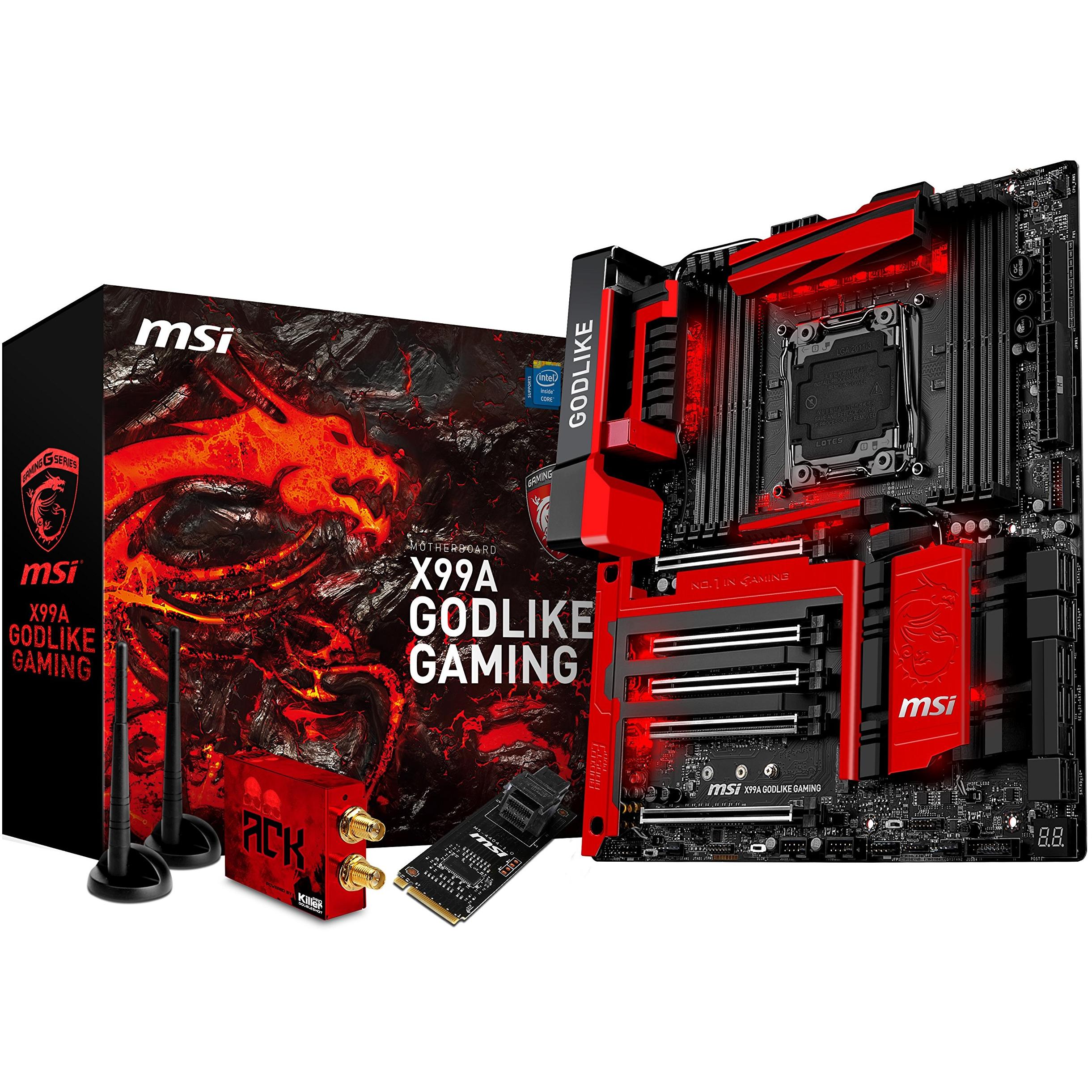
MSI X99A GODLIKE Ultra Edition


Sponsored This site contains affiliate links for which we may receive compensation. More information
Find other available options:

| Identifiers | |
|---|---|
| Model | MSI X99A GODLIKE GAMING |
| MPN | MSI X99A GODLIKE GAMING |
| Dimensions / Weight | |
| Key Features | |
|
Audio chip The model of the audio processing chip integrated into a device, indicating the specific hardware responsible for sound generation and decoding.
|
Realtek ALC1150 |
|
Audio output channels Indicates the total number of independent audio channels that a product can produce or process, including sub‑channels such as those used in surround sound configurations (e.g., 5.1, 7.2). The value may be an integer or a decimal to represent fractional channel groups.
|
7.1 channels |
|
BIOS type The firmware interface used by a computer system to initialize hardware and load the operating system, such as UEFI or legacy BIOS. It indicates whether the motherboard supports modern features like secure boot, fast startup, or compatibility with older operating systems.
|
UEFI |
| Bluetooth | Yes |
|
Bluetooth version The specific version of the Bluetooth standard supported by the product, indicating its capabilities for wireless communication and compatibility with other devices. Values may be numeric (e.g., 4.2, 5.0) or include additional descriptors such as "+HS" or feature lists.
|
4.0 |
|
Chassis intrusion connector Indicates whether a computer chassis includes a dedicated intrusion connector, which allows the attachment of security or monitoring devices to detect unauthorized access. A value of "Yes" means the connector is present; "No" means it is absent.
|
Yes |
|
Clear CMOS jumper Indicates whether the product includes a clear‑CMOS jumper, a small connector that allows resetting the CMOS memory to factory defaults. A value of "Yes" means the jumper is present and can be used for troubleshooting or configuration reset; "No" indicates it is absent.
|
Yes |
|
Compatible processor series List of processor families that the product can support, such as Intel Celeron, Intel Core i5, AMD Ryzen 3, etc. Each value represents a distinct CPU family or brand that is compatible with the hardware platform.
|
Intel Core i7 |
|
Component for Specifies the type of device or system that the product is intended to be used with, such as a PC, server, notebook, surveillance system, or other electronic equipment. The value represents a single category and can be used to filter or group products by their target platform.
|
PC |
| CPU fan connector | Yes |
|
Depth The linear measurement of an object from front to back or top to bottom, expressed in a physical unit such as millimeters, centimeters, inches, etc. It indicates how deep the item is and can be used for fitting, compatibility, or spatial planning.
|
272 mm |
|
ECC Indicates whether the memory module or component supports Error‑Correcting Code (ECC) for detecting and correcting single-bit errors during operation. A value of "Yes" means ECC is enabled, allowing automatic correction of data corruption; a value of "No" indicates no ECC support.
|
No |
|
Ethernet interface type A list of the Ethernet standards that a product supports, such as Fast Ethernet (10/100 Mbps), Gigabit Ethernet (1 Gbps), 2.5 GbE, 10 GbE, and other variants. Each value is a free‑text label describing one supported interface; multiple values are separated by commas when the device offers more than one speed or generation.
|
Gigabit Ethernet |
|
Ethernet LAN Indicates whether the product includes an Ethernet LAN interface for wired network connectivity, allowing data transmission over RJ‑45 or compatible cables.
|
Yes |
|
Front panel audio connector Indicates whether the product has an audio connector on its front panel. The value is "Yes" if a front‑panel audio jack or similar input is present, and "No" otherwise.
|
Yes |
|
Headphone outputs Represents how many separate headphone output ports a product provides, such as the number of 3.5 mm jacks or other audio connectors available for headphones or earphones.
|
1 |
|
Intel trusted execution technology Indicates whether the product incorporates Intel’s Trusted Execution Technology, a security feature that creates isolated execution environments to protect sensitive code and data from tampering or unauthorized access.
|
No |
|
LAN controller The specific model or designation of the LAN (network) controller integrated into a device, such as "Intel I219-V" or "Realtek RTL8111H." This value identifies the exact network interface hardware used for Ethernet connectivity, enabling users to compare performance, compatibility, and support across products.
|
Atheros Killer E2400 |
|
Maximum internal memory The largest amount of internal random‑access memory that a device can support, expressed as a data size such as megabytes or gigabytes. It indicates the maximum capacity for active processes and multitasking performance.
|
128 GB |
|
Memory channels The configuration of memory channels supported by a device, indicating how many independent memory paths the system can use for data transfer (e.g., Dual‑channel, Quad‑channel). This attribute helps users understand the potential bandwidth and performance characteristics of the memory subsystem.
|
Quad-channel |
|
Memory slots type The form factor of the memory module that a product can accept, such as DIMM or SO‑DIMM. It indicates whether the device uses standard desktop RAM modules (DIMM) or smaller laptop‑style modules (SO‑DIMM).
|
DIMM |
|
Motherboard chipset The model of the motherboard’s chipset, indicating the family of supported processors and integrated features such as I/O interfaces, memory support, and peripheral connectivity.
|
Intel® X99 |
|
Motherboard chipset family The chipset family identifies the group of integrated circuits that manage communication between a computer’s CPU, memory, and peripheral devices on a motherboard. It indicates the supported processor families, available I/O interfaces, and overall system capabilities, helping users assess compatibility and feature sets for motherboards or other hardware components.
|
Intel |
|
Motherboard form factor The physical layout and size classification of a motherboard, such as ATX, Micro‑ATX, Mini‑ITX, or other standardized formats. It indicates the dimensions, mounting points, and expansion capabilities that determine compatibility with computer cases and components.
|
Extended ATX |
|
Non-ECC Indicates whether the memory module does not support error‑correcting code (ECC). A value of Yes means the module lacks ECC protection, while No means it includes ECC functionality.
|
Yes |
|
Number of memory slots The count of physical memory slots available on a device for installing RAM modules. It indicates how many separate DIMM sticks can be installed or upgraded, regardless of size or speed.
|
8 |
|
Number of SATA III connectors The total count of physical SATA III (Serial ATA Revision 3) ports available on a product. It indicates how many internal connections can be used to attach storage devices such as hard drives or solid‑state drives that support the SATA III interface.
|
10 |
|
Parallel processing technology support A list of GPU multi‑processing technologies that the product can support, such as CrossFireX, SLI, NVLink or combinations thereof. Each value represents a distinct configuration that allows multiple graphics cards to work together for improved performance.
|
3-Way SLI,4-Way CrossFireX,4-Way SLI |
|
Power source type The type of electrical supply that powers the device, such as mains electricity, batteries, USB power, or a combination of these options.
|
ATX |
|
Processor socket The physical connector used by a processor to attach to a motherboard or other compatible platform. Common examples include LGA 1151, BGA 1440, Socket AM4, and LGA 1200. This attribute indicates the exact socket designation required for proper CPU installation and compatibility.
|
LGA 2011-v3 |
|
RAID levels A comma‑separated list that specifies the RAID configurations supported by a storage controller or device. Each entry can be a numeric level (e.g., 0, 1, 5, 10) or a special label such as JBOD. This attribute indicates which disk arrangements the system can manage.
|
0,1,5,10 |
| S/PDIF out port | Yes |
|
Supported memory clock speeds The operating frequencies that a processor or memory module can run at, expressed in megahertz (MHz) or gigahertz (GHz). This attribute lists all supported clock rates, allowing users to understand the performance range of the component.
|
2133,2200,2400,2600,2666,2800,3000,3333,3400 MHz |
|
Supported memory types A list of the memory module types that a device can accept or support, such as DDR4 SDRAM, LPDDR3, or other RAM technologies. Each entry represents a distinct memory architecture or generation compatible with the product.
|
DDR4-SDRAM |
|
Supported storage drive interfaces List of physical or logical interfaces that allow an internal storage drive to communicate with the system, such as SATA, M.2 PCIe, U.2, SAS, NVMe, or other standard connections.
|
M.2,Serial ATA III |
|
TPM connector Indicates whether the product includes a physical port that can accept a Trusted Platform Module (TPM) chip, enabling hardware‑based security features such as secure boot and encrypted storage.
|
Yes |
|
Unbuffered memory Indicates whether the memory modules in the product are unbuffered (non‑registered). A value of "Yes" means the device uses standard unbuffered RAM, while "No" indicates that buffered or registered memory is used.
|
Yes |
|
Wi-Fi Indicates whether the product has built‑in Wi‑Fi capability, allowing it to connect to wireless networks without requiring external adapters or dongles.
|
Yes |
|
Wi-Fi standards A list of the wireless networking protocols and frequency bands that a device can connect to, such as 802.11a, 802.11b, 802.11g, Wi‑Fi 4 (802.11n), Wi‑Fi 5 (802.11ac) or Wi‑Fi 6 (802.11ax). The values are typically separated by commas and may include both the technical name and a consumer‑friendly label.
|
802.11a,Wi-Fi 5 (802.11ac),802.11b,802.11g,Wi-Fi 4 (802.11n) |
|
Width The horizontal measurement of a product, expressed in a linear unit such as millimetres or inches. It indicates how wide the item is from one side to the other and is used for sizing, fitting, and compatibility purposes.
|
305 mm |

MSI is a Taiwanese computer hardware company that produces motherboards, graphics cards, laptops, and PCs. The company is well-known for its gaming laptops and gaming motherboards.
