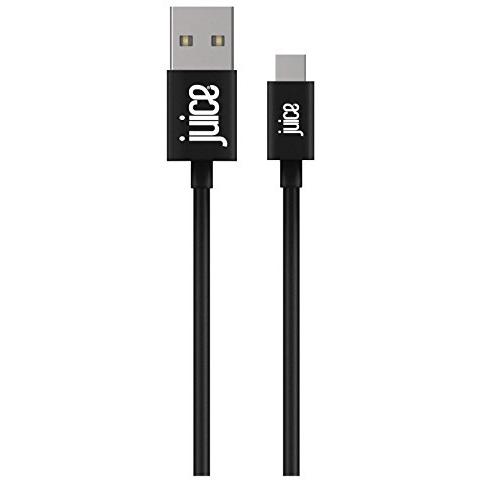
UltraSync 1M USB‑C Charger & Data Cable


Sponsored This site contains affiliate links for which we may receive compensation. More information
Find other available options:

| Identifiers | |
|---|---|
| MPN | Juice JUICECDATA1M-BLACK |
| Model | Juice Type C 1m |
| Dimensions / Weight | |
| Key Features | |
|
3.5 mm connector Indicates whether a product includes a standard 3.5 mm audio connector, the common analog jack used for headphones, microphones and other audio devices.
|
Yes |
|
3D Indicates whether the product has built‑in support for 3‑dimensional (3D) content or displays. A value of "Yes" means the device can render or display 3D images, videos, or games; a value of "No" means it does not have native 3D capability.
|
Yes |
|
AC input frequency The frequency of the alternating current supplied to a power supply or charger, expressed in hertz (Hz). It indicates the acceptable operating range for the electrical mains that powers the device, ensuring proper functionality and safety.
|
50/60 Hz |
|
AC input voltage The range of alternating current voltage that the product accepts from its power source, expressed in volts (V). It indicates the minimum and maximum supply voltages compatible with the device across different regions.
|
100-240 V |
|
Access Control List ACL Indicates whether the product supports an Access Control List (ACL) feature, allowing administrators to define rules that permit or deny network traffic based on criteria such as IP address, port number, or protocol.
|
Yes |
|
Audio Return Channel ARC Indicates whether the product supports an audio return channel (ARC) over HDMI, allowing audio to be sent back from a TV or display to an external audio device such as a soundbar or AV receiver.
|
Yes |
|
AWG wire size The American Wire Gauge (AWG) size of a conductor, expressed as an integer that indicates the wire’s diameter and cross‑sectional area. Lower numbers represent thicker wires with higher current capacity; higher numbers indicate thinner conductors suitable for lower currents or signal applications.
|
28 |
|
Backlight The illumination source used behind a display panel, such as LED, WLED, CCFL or LCD. It determines the brightness, energy efficiency and color accuracy of the screen.
|
No |
|
Backup button Indicates whether the device has a dedicated physical button that initiates or controls backup operations, such as creating data backups or restoring from them.
|
Yes |
| Backup features | Cloud, USB drive, iSCSI LUN |
|
Backup function Indicates whether a device has the capability to create backups of its data or settings, allowing restoration in case of loss, failure, or interruption.
|
Yes |
|
Bad block scan Indicates whether the device performs a bad block scan to detect and mark defective storage sectors. A value of Yes means the feature is available, while No means it is not.
|
Yes |
|
Bandwidth The highest rate at which a device can transfer data, expressed as a frequency in hertz (Hz). It indicates the maximum throughput capability of the component or connection and allows comparison across similar products.
|
600 MHz |
|
Best uses A set of categories that describe the intended purpose or application of a product, such as personal audio, business functions, or specialized equipment. Each value represents a distinct use case and can be selected for multiple products.
|
Home |
| Bluetooth | No |
|
Brand compatibility A list of brand names that the product is compatible with. Each entry represents a manufacturer whose products can be used with or alongside the item.
|
Any brand |
|
Browser supported A list of web browsers that the product can run or support, typically including major desktop and mobile browsers such as Chrome, Firefox, Safari, Edge, Internet Explorer, Opera, and others. Each value represents a distinct browser name or version range that has been verified to work with the device.
|
Apple Safari 7+, Google Chrome, Microsoft Internet Explorer 10+, Mozilla Firefox |
|
Built-in FTP server Indicates whether the product includes a built‑in FTP server that allows file transfer and management over the network without requiring an external device.
|
Yes |
| Buzzer | Yes |
|
Cable colour The visual hue or combination of hues that a cable exhibits, expressed as common colour names such as "Black", "White" or comma‑separated lists like "Black, White". It indicates the appearance of the cable for identification and aesthetic purposes.
|
Black |
| Cable jacket material | Polyvinyl chloride (PVC) |
|
Cable length The linear distance that a cable covers, expressed with a length unit such as meters, centimeters or inches. It represents the total usable length of the cable for connecting devices.
|
1 m |
|
Cable Lock Slot Indicates whether the product includes a slot for inserting a cable lock, such as a Kensington or similar security device.
|
Yes |
|
Cable lock slot type Specifies the type of interface or mechanism used to secure a cable in its port, such as Kensington, Noble, IBM, or other standard lock slots. This attribute helps users identify compatibility and security features of the device.
|
Kensington |
|
Cables included A list of the cable types that are supplied with the product, such as USB, HDMI, VGA, DisplayPort, LAN (RJ‑45), SATA, audio or other relevant connectors.
|
AC, LAN (RJ-45) |
|
Case type The form or style of a protective enclosure for electronic devices, such as laptops, tablets, phones, or other gadgets. It indicates whether the case is a hard shell, soft sleeve, backpack, messenger bag, folio, flip cover, or any other design that protects and carries the device.
|
Hardshell case |
|
Certification A list of official certifications or compliance marks that the product has received from regulatory bodies, safety organizations, or industry standards groups. Each entry represents a distinct certification such as CE, FCC, RoHS, UL, or WEEE, and may include additional details like version numbers or specific test reports.
|
RoHS, CE |
|
Chassis type The physical form factor of a computer chassis, indicating its size and layout such as Tower, Desktop, Mini‑PC, or rack units (e.g., 1U, 2U). This attribute helps users identify the footprint, mounting options, and compatibility with other hardware.
|
Tower |
|
Chipset The chipset is the collection of integrated circuits that manages communication between a computer’s CPU, memory, and peripheral devices. It defines the supported processor families, available I/O interfaces, and overall system capabilities, allowing users to understand compatibility and feature sets for motherboards or other hardware components.
|
Parade - PS171 |
|
Cleaning cloth Indicates whether the cleaning cloth can be washed or not. A value of "Yes" means the cloth is machine‑washable or hand‑washable, while "No" indicates it should not be washed and may require dry cleaning or special care.
|
Yes |
|
Compatible power plug types A list of the electrical plug or socket types that a product can accept, such as UK, EU, US, AU, JP, etc. Each value represents a distinct plug configuration that the device is designed to accommodate, allowing users to determine if it will fit their local outlets.
|
UK |
|
Connectivity technology The network and data interface technologies supported by the product, such as Wired, Wireless, USB, Bluetooth, or combinations thereof. Each value represents a distinct technology that can be used for communication or power delivery.
|
Wireless |
|
Connector 1 The physical interface or port located at the first end of a cable or device, such as USB‑A, HDMI, RJ‑45, DisplayPort, Lightning, or other standard connectors. It identifies the shape, pin count and electrical characteristics that determine compatibility with cables, adapters or other components.
|
USB A |
|
Connector 1 form factor The physical shape or configuration of the first connector on a device, indicating whether it is straight, angled, right‑handed, left‑handed, rotating, foldable, or another form. This attribute helps users identify how the connector aligns with cables and ports.
|
Straight |
|
Connector 1 gender Indicates the gender or sex classification of a connector, such as Male, Female, or Unspecified. This attribute helps users identify whether a cable or port is designed for insertion (Male) or reception (Female).
|
Male |
|
Connector 2 The physical interface or port used to connect a device to another component, such as USB, HDMI, RJ‑45, audio jacks, or fiber optic connectors. It identifies the shape, pin count, and electrical characteristics that determine compatibility with cables, adapters, and peripherals.
|
USB C |
|
Connector contacts plating The metal coating applied to the contacts of a connector, such as gold, nickel, copper or chrome. It provides corrosion resistance, conductivity and durability for the electrical connections.
|
Gold |
|
Connector location The physical position of a connector on a product, such as top left, bottom right, front panel, rear panel or internal mounting point. It indicates where the interface is situated relative to the device’s exterior or interior layout, helping users identify installation points and compatibility with cables or accessories.
|
Bottom right |
|
Connector Type The physical interface or port used to connect a device to another component or system, such as USB, HDMI, RJ‑45, 3.5 mm jack, or fiber optic connectors. It indicates the shape, pin count, and electrical characteristics that determine compatibility with cables, adapters, and peripherals.
|
30-pin, BRHS |
|
Control type Indicates the mechanism or method used to operate a product, such as buttons, knobs, touch panels, rotary dials, sensors, or other physical or digital controls. The value describes the interaction required by the user and the available options for operating the device.
|
Buttons |
| Control unit type | In-line control unit |
|
Converter Type The category of a device that changes one signal format to another, such as converting video or audio signals between different connector types or standards.
|
Active |
|
Data transfer rate The highest theoretical speed at which a device can send or receive data, expressed in bits per second (bps) or its multiples such as kbps, mbps, gbps, etc. It represents the upper bound of throughput under optimal conditions and is useful for comparing performance across devices and interfaces.
|
18 Gbit/s |
|
Depth The linear measurement of an object from front to back or top to bottom, expressed in a physical unit such as millimeters, centimeters, inches, etc. It indicates how deep the item is and can be used for fitting, compatibility, or spatial planning.
|
320 mm |
|
Device class A free‑text label that identifies the general category or type of a device, such as "NAS", "Server", "Router", "Storage Enclosure" or any other descriptive class used by manufacturers to classify their products. The value is intended to help users quickly understand the primary function or form factor of the item.
|
Home & Home Office |
|
Device type The general classification of a product, such as tablet, smartphone, router, or computer. It indicates the primary function or form factor that helps buyers quickly identify and compare similar items.
|
Mobile phone/Smartphone |
|
DHCP client Indicates whether the device supports the DHCP client function, meaning it can automatically request an IP address and related network settings from a DHCP server.
|
Yes |
|
DHCP server Indicates whether the device supports acting as a DHCP server, allowing it to assign IP addresses and network configuration settings to clients on the network.
|
Yes |
| Display diagonal | 35.6 cm (14") |
|
Display resolution The pixel dimensions of a display or image, expressed as width by height (e.g., 1920x1080). It indicates how many pixels are used to render visual content and is commonly used for monitors, TVs, smartphones, cameras, and digital images.
|
1366 x 768 pixels |
|
Display type The type of visual panel or display technology used in a product, such as LCD, LED, OLED, TFT, IPS, AMOLED, or analog. It indicates the underlying technology that determines image quality, color reproduction, power consumption and suitability for different use cases.
|
LED |
|
Driver unit The physical dimension of the driver’s diaphragm or cone in a speaker or headphone. It is expressed as a linear measurement (e.g., millimetres, centimetres, inches) and allows users to compare the relative size of drivers across different products.
|
3.2 cm |
|
Dynamic DNS DDNS Indicates whether a device can automatically update its IP address with a Dynamic DNS service, allowing remote access even when the public IP changes.
|
Yes |
|
Ear coupling The type of ear attachment used by a headset or earphones, indicating how the device fits around or inside the ear. Common values include "Intraaural", "Circumaural", "Supraaural" and "On‑ear". This attribute helps users choose a model that matches their preferred fit and comfort.
|
Supraaural |
|
Ethernet LAN Indicates whether the product includes an Ethernet LAN interface for wired network connectivity, allowing data transmission over RJ‑45 or compatible cables.
|
Yes |
|
Ethernet LAN data rates Maximum theoretical speed at which a device can send or receive data over its Ethernet LAN interface, expressed in megabits per second (Mbps) or gigabits per second (Gbps). It represents the upper bound of throughput under optimal conditions and is useful for comparing network performance between devices with wired connectivity.
|
10,100,1000,2500 Mbit/s |
|
Ethernet LAN ports Represents the total count of Ethernet LAN (RJ‑45) interfaces available on a product. The value is an integer indicating how many physical Ethernet ports are present, regardless of speed or generation.
|
2 |
|
External power adapter Indicates whether the product comes with an external power adapter in its packaging. A value of "Yes" means a charger is supplied; a value of "No" means no charger is included and the user must obtain one separately.
|
Yes |
|
Fan diameter The linear measurement across the widest part of a fan, expressed in units such as millimeters (mm), centimeters (cm) or inches (in). It represents the overall width of the fan and is useful for determining fit, compatibility with cases, and airflow characteristics.
|
12 cm |
|
Flash memory The total amount of internal flash memory available in a device, expressed as a data size (e.g., megabytes or gigabytes). This attribute indicates how much data can be stored on the device’s built‑in flash storage and is useful for comparing storage capacity across products.
|
512 MB |
|
Glossy display Indicates whether a product’s screen has a glossy (shiny) or matte (non‑glossy) finish. A value of "Yes" means the display is glossy, while "No" indicates a non‑glossy surface.
|
No |
|
HD type The pixel dimensions of a product’s screen, expressed as width by height (e.g., 1920x1080). It indicates the total number of pixels that compose the display and is used to assess image sharpness and clarity across devices such as monitors, TVs, laptops, and cameras.
|
WXGA |
|
HDD size The physical width of a hard disk drive expressed in inches or centimeters. It indicates the standard size that determines which enclosures, bays, and mounting hardware are compatible with the drive.
|
2.5" |
|
HDMI Ethernet channel Indicates whether an HDMI cable or connector includes an embedded Ethernet channel, allowing network data to be transmitted over the same cable as audio and video signals.
|
Yes |
|
Headphone frequency The span of audio frequencies that a product can accurately reproduce or respond to, expressed in hertz (Hz). It indicates the lowest and highest frequencies the device can handle, helping users assess suitability for music playback, communication, or signal processing applications.
|
20 - 20000 Hz |
|
Headphone sensitivity The sensitivity of a headphone expressed in decibels (dB), indicating how much sound pressure the headphones can produce or detect for a given electrical input level. Values may be positive, negative, or zero and are typically measured at 1 kHz. This attribute helps users compare the loudness performance of different headphones.
|
84 dB |
|
Headset type The general classification of a headset based on how it delivers audio to the user, such as binaural (two‑channel), monaural (single‑channel), or other configurations. This attribute helps buyers understand whether the device provides stereo sound, single‑speaker output, or specialized listening modes.
|
Binaural |
|
Height The vertical dimension of a product measured from its lowest to highest point. It is expressed in a physical unit such as millimetres, centimetres or inches and applies to any item where height is relevant, including books, electronics, furniture and other objects.
|
5 mm |
|
Hot spare Indicates whether the device includes an active backup unit (hot spare) that can automatically replace a failed drive without service interruption.
|
Yes |
|
Hot-swap drive bays Indicates whether the product’s drive bays support hot‑swap, meaning drives can be inserted or removed while the device is powered on without shutting down or rebooting.
|
Yes |
|
Housing material Indica el material o la combinación de materiales con los que está fabricado el componente más importante de un producto, como metal, plástico, vidrio u otros compuestos. Este atributo ayuda a comprender la durabilidad, peso y estética del artículo.
|
Polycarbonate (PC) |
| Installed storage drive type | HDD |
|
Internal memory The total amount of internal memory available in a device, expressed as a data size such as megabytes (MB) or gigabytes (GB). It indicates how much information the component can hold for active processes and affects multitasking performance.
|
4 GB |
|
Internal memory type The type of memory physically installed inside a device, such as DDR4 SDRAM, LPDDR3, or other RAM variants. It indicates the architecture and generation of the internal memory modules that the product uses or supports.
|
DDR3 |
| iSCSI support | Yes |
| Jumbo frames support | Yes |
|
LED backlight The illumination source used behind a display panel, such as LED, WLED, CCFL or LCD. It determines the brightness, energy efficiency and color accuracy of the screen.
|
Yes |
|
LED indicators A list of the functions or statuses that an LED indicator on a device can display, such as power status, activity, link, and other operational signals.
|
Yes |
|
Link aggregation Indicates whether the device can combine multiple network connections into a single logical link to increase bandwidth or provide redundancy.
|
Yes |
|
Linux operating systems supported List of Linux operating systems that the product can run or support, including specific versions and architectures when relevant. Each value represents a distinct Linux distribution or kernel version supported by the hardware or software.
|
Yes |
| Load balancing system | Yes |
|
Mac operating systems supported A list of macOS operating system versions that the product supports or is compatible with, such as "macOS 10.15 Catalina", "macOS 11 Big Sur" or newer releases. Each entry represents a distinct OS version that can run on or be supported by the device.
|
Yes |
|
Magnetically shielded Indicates whether the product is designed to block or reduce electromagnetic interference, ensuring stable operation and compliance with regulatory standards.
|
Yes |
|
Management protocols A list of network protocols that a device can use for configuration, monitoring and remote management, such as SNMP, HTTP/HTTPS, Telnet, SSH or other standard interfaces. Each protocol is represented by its common name and may be separated by commas or slashes in the source data.
|
SNMP |
|
Manual Indicates whether a user manual—physical or digital—is provided with the product. A value of "Yes" means that a manual is included, while a value of "No" indicates that no manual is supplied.
|
Yes |
|
Material The material indicates the type of substance from which a product is made, such as metal, plastic, wood, glass, or composite materials. It helps users understand the product’s durability, weight, appearance, and suitability for specific applications.
|
Polycarbonate |
|
Maximum current The highest electrical current that a device can safely draw from its power source, expressed in amperes (A). It indicates the maximum load the product is designed to handle during normal operation and helps users verify compatibility with power supplies or sockets.
|
13 A |
|
Maximum RAM supported The largest amount of internal random‑access memory (RAM) that a network attached storage (NAS) device can accommodate, expressed as a data size such as megabytes or gigabytes. It indicates the upper limit for active processes and multitasking performance on the NAS.
|
8 GB |
|
Maximum refresh rate The highest number of times per second that a display can update its image, expressed in hertz (Hz). It indicates the maximum refresh capability of the device and is useful for comparing visual performance across monitors, TVs, laptops, and other screen‑based products.
|
60 Hz |
|
Maximum resolution The highest pixel dimensions that a device can output or support, expressed as width by height (e.g., 1920x1080). It indicates the maximum resolution available for display content on the product.
|
1920 x 1200 pixels |
|
Maximum Screen Size The largest diagonal measurement of a display that the product can accommodate, expressed in units such as inches or centimeters. It indicates the maximum screen size that will fit within the device’s enclosure or mounting area.
|
24.6 cm (9.7") |
|
Maximum screen size compatibility The largest diagonal measurement of a display that the product can accommodate, expressed in units such as inches or centimeters. It indicates the maximum screen size that will fit within the device’s enclosure or mounting area.
|
33 cm (13") |
|
Memory form factor The physical configuration or size classification of a memory module, such as SO‑DIMM, UDIMM, RDIMM, or on‑board. It indicates the form factor that determines compatibility with motherboards and other hardware components.
|
SO-DIMM |
|
Microphone frequency The span of audible frequencies that a microphone can accurately capture, expressed as a minimum and maximum value in hertz (Hz). It indicates the lowest and highest tones the device can reproduce or record, helping users assess suitability for different audio applications.
|
100 - 10000 Hz |
|
Microphone sensitivity The acoustic sensitivity of a microphone, expressed in decibels (dB). It indicates how effectively the microphone converts sound pressure into an electrical signal; lower (more negative) values mean higher sensitivity and better performance at low sound levels.
|
-35 dB |
|
Microphone Type The classification of a microphone’s design or pickup pattern, such as condenser, dynamic, lavalier, boom, built‑in, handheld or other types. It indicates the physical form and typical usage scenario of the microphone.
|
Boom |
| Noise Level | 19.2 dB |
| Noise-canceling | Yes |
|
On/off switch Indicates whether the product includes an on/off switch that allows the user to power it on or off manually.
|
Yes |
|
Online RAID expansion Indicates whether the product can expand its storage capacity by adding additional drives or modules that are managed through a RAID configuration. A value of "Yes" means the device supports such expansion, while "No" indicates it does not.
|
Yes |
|
Online RAID migration Indicates whether the product supports migrating data from an external RAID system to its internal storage without downtime or additional hardware. A value of "Yes" means the device can perform this operation, while "No" indicates the feature is not available.
|
Yes |
|
Operating keys A list of functional controls or button combinations that can be used on a device, such as volume adjustment, mute, play/pause, call handling, and Bluetooth pairing. Each entry represents an individual key action or a multi‑key sequence that the user can trigger.
|
Volume +, Volume - |
|
Operating relative humidity The range of relative humidity (in percentage) within which the product is designed to operate reliably. Values are expressed as a minimum–maximum interval such as "20 - 80 %" and indicate the acceptable environmental moisture level for optimal performance.
|
5 - 90% |
|
Operating system installed The operating system that is installed on the device, indicating the software platform that manages hardware resources and provides services for applications. It can be a commercial OS such as Windows or macOS, an open‑source distribution like Linux, or a proprietary firmware used in embedded devices.
|
QNAP Turbo System |
|
Operating system version The specific version of the operating system that a product supports or runs, expressed as a numeric revision (e.g., 10, 11) or a descriptive name (e.g., Nougat). This attribute helps users determine compatibility with software and updates.
|
4.4.2 |
|
Package type The form of packaging used for a product, such as box, blister pack, bag, or pallet. It indicates how the item is contained and protected during shipping and storage.
|
Polybag |
|
Placement supported A list of the positions or mounting options where a product can be installed, such as indoor, outdoor, wall, desk, floor, ceiling, or universal. Each value represents a distinct placement scenario that the device supports.
|
Indoor |
|
Plug and play Indicates whether the product can be used immediately after installation without requiring additional configuration or drivers.
|
Yes |
| Power consumption | 15.6 W |
| Power consumption sleep | 8.46 W |
|
Power supply location The physical position where the power supply unit is installed or mounted within a device, such as top, bottom, rear, side, front, or built‑in. This attribute helps users understand where to find the power source and plan cable routing or ventilation.
|
External |
|
Power supply unit PSU capacity The electrical power rating of a power supply unit (PSU), expressed in watts (W). It indicates the maximum output power that the PSU can deliver to connected components, helping users assess compatibility and energy requirements for their system.
|
90 W |
|
Printing colours A comma‑separated list of colour names that a product can produce or display, such as black, cyan, magenta, yellow and any additional variations (e.g., photo‑black, matte black). This attribute applies to printers, ink cartridges, toner cartridges, and other printing consumables.
|
Neutral |
|
Printing material The type of material used to produce a printed object, such as PLA, ABS, PETG, resin or other thermoplastic or photopolymer substances. It indicates the physical composition that determines properties like strength, flexibility, color options and suitability for specific printing technologies.
|
Polylactic acid (PLA) |
|
Processor family The processor family identifies the group or series of CPU models that share a common architecture, design, and performance characteristics. It helps users compare processors across brands and generations by indicating the underlying technology used in the chip.
|
Annapurna Labs |
|
Processor frequency The fundamental operating frequency of a processor, expressed in hertz (Hz). It indicates the speed at which the CPU runs under normal conditions and is typically reported in gigahertz (GHz) or megahertz (MHz). This value helps users compare performance potential across different models.
|
1.7 GHz |
|
Processor model Identifies the exact model of the central processing unit used in a device, including brand and numeric designation such as "Intel Core i5-8250U" or "AMD Ryzen 7 3700X". This value allows users to distinguish between different processor families, generations, and performance levels.
|
AL314 |
|
Product main colour A visual attribute that describes the dominant hue or combination of hues present on a product. It can be a single colour such as "Black" or a comma‑separated set like "Black, Grey" to indicate multiple prominent colours used in the item’s design.
|
Blue |
|
Protection features A comma‑separated list of protective characteristics that a product offers, such as resistance to dust, water, shock, heat, or other environmental factors.
|
Scratch resistant |
|
RAID levels A comma‑separated list that specifies the RAID configurations supported by a storage controller or device. Each entry can be a numeric level (e.g., 0, 1, 5, 10) or a special label such as JBOD. This attribute indicates which disk arrangements the system can manage.
|
0,1,JBOD |
|
RAID Support A comma‑separated list of RAID levels that a storage device or controller can support, such as 0, 1, 5, 10, JBOD, and other proprietary configurations. Each value represents a distinct RAID mode the system is capable of creating or managing.
|
Yes |
|
Recommended usage A brief statement of the intended or most suitable use cases for a product, such as the type of environment (indoor, outdoor), activity (gaming, office work, music listening) or general application category. It helps customers quickly determine whether the item fits their needs.
|
Office/Call center |
|
Reset button Indicates whether the device has a physical reset button that restores factory settings or original configuration when pressed.
|
Yes |
|
Security algorithms A list of cryptographic and authentication methods that a device can use for secure communication or data protection. Each entry represents a distinct algorithm or protocol, such as encryption ciphers (e.g., AES, WEP), authentication mechanisms (e.g., RADIUS, WPA‑PSK), or network security protocols (e.g., HTTPS, SSL/TLS). The values are typically separated by commas and may include both technical identifiers and consumer‑friendly labels.
|
256-bit AES,FIPS 140-2,HTTPS |
|
Share folder access right management Indicates whether the product allows users to manage access rights for shared folders. A value of "Yes" means that the device or service provides a mechanism to assign, modify, or revoke permissions on shared directories, enabling controlled sharing among multiple users.
|
Yes |
|
SMART support Indicates whether the product supports Intel Smart Response Technology (or equivalent), a feature that uses flash memory as a cache to accelerate disk access and improve overall system performance.
|
Yes |
|
Smartphone remote support Indicates whether a product can be remotely supported or managed by the manufacturer or a service provider. A value of "Yes" means remote support is available, while "No" indicates it is not.
|
Yes |
|
Snapshot Indicates whether the product has the capability to create point‑in‑time copies of its data or configuration, allowing recovery or backup without interrupting normal operation.
|
Yes |
|
Stand mode Indicates whether the product includes a built‑in stand or support for an external stand, allowing it to be positioned upright without additional accessories.
|
Yes |
|
Storage drive interface List of physical or logical interfaces that allow a storage drive to connect with other components, such as SATA, M.2 PCIe, U.2, SAS, NVMe or other standard connections.
|
Serial ATA |
|
Storage drive sizes supported A list of the physical sizes and types of storage drives that a product can accommodate, such as 2.5‑inch, 3.5‑inch, or M.2. The values are typically separated by commas and may include additional descriptors like "M.2" to indicate an internal solid‑state drive interface.
|
2.5,3.5" |
|
Storage drives installed The total count of individual storage devices (hard disk drives or solid‑state drives) that are physically present in the product. It indicates how many separate drives are installed, regardless of capacity or interface type.
|
Yes |
|
Supported file systems A comma‑separated list of file system formats that the product can read or write, such as FAT32, NTFS, ext4, exFAT, HFS+, and others. Each value represents a distinct storage format supported by the device’s firmware or operating system.
|
FAT32,HFS+,NTFS,exFAT,ext3,ext4 |
|
Supported Graphics Resolutions The pixel dimensions that a device can output or support, expressed as width by height (e.g., 1920x1080). It indicates the maximum resolution available for display content on the product.
|
3840 x 2160 |
|
Supported storage drive interfaces List of physical or logical interfaces that allow an internal storage drive to communicate with the system, such as SATA, M.2 PCIe, U.2, SAS, NVMe, or other standard connections.
|
Serial ATA II, Serial ATA III |
|
Supported storage drive types A list of the types of storage drives that a product can use, such as HDD or SSD. Each entry indicates a distinct drive type supported by the device, allowing users to understand which internal or external storage media are compatible.
|
HDD & SSD |
|
Surface coloration Represents the visual appearance or pattern applied to a product’s surface, such as a single color (monotone), an image, or a repeating design. It indicates how the exterior of the item is finished and can be used to differentiate models or styles.
|
Monotone |
|
Sustainability certificates A list of environmental, safety or quality certifications that a product has obtained from recognized authorities. Typical entries include RoHS, ENERGY STAR, CE, WEEE, TCO Certified, FCC, and other industry‑specific standards.
|
RoHS |
|
System log Indicates whether the product includes a system log feature that records events, errors, or status updates for troubleshooting and monitoring purposes. The value is a simple yes/no answer.
|
Yes |
|
Thickness The measured distance between two opposite surfaces of a material or component, expressed in a linear unit such as millimeters or inches.
|
1.75 mm |
|
Third-party support Indicates whether the product supports third‑party accessories or components that are not included with the device. A value of "Yes" means such accessories can be used, while "No" indicates they cannot.
|
Yes |
|
Touchscreen Indicates whether a device has a touchscreen interface that can detect touch input. The value is "Yes" if the device includes a functional touchscreen, and "No" otherwise.
|
No |
|
Type The general category or style of the product, such as laptop, printer cartridge, or cooling fan. It helps buyers quickly identify the nature of the item and compare similar products.
|
Bezel panel |
|
Universal Plug and Play UPnP Indicates whether the product can automatically discover and communicate with other devices on the network using Universal Plug and Play (UPnP) protocols, enabling seamless configuration and media sharing without manual setup.
|
Yes |
|
USB connectivity Indicates whether the product has a USB interface for data transfer or power delivery. A value of "Yes" means at least one USB port is present; "No" indicates no USB ports are available.
|
Yes |
|
USB connector The physical interface of the main USB port on a device, such as USB‑A, USB‑B, USB‑C, Micro‑USB or Mini‑USB. It indicates the shape and electrical characteristics that determine compatibility with cables, adapters and peripherals.
|
USB Type-A |
|
USB port Indicates the presence and quantity of USB connectors on a product. The value is typically an integer representing how many USB ports are available, regardless of type or version.
|
Yes |
|
USB version The specific version of the USB standard that a product supports, expressed as a generation number and optional descriptive suffix (e.g., "3.2 Gen 1" or simply "3.0"). This attribute indicates the data‑transfer capabilities and compatibility with USB devices.
|
3.2 Gen 1 (3.1 Gen 1) |
|
Volume control Indica el mecanismo o método con que se opera la función de ajuste de volumen en un producto, como botones físicos, controles giratorios, táctiles, digitales o combinaciones de estos. Los valores comunes incluyen "Tocar", "Botones", "Giratorio", "Control en línea" y otras variantes similares.
|
Button |
|
Wake-on-LAN ready Indicates whether the device can be powered on remotely via Wake‑on‑LAN, allowing a network administrator or user to start it from sleep or off state using a network packet.
|
Yes |
|
Wearing style A textual description of the way a product is worn or fitted on the body, such as "headband", "earhook", "neck‑band", "over‑the‑ear", or "in‑ear". This attribute helps users understand how the item will be positioned and secured during use.
|
Head-band |
|
Web-based management Indicates whether the product can be configured and monitored through a web interface accessible via a browser, allowing remote administration over a local or internet connection.
|
Yes |
|
Weight The mass of the product expressed in a standard unit such as grams or kilograms. It represents how heavy the item is and can be used for shipping calculations, handling instructions, or consumer information.
|
40 g |
|
Wi-Fi Indicates whether the product has built‑in Wi‑Fi capability, allowing it to connect to wireless networks without requiring external adapters or dongles.
|
Yes |
|
Wi-Fi data rate The maximum theoretical speed at which a device can send or receive wireless data, expressed in bits per second (bps) or its multiples such as kbps, mbps, gbps. It represents the upper bound of throughput under optimal conditions and is useful for comparing performance across Wi‑Fi devices.
|
150 Mbit/s |
|
Wi-Fi standards A list of the wireless networking protocols and frequency bands that a device can connect to, such as 802.11a, 802.11b, 802.11g, Wi‑Fi 4 (802.11n), Wi‑Fi 5 (802.11ac) or Wi‑Fi 6 (802.11ax). The values are typically separated by commas and may include both the technical name and a consumer‑friendly label.
|
802.11b,802.11g,Wi-Fi 4 (802.11n) |
|
Width The horizontal measurement of a product, expressed in a linear unit such as millimetres or inches. It indicates how wide the item is from one side to the other and is used for sizing, fitting, and compatibility purposes.
|
209 mm |
|
Wire length The linear distance that a wire covers, expressed with a length unit such as meters or centimeters. It represents the total usable length of the wire for connecting devices.
|
335 m |
|
Wireless technology The radio‑frequency or wireless communication technology used by a product, such as Bluetooth, Wi‑Fi, RF, DECT, ZigBee, Z‑Wave, or other supported protocols. The value is typically a free‑text label that identifies the primary wireless capability of the device.
|
Wi-Fi |
|
WLAN adapter supported Indicates whether the product includes a built‑in wireless LAN (Wi‑Fi) adapter that can connect to Wi‑Fi networks. A value of "Yes" means the device has an integrated WLAN module; "No" means it relies on external adapters or does not support Wi‑Fi.
|
Yes |
|
Works with Amazon Alexa Indicates whether a product can be controlled by voice through the Amazon Alexa assistant and integrated with other smart devices.
|
Yes |
|
Works with the google assistant Indicates whether a product can be controlled or interacted with using Google Assistant voice commands. A value of "Yes" means the device supports integration with Google Assistant, while a value of "No" indicates it does not.
|
Yes |
Juice
Juice is a brand that sells fruit juices and smoothies. They have a wide variety of flavors and types of juice, and they are all made with natural ingredients.
Juice is a brand that sells fruit juices and smoothies. They have a wide variety of flavors and types of juice, and they are all made with natural ingredients.


