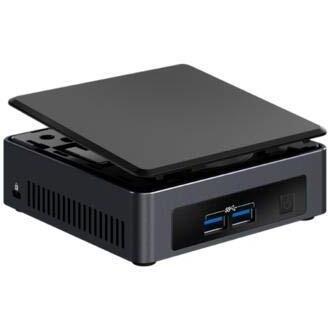
Ultra‑Mini Intel NUC 7i5DNKE Kit


Sponsored This site contains affiliate links for which we may receive compensation. More information
Find other available options:

| Identifiers | |
|---|---|
| Model | Intel BLKNUC7I5DNKE |
| MPN | Intel BLKNUC7I5DNKE |
| Dimensions / Weight | |
| Key Features | |
|
Audio output channels Indicates the total number of independent audio channels that a product can produce or process, including sub‑channels such as those used in surround sound configurations (e.g., 5.1, 7.2). The value may be an integer or a decimal to represent fractional channel groups.
|
7.1 channels |
| BIOS memory size | 64 Mbit |
|
BIOS type The firmware interface used by a computer system to initialize hardware and load the operating system, such as UEFI or legacy BIOS. It indicates whether the motherboard supports modern features like secure boot, fast startup, or compatibility with older operating systems.
|
EEPROM |
| Bluetooth | Yes |
|
Built-in processor Indicates whether the product contains a built‑in central processing unit (CPU) that can execute instructions without requiring an external processor module. A value of "Yes" means the device has such a CPU; "No" means it does not.
|
Yes |
|
Cable lock slot Indicates whether the product includes a slot for inserting a cable lock, such as a Kensington or similar security device.
|
Yes |
|
Cable lock slot type The specific type of cable lock interface that a device provides for securing cables, such as Kensington, Noble, IBM or other standard locking mechanisms.
|
Kensington |
|
Chassis type The physical configuration or shape of a computer chassis, such as tower, rack‑mount (e.g., 1U, 2U), desktop, mini‑PC, or other compact designs. It indicates the overall size and mounting style that determines compatibility with motherboards, power supplies, and case accessories.
|
UCFF |
|
Compatible operating systems List of operating systems that the product can run or support, including specific versions and architectures when relevant. Each value represents a distinct OS that is compatible with the hardware or software.
|
Windows 10, 64-bit*, Windows 10 IoT Enterprise*, Windows Server 2016* |
|
DC input voltage The electrical potential difference that a device is designed to accept from its power source, expressed in volts (V). It indicates the nominal operating voltage for the product and helps users verify compatibility with local mains or battery supplies.
|
12-24 DC |
| DC-in jack | Yes |
|
Drivers included Indicates whether the product comes with drivers included in the package or available for download. A value of "Yes" means that drivers are supplied, while a value of "No" indicates they are not provided and must be obtained separately.
|
Yes |
|
ECC Indicates whether the memory module or component supports Error‑Correcting Code (ECC) for detecting and correcting single-bit errors during operation. A value of "Yes" means ECC is enabled, allowing automatic correction of data corruption; a value of "No" indicates no ECC support.
|
No |
|
Embedded options available Indicates whether the product includes embedded options such as firmware features, hardware modules or configuration settings that are built into the device and available for use without external accessories.
|
Yes |
| Enhanced intel speedstep technology | Yes |
|
Ethernet LAN Indicates whether the product includes an Ethernet LAN interface for wired network connectivity, allowing data transmission over RJ‑45 or compatible cables.
|
Yes |
|
Execute disable bit Indicates whether the processor’s Execute Disable bit is enabled, allowing the CPU to prevent execution of code from memory regions marked as non-executable.
|
Yes |
|
Graphics adapter The specific model or designation of the graphics adapter present in a device, such as "Intel HD Graphics", "AMD Radeon Vega 8", or "NVIDIA GeForce GTX 1660". This value helps users understand the visual performance and capabilities that the product can deliver.
|
HD Graphics 620 |
|
Graphics adapter family The brand or family of the graphics adapter present in a device, such as Intel, AMD, NVIDIA, Apple, or other vendors. It indicates the general source of the GPU technology and helps users compare visual performance across products.
|
Intel |
|
Graphics output A list of the video output connectors and protocols that a device can provide for transmitting visual signals, such as HDMI, DisplayPort, VGA, or USB‑C based outputs. Each entry indicates a distinct connector type or version (e.g., "HDMI 2.1", "DP 1.4"). This attribute helps users identify which displays or external devices the product can support.
|
Dual HDMI 2.0a, 4-lane eDP 1.4 |
| HDMI ports quantity | 2 |
|
HDMI version The specific version of the HDMI standard that a product supports, such as "2.0", "2.1" or "1.4b". This value indicates the capabilities and compatibility of the HDMI interfaces on the device.
|
2.0a |
|
Idle states A list of the various low‑power or standby modes that a device can enter to conserve energy when not actively performing tasks.
|
Yes |
|
Intel 64 Indicates whether the processor is compatible with the Intel® 64 architecture, enabling it to run operating systems and applications designed for x86‑64 processors.
|
Yes |
|
Intel clear video technology Indicates whether the product incorporates Intel’s Clear Video HD technology, a hardware feature that enhances video playback and capture quality by providing smoother motion, reduced artifacts, and improved color accuracy.
|
Yes |
|
Intel flex memory access Indicates whether the product supports Intel’s flexible memory access feature, which allows dynamic allocation and sharing of memory resources between the CPU and other components to improve performance and power efficiency.
|
Yes |
|
Intel rapid storage technology Indicates whether the product supports Intel Rapid Storage Technology, a software and firmware solution that enables RAID configurations, improves storage performance, and provides data protection features for compatible drives.
|
Yes |
|
Intel trusted execution technology Indicates whether the product incorporates Intel’s Trusted Execution Technology, a security feature that creates isolated execution environments to protect sensitive code and data from tampering or unauthorized access.
|
Yes |
|
Intel TSX-NI Indicates the specific version of Intel Transactional Synchronization Extensions – No Interlock (TSX‑NI) supported by a processor, which determines its capability for efficient transaction processing and concurrency control.
|
Yes |
|
L3 cache The amount of internal memory reserved for a processor’s L3 cache, expressed in units such as megabytes (MB) or gigabytes (GB). This value indicates how much data the CPU can store locally to accelerate access and improve overall performance.
|
3 MB |
|
LAN controller The specific model or designation of the LAN (network) controller integrated into a device, such as "Intel I219-V" or "Realtek RTL8111H." This value identifies the exact network interface hardware used for Ethernet connectivity, enabling users to compare performance, compatibility, and support across products.
|
Intel I219LM |
| M.2 card slot (storage) | 22x80 (key M) slot |
|
M.2 card slot (wireless) The physical slot on a device that accepts an M.2 card, typically used for wireless modules such as Wi‑Fi or Bluetooth adapters. The value specifies the slot’s dimensions and keying, for example "22x30 (key E) slot", indicating the width, height and key type required for compatible cards.
|
22x30 (key E) slot |
|
Maximum internal memory The largest amount of internal random‑access memory that a device can support, expressed as a data size such as megabytes or gigabytes. It indicates the maximum capacity for active processes and multitasking performance.
|
32 GB |
|
Memory slots type The form factor of the memory module that a product can accept, such as DIMM or SO‑DIMM. It indicates whether the device uses standard desktop RAM modules (DIMM) or smaller laptop‑style modules (SO‑DIMM).
|
SO-DIMM |
|
Memory voltage The electrical voltage required by the RAM modules of a device, expressed in volts (V). It indicates the operating supply voltage that the memory needs to function correctly and safely.
|
1.2 V |
|
Number of Processors Supported The total count of CPU units that a computer system or component can accommodate or run simultaneously. It indicates how many separate processor chips are installed, supported by the motherboard or chassis, and is useful for understanding multi‑core or multi‑CPU configurations.
|
1 |
|
On-board graphics adapter The model name or number of the integrated graphics adapter built into a device, such as a laptop, desktop, or motherboard. It identifies the specific GPU variant used for rendering and video processing, allowing users to compare visual performance and compatibility across products.
|
Yes |
|
PCI Express slots version The version of the PCI Express specification supported by a device or component. It indicates the maximum bandwidth and compatibility with PCIe devices such as graphics cards, storage controllers, and expansion cards. The value is typically expressed as a numeric revision (e.g., 2.0, 3.0, 4.0) but may also include descriptive labels for specific generations.
|
3.0 |
|
Power supply type The type of electrical supply that powers the device, such as mains AC, DC, USB, battery, or a combination of these options.
|
External AC adapter |
|
Processor boost frequency The maximum operating frequency that a processor can reach when its turbo or boost feature is active, expressed in hertz (Hz). This value indicates the peak performance capability of the CPU under load and helps users compare how fast a processor can run beyond its base clock speed.
|
3.50 GHz |
|
Processor family The processor family identifies the group or series of CPU models that share a common architecture, design, and performance characteristics. It helps users compare processors across brands and generations by indicating the underlying technology used in the chip.
|
7th gen Intel® Core™ i5 |
|
Processor frequency The fundamental operating frequency of a processor, expressed in hertz (Hz). It indicates the speed at which the CPU runs under normal conditions and is typically reported in gigahertz (GHz) or megahertz (MHz). This value helps users compare performance potential across different models.
|
2.60 GHz |
|
Processor lithography The lithography process defines the minimum feature size that can be etched onto a semiconductor chip, expressed in nanometers (nm). It indicates the manufacturing technology generation and influences performance, power consumption, and integration density of the processor.
|
14 nm |
|
Processor model Identifies the exact model of the central processing unit used in a device, including brand and numeric designation such as "Intel Core i5-8250U" or "AMD Ryzen 7 3700X". This value allows users to distinguish between different processor families, generations, and performance levels.
|
i5-7300U |
|
Processor socket The physical connector used by a processor to attach to a motherboard or other compatible platform. Common examples include LGA 1151, BGA 1440, Socket AM4, and LGA 1200. This attribute indicates the exact socket designation required for proper CPU installation and compatibility.
|
BGA 1356 |
|
Processor threads The number of independent execution units (threads) that a processor can handle simultaneously. This value indicates how many parallel tasks the CPU can process at once, which affects multitasking performance and workload distribution.
|
4 |
|
Product family The maximum clock frequency at which a processor operates, expressed in megahertz (MHz) or gigahertz (GHz). This value indicates the speed of the CPU and allows users to compare performance across different models.
|
Intel NUC |
| Product series | Intel NUC kit |
|
Product Type Indicates the general classification or type of an item, such as "laptop", "projector", "router" or "paint". It helps users quickly identify the nature of the product and compare similar items across categories.
|
Mini PC barebone |
|
Serial port via internal header Indicates whether the product includes a serial port that can be accessed through an internal header. A value of "Yes" means the device provides this interface, while "No" indicates it does not. This attribute helps users determine if the product can be connected to serial devices without external adapters.
|
Yes |
| Status | Launched |
|
Storage drive sizes supported A list of the physical sizes and types of storage drives that a product can accommodate, such as 2.5‑inch, 3.5‑inch, or M.2. The values are typically separated by commas and may include additional descriptors like "M.2" to indicate an internal solid‑state drive interface.
|
2.5" |
|
Supported memory clock speeds The operating frequencies that a processor or memory module can run at, expressed in megahertz (MHz) or gigahertz (GHz). This attribute lists all supported clock rates, allowing users to understand the performance range of the component.
|
2133 MHz |
| Supported RAID configuration | N/A |
|
Supported storage drive types A list of the types of storage drives that a product can accommodate or use, such as HDD, SSD, or hybrid configurations. Each entry indicates a distinct drive type that is supported by the device’s bays, slots, or external interfaces.
|
HDD,SSD |
| Thermal monitoring technologies | Yes |
|
Wi-Fi Indicates whether the product has built‑in Wi‑Fi capability, allowing it to connect to wireless networks without requiring external adapters or dongles.
|
Yes |
|
Wi-Fi standards A list of the wireless networking protocols and frequency bands that a device can connect to, such as 802.11a, 802.11b, 802.11g, Wi‑Fi 4 (802.11n), Wi‑Fi 5 (802.11ac) or Wi‑Fi 6 (802.11ax). The values are typically separated by commas and may include both the technical name and a consumer‑friendly label.
|
Wi-Fi 5 (802.11ac) |

Intel is a computer chip manufacturer that also produces motherboard chipsets, network interface controllers and other integrated circuits. It is the world's largest semiconductor company.


