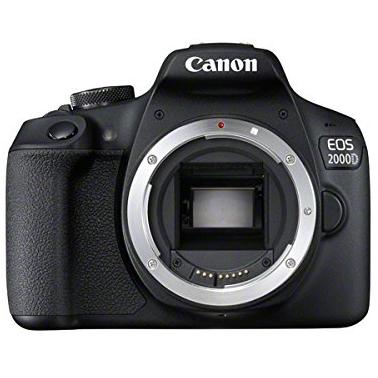
Canon EOS 2000D Digital SLR Camera Body 2728C004


Sponsored This site contains affiliate links for which we may receive compensation. More information

Sponsored Canon EOS 2000D / Rebel T7 Digital SLR Camera Body 24.1MP Wi-Fi-WHITE BOX
199.95 USD
Price updated on: 31-08-2026 10:05:10 Refurbished Product
199.95 USD
Price updated on: 31-08-2026 10:05:10 Refurbished Product  6 Ave Electronics
Sponsored Canon EOS 2000D DSLR Camera Body (International Model)
320.49 USD
Price updated on: 10-02-2026 00:11:57
320.49 USD
Price updated on: 10-02-2026 00:11:57 | Identifiers | |
|---|---|
| Model | Canon 2000D |
| MPN | Canon 2000D |
| Dimensions / Weight | |
| Key Features | |
|
Auto exposure AE lock Indicates whether the camera’s auto‑exposure system is locked, preventing automatic adjustments of exposure settings during shooting.
|
Yes |
|
Auto focusing AF modes A list of the available autofocus modes that a camera or imaging device can use, such as continuous autofocus, single-shot autofocus, face detection, tracking autofocus, contrast‑detection autofocus, servo‑autofocus, AI focus, and other manufacturer‑specific combinations. Each mode is represented by a free‑text string.
|
Contrast Detection Auto Focus, One Shot Focus |
|
Battery technology The chemical composition or classification of a battery, such as lithium‑ion, lithium‑polymer, nickel‑metal hydride, sealed lead acid, alkaline, zinc‑air, etc. It indicates the type of electrochemical reaction that stores and delivers energy in the device.
|
Lithium-Ion (Li-Ion) |
|
Camera file system A list of the image and metadata file formats that a camera can capture or store, such as DPOF, Exif, RAW, MPF, or DCF. Each entry represents a distinct format supported by the device, allowing users to understand what types of files they will receive when using the camera.
|
RAW |
|
Camera playback The types of media playback that the camera can handle, such as movies, single images, slide shows, or thumbnails. Each value represents a distinct mode in which captured content can be viewed directly on the device.
|
Movie |
| Camera shutter type | Electronic |
|
Camera type The general classification of a camera, such as compact, single‑lens reflex (SLR), mirrorless interchangeable lens camera (MILC), bridge, or video camera. It indicates the form factor and primary use case of the device.
|
SLR Camera Body |
|
Colour The colour or combination of colours that a product is available in, expressed as common names such as "Black", "Silver" or comma‑separated lists like "Black, White". It indicates the visual appearance of the item for consumers.
|
Black |
|
Compatible memory cards List of the memory card types that a device can read or write, such as MicroSD (TransFlash), SD, MMC, CompactFlash, and others. Each value represents a format that the device’s slot or reader supports for storage expansion.
|
SD,SDHC,SDXC |
| Display | TFT |
| Display diagonal | 3.0" |
|
Flash exposure correction The adjustment applied to a camera’s sensor exposure to compensate for lighting conditions, expressed in Exposure Value (EV) units. Positive values increase brightness, negative values decrease it, and the step size indicates how finely the adjustment can be tuned.
|
2 EV ( |
|
Focus Specifies the focusing behavior of a camera or imaging device, indicating whether it uses automatic focus, manual focus, or a combination such as auto‑manual. The value is expressed as a free‑text string that describes the mode in use.
|
TTL |
|
Focus adjustment Specifies whether the camera’s focusing system operates automatically or requires manual adjustment. Common values include "Auto", "Manual", and combinations such as "Auto/Manual".
|
Auto/Manual |
|
Harmonized System HS code The Harmonized System (HS) code is a standardized numerical identifier used internationally to classify traded goods. It consists of up to six digits, where each pair of digits represents progressively more specific product categories. The HS code facilitates customs duties, trade statistics, and regulatory compliance by providing a common language for describing products across borders.
|
85258900 |
|
HD type The pixel dimensions of a product’s screen, expressed as width by height (e.g., 1920x1080). It indicates the total number of pixels that compose the display and is used to assess image sharpness and clarity across devices such as monitors, TVs, laptops, and cameras.
|
1920x1080 |
| HDMI connector type | Mini |
|
Image formats supported A list of the file extensions and codecs that a product can read, display, or record. Each value represents a valid format such as JPG, PNG, BMP, GIF, HEIF, WebP, RAW, etc., and may include both the extension and the associated codec name.
|
JPEG |
|
Image stabilizer location The physical location of the image stabilization system within a camera or imaging device, such as on the lens assembly or in the camera body. This indicates where the stabilization mechanism is mounted and helps users understand whether the feature is integrated into the lens, the sensor module, or the main chassis.
|
Lens |
|
ISO Sensitivity The ISO sensitivity setting of a camera, indicating the sensor’s sensitivity to light. Values are typically numeric (e.g., 100, 200, 400) and may include an "Auto" option where the camera selects the appropriate ISO automatically.
|
6400 |
|
Lens mount interface List of lens mount interfaces supported by a camera or lens, such as Canon EF, Nikon F, Sony E‑mount, Micro Four Thirds, etc. The value can be a single interface name or a comma‑separated list of multiple compatible mounts.
|
Canon EF,Canon EF-S |
|
Light exposure modes The set of camera settings that determine how the sensor is exposed to light. Common values include Auto, Aperture priority, Shutter priority, Manual and combinations thereof. Each value represents a selectable mode that controls shutter speed, aperture, ISO or a combination of these parameters.
|
Aperture priority AE, Manual, Shutter priority AE |
|
Light metering The method used by a camera to determine the appropriate exposure settings based on the scene’s lighting conditions. Common modes include Centre‑weighted, Spot, Evaluative (Multi‑pattern), and Highlight‑weighted. The value is typically a single mode or a comma‑separated list of modes that can be applied simultaneously.
|
Centre-weighted |
|
Magnification The optical magnification factor of a device such as a camera lens, binoculars or telescope. It indicates how many times larger an object appears compared to its actual size when viewed through the product. Values are expressed as a multiplier (e.g., 2x, 10x).
|
0.8 x |
|
Maximum image resolution The highest pixel dimensions of an image or display that a product can output, capture, or support, expressed as width by height (e.g., 1920x1080). It indicates the maximum resolution available for visual content on the device.
|
6000x4000 |
|
Photo effects A list of photographic effects that can be applied to images, such as black‑and‑white, sepia, vivid, or other stylistic filters. Each value represents a distinct effect that may be available in the product’s software or hardware.
|
Black&White, Neutral |
|
Resolución The number of megapixels captured by a camera’s sensor, expressed as a single numeric value (e.g., 12.3 MP). This metric indicates the overall detail and clarity that the camera can record in still images or video frames.
|
24.7 MP |
|
Scene modes A set of predefined camera settings that automatically adjust exposure, white balance, focus and other parameters to suit specific shooting situations such as portrait, landscape, night or sports. Each value represents a selectable mode that the user can choose from when capturing images.
|
Close-up (macro), Food, Landscape, Night portrait, Portrait, Sports |
|
Sensor format Indicates the type of image sensor used in a camera or imaging device, such as APS‑C, DX, Full‑frame, etc. The value describes the physical size and format of the sensor that determines resolution, field of view and other optical characteristics.
|
Advanced Photo System type-C (APS-C) |
|
Shooting modes A set of selectable camera settings that determine how the sensor is exposed to light and other shooting parameters. Each value represents a mode such as Auto, Aperture priority, Shutter priority, Manual or combinations thereof, controlling shutter speed, aperture, ISO and other exposure parameters.
|
Aperture priority, Program, Scene, Shutter priority |
|
Supported aspect ratios The proportion between the width and height of a product’s display or image, expressed as two numbers separated by a colon (e.g., 16:9). It indicates whether the content is designed for widescreen, square, or other aspect ratios.
|
3:2 |
|
Video resolutions The pixel dimensions of a video image, expressed as width by height (e.g., 1920x1080). It indicates the resolution that a device can display or record.
|
640x4801 |
|
Viewfinder type The type of viewfinder used in a camera or similar device, such as optical, electronic, hybrid, pentaprism, or pentamirror. It indicates how the photographer sees through the camera and can affect image quality, field of view, and usability.
|
Optical |
|
White balance The set of white‑balance settings available for a camera or imaging device. Each mode adjusts the color temperature and tint to compensate for different lighting conditions (e.g., Auto, Cloudy, Daylight, Flash, Tungsten). The attribute may contain a single value or a list of selectable modes.
|
Auto, Cloudy, Daylight, Flash, Fluorescent, Shade, Tungsten |
|
Wi-Fi standards A list of the wireless networking protocols and frequency bands that a device can connect to, such as 802.11a, 802.11b, 802.11g, Wi‑Fi 4 (802.11n), Wi‑Fi 5 (802.11ac) or Wi‑Fi 6 (802.11ax). The values are typically separated by commas and may include both the technical name and a consumer‑friendly label.
|
802.11g,Wi-Fi 4 (802.11n) |

Canon is a Japanese multinational corporation that specializes in the manufacture of imaging and optical products, including cameras, camcorders, photocopiers, steppers, and medical equipment. It has a wide range of products for both personal and business use, and is one of the leading brands in the digital camera market.


