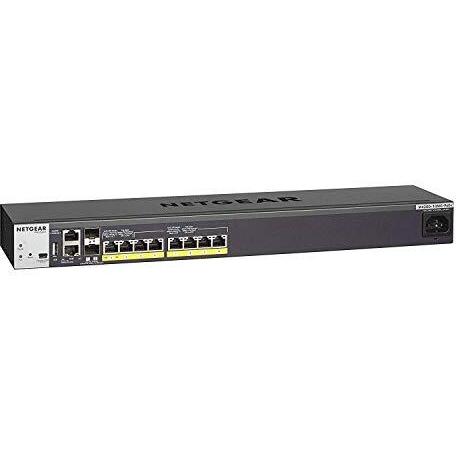
NETGEAR 10-Port Multi-Gigabit Ethernet Fully Managed PoE Switch (GSM4210P)


Sponsored This site contains affiliate links for which we may receive compensation. More information
 connectixcablingsystems.com
Netgear M4200-10MG-PoE+
999999.99 USD
Price updated on: 24-08-2025 08:30:43
999999.99 USD
Price updated on: 24-08-2025 08:30:43 Find other available options:

| Identifiers | |
|---|---|
| Model | NETGEAR GSM4210P-100NES |
| MPN | NETGEAR GSM4210P-100NES |
| Dimensions / Weight | |
| Key Features | |
|
10g support Indicates whether the product supports 10 Gigabit Ethernet (10 GbE) connectivity, either through dedicated 10 GbE ports or via SFP+ modules that enable 10 GbE operation.
|
Yes |
|
AC adapter included Indicates whether the product comes with an AC power adapter included in the package. A value of "Yes" means a charger is supplied, while "No" indicates that no charger is provided and the user must obtain one separately.
|
Yes |
|
AC input frequency The frequency of the alternating current supplied to the device, expressed in hertz (Hz). It indicates the acceptable operating range for the electrical mains that powers the product.
|
50 - 60 Hz |
|
AC input voltage The alternating current voltage range that the product accepts from its power source, expressed in volts (V). It indicates the minimum and maximum supply voltages compatible with the device.
|
100 - 240 V |
|
ARP inspection Indicates whether the product includes an ARP inspection feature, allowing the device to monitor and filter Address Resolution Protocol traffic for security or performance purposes.
|
Yes |
|
Basic switching RJ-45 Ethernet ports quantity Indicates the total count of physical RJ‑45 Ethernet connectors available on a device for wired network connectivity. The value is an integer representing how many separate ports can be used to connect Ethernet cables.
|
8 |
|
Cable types supported A list of the cable categories or standards that a product can use, such as Cat5e, Cat6, Cat6a, Cat7, Fiber, HDMI, USB, etc. The values are separated by commas and represent the types of cables compatible with the device.
|
Cat5e,Cat6e |
|
Cables included A list of the cable types that are supplied with the product, such as USB, HDMI, VGA, DisplayPort, LAN (RJ‑45), SATA, audio or other relevant connectors.
|
AC,LAN (RJ-45),Mini-USB,SFP+,USB |
|
Console port Represents how many console ports are physically present on the product. The value is a simple integer indicating the total count of console connectors, regardless of type or version.
|
USB |
|
DHCP features A comma‑separated list of the DHCP roles and options that a device can provide or use, such as server, client, relay, snooping, option 82 support, and IPv6 variants. The value may contain multiple items for a single product.
|
DHCP server,DHCP client |
|
Flash memory The total amount of internal flash memory available in a device, expressed as a data size (e.g., megabytes or gigabytes). This attribute indicates how much data can be stored on the device’s built‑in flash storage.
|
256 MB |
|
Flow control support Indicates whether a device includes hardware or firmware that can manage the flow of data on its interfaces, such as enabling or disabling automatic pause frames, handling congestion, or providing other traffic‑control mechanisms. A value of "Yes" means the feature is present and can be configured; "No" indicates it is not available.
|
Yes |
|
Form Factor Specifies the physical configuration or design of a product, such as ATX, Micro‑ATX, Mini‑ITX, tower, case with cover, etc. It describes how the device is built and what mounting or expansion options it supports.
|
1U |
| IGMP snooping | Yes |
|
Internal memory The total amount of internal memory available in a device, expressed as a data size such as megabytes (MB) or gigabytes (GB). It indicates how much information the component can hold for active processes and affects multitasking performance.
|
1000 MB |
|
IP routing Indicates whether the product can perform IP routing, forwarding packets between networks based on destination addresses.
|
Yes |
|
LED indicators A list of the functions or statuses that an LED indicator on a device can display, such as power status, activity, link, and other operational signals.
|
Fan fail,Power |
|
Link aggregation Indicates whether the device can combine multiple network connections into a single logical link to increase bandwidth or provide redundancy.
|
Yes |
|
MAC address table The total count of unique MAC addresses that the device can store in its forwarding table. This value indicates how many devices can be simultaneously connected before the switch must start discarding or aging out older entries.
|
16000 entries |
|
Manual Indicates whether a user manual—physical or digital—is provided with the product. A value of "Yes" means that a manual is included, while a value of "No" indicates that no manual is supplied.
|
Yes |
|
Memory type The classification of a device’s memory technology, such as DDR4 SDRAM, GDDR6, or MLC NAND. It indicates the underlying architecture and generation that determines performance characteristics like bandwidth, latency, and power consumption.
|
RAM |
|
Mounting brackets included Indicates whether the product comes with mounting brackets as part of its standard package. A value of "Yes" means that one or more brackets are supplied to facilitate installation, while a value of "No" indicates that no brackets are included and must be purchased separately.
|
Yes |
|
Multicast support Indicates whether the device can send or receive IP multicast traffic, allowing it to participate in group communications such as streaming media, IPTV, and certain network protocols that rely on multicast distribution.
|
Yes |
|
Networking standards A list of the networking protocols and standards that a device can support or comply with, such as IEEE 802.11 variants for wireless, IEEE 802.3 for Ethernet, or other relevant networking specifications. The values are typically separated by commas and may include both technical identifiers and consumer‑friendly labels.
|
IEEE 802.3az |
|
Noise level The sound intensity produced by a product, expressed in decibels (dB) or sones. It indicates how loud the device is during operation and helps users assess suitability for quiet environments.
|
28.9 dB |
|
Packet buffer memory The amount of temporary storage that a device allocates in its internal memory for buffering data before processing or forwarding it. Expressed as a digital capacity (e.g., kilobytes, megabytes), this value indicates how much information the hardware can hold at once and influences performance when handling high‑throughput or bursty traffic.
|
16 MB |
|
Port mirroring Indicates whether the device supports port mirroring, a feature that allows one or more ports to copy traffic from another port for monitoring or analysis purposes.
|
Yes |
|
Processor frequency The fundamental operating frequency of a processor, expressed in hertz (Hz). It indicates the speed at which the CPU runs under normal conditions and is typically reported in gigahertz (GHz) or megahertz (MHz). This value helps users compare performance potential across different models.
|
800 MHz |
|
Rack mounting Indicates whether a product is designed to be mounted in a rack system. The value can be "Yes" or "No", or it may specify the height occupied by the device using rack units (U) such as "1U", "2U", or a numeric measurement with unit, e.g., "61.25 mm".
|
Yes |
|
SFP+ module slots quantity The total count of Small Form‑factor Pluggable (SFP+) ports available on a networking device, such as switches or routers. Each port can accept an SFP+ transceiver module for fiber or copper connections. The value is a whole integer indicating how many separate SFP+ interfaces the product provides.
|
2 |
|
Spanning Tree Protocol Indicates whether the device implements the Spanning Tree Protocol (STP), a network protocol that prevents loops in Ethernet topologies by dynamically blocking and forwarding paths to maintain a loop‑free logical topology.
|
Yes |
|
Switch layer The network layer(s) that a device can operate at, expressed as a string such as "L2", "L3" or combinations like "L2/L3". This attribute indicates the protocol stack level supported by the hardware or firmware.
|
L2/L3 |
|
Switch type The classification of a network switch based on its management capabilities, such as Managed or Unmanaged. This attribute indicates whether the device can be configured and monitored remotely (Managed) or operates with fixed settings without remote configuration (Unmanaged). It helps users choose a switch that matches their networking expertise and control requirements.
|
Managed |
|
Switching capacity The maximum data transfer rate that the device can handle, expressed as a numeric value with an appropriate unit such as Gbit/s or Mbit/s. This attribute indicates how quickly data can be transmitted through the device and helps users compare networking performance across products.
|
90 Gbit/s |
|
Throughput The maximum rate at which a device can process or transmit data, expressed in megabits per second (Mpps). It indicates the capacity of network equipment such as switches, routers, or hubs to handle traffic without bottlenecks.
|
66.9 Mpps |
|
User guide The mass of the product expressed in a standard unit such as grams or kilograms. It represents how heavy the item is and can be used for shipping, handling, or user information purposes.
|
Yes |
|
VLAN support Indicates whether the device can configure and manage Virtual LANs (VLANs) for network segmentation and traffic isolation. A value of "Yes" means the product supports VLAN tagging, creation, and management; a value of "No" indicates it does not provide this capability.
|
Yes |

NETGEAR is a brand of networking equipment, including routers, switches and wireless access points. The company was founded in 1996 and is headquartered in San Jose, California.


