VA2418-SH Viewsonic Value Series VA2418-SH LED display 60.5 cm (23.8") 1920 x 10




Sponsored This site contains affiliate links for which we may receive compensation. More information
Find other available options:

| Identifiers | |
|---|---|
| MPN | Viewsonic VA2418-SH |
| Dimensions / Weight | |
| Key Features | |
|
AC input frequency The frequency of the alternating current supplied to the device, expressed in hertz (Hz). It indicates the acceptable operating range for the electrical mains that powers the product.
|
50/60 Hz |
|
AC input voltage The alternating current voltage range that the product accepts from its power source, expressed in volts (V). It indicates the minimum and maximum supply voltages compatible with the device.
|
100 - 240 V |
|
AMD FreeSync Indicates whether a monitor or graphics card supports AMD’s Adaptive Sync technology, FreeSync. A value of "Yes" means the device is compatible; "No" means it does not support the feature.
|
Yes |
|
Audio input Indicates how many separate audio input connections are available on the product. Each port can accept a microphone, line‑level signal or other audio source and is typically identified by its connector type (e.g., 3.5 mm jack, XLR). The value is an integer that represents the total count of distinct input ports.
|
No |
|
Built-in camera Indicates whether the product includes a built‑in camera that can capture images or video directly, without requiring an external device. A value of "Yes" means the device has such a camera; "No" means it does not.
|
No |
| Built-in USB Hub | No |
|
Cable lock slot Indicates whether the product includes a slot for inserting a cable lock, such as a Kensington or similar security device.
|
Yes |
|
Cable lock slot type The specific type of cable lock interface that a device provides for securing cables, such as Kensington, Noble, IBM or other standard locking mechanisms.
|
Kensington |
|
Cables included A list of the cable types that are supplied with the product, such as USB, HDMI, VGA, DisplayPort, LAN (RJ‑45), SATA, audio or other relevant connectors.
|
AC, VGA |
|
Colour depth The number of bits used to represent each pixel’s colour on a display or image, indicating how many distinct colours can be shown. A higher bit count allows smoother gradients and more accurate colour reproduction.
|
8 bit |
|
Compatible operating systems List of operating systems that the product can run or support, including specific versions and architectures when relevant. Each value represents a distinct OS that is compatible with the hardware or software.
|
Windows 10, macOS |
|
Country of origin The nation in which the product was assembled or produced. This attribute indicates the primary geographic source of manufacturing for the item.
|
China |
|
Detachable stand Indicates whether a product includes a detachable stand that can be removed or attached as needed. The value is expressed as a simple yes/no text, such as "Yes" or "No", and applies to items where a stand may be optional or removable, including monitors, furniture, appliances, and other equipment.
|
Yes |
|
Digital horizontal frequency The horizontal digital frequency indicates the range of frequencies, expressed in kilohertz (kHz), over which a device can process or transmit horizontal digital signals. It is represented as a minimum–maximum interval and helps users understand the signal bandwidth supported by the product.
|
24 - 86 kHz |
|
Digital vertical frequency The range of frequencies, in hertz (Hz), at which a display device can refresh its image vertically when operating in digital mode. It indicates the minimum and maximum vertical scan rates supported, helping users assess visual smoothness and compatibility with various content sources.
|
48 - 75 Hz |
| Display Diagonal | 60.5 cm (23.8") |
|
Display number of colours The total count of distinct colours that a product’s display can reproduce. This value indicates the colour depth or gamut capability of the screen, helping users compare visual fidelity across devices.
|
16.7 million colours |
|
Display resolution The pixel dimensions of a display or image, expressed as width by height (e.g., 1920x1080). It indicates how many pixels are used to render visual content and is commonly used for monitors, TVs, smartphones, cameras, and digital images.
|
1920 x 1080 pixels |
|
Display surface The visual appearance or texture of a product’s display surface, such as matte, glossy, or satin. It indicates how light reflects off the screen and can affect glare, visibility, and aesthetic preference for users.
|
Matt |
|
Display technology The type of display panel used in a visual device, such as LED‑backlit LCD, IPS, TN, VA, OLED, or AMOLED. It indicates the underlying technology that determines image quality, color accuracy, viewing angles, response time and power consumption.
|
LED |
|
DVI port Indicates how many DVI connectors are present on the product. The value is a simple integer representing the total count of DVI ports, regardless of type or version.
|
No |
|
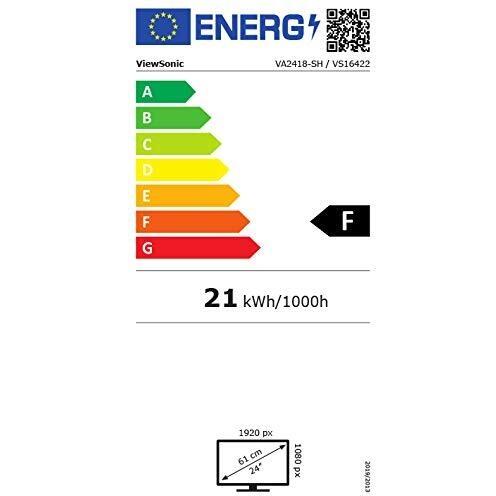
Energy consumption (SDR) per 1000 hours The total amount of electrical energy a product consumes during 1,000 operating hours, expressed in kilowatt‑hours (kWh). This metric allows comparison of energy efficiency across devices regardless of their typical usage patterns.
|
21 kWh |
|
Energy efficiency class (SDR) The energy efficiency class indicates the relative performance of a product, expressed with letters ranging from A+++ (most efficient) to G (least efficient). It allows consumers to compare expected operating costs and environmental impact across similar items.
|
F |
|
Feet colour The colour or combination of colours that the feet of a product are available in, expressed as common names such as "Black", "Silver" or comma‑separated lists like "Black, White". It indicates the visual appearance of the feet for consumers.
|
Black |
|
Flicker-free technology Indicates whether the product incorporates a flicker‑free display technology that eliminates or reduces screen flickering, improving visual comfort and reducing eye strain.
|
Yes |
|
HD type The pixel dimensions of a screen’s display expressed as width by height (e.g., 1920×1080). It indicates the number of pixels that can be shown on the monitor or device, affecting image sharpness and clarity.
|
Full HD |
|
HDCP Indicates whether a device supports HDCP (High‑bandwidth Digital Content Protection), allowing it to play or display protected digital content on compatible screens and audio/video equipment.
|
Yes |
|
HDMI A list of the HDMI ports available on the product, each entry indicating the number of ports and their specific HDMI version or additional features (e.g., "2 x HDMI 2.0b", "1 x HDMI 1.4 with CEC"). This attribute helps users understand both the quantity and capabilities of the HDMI connections.
|
Yes |
| HDMI ports quantity | 1 |
|
HDMI version The specific version of the HDMI standard that a product supports, such as "2.0", "2.1" or "1.4b". This value indicates the capabilities and compatibility of the HDMI interfaces on the device.
|
1.4 |
|
Headphone connectivity Indicates the types of headphone or earphone connections available on a product, such as wired jacks (e.g., 3.5 mm), USB‑C, Lightning, or wireless Bluetooth. The value may list one or more connection types separated by commas.
|
3.5 mm |
|
Headphone out Indicates whether the product has a dedicated headphone output for connecting headphones or earphones. The value may be "Yes" or "No", or it can specify the type of connector such as "3.5 mm jack", "USB‑C", or other descriptive terms.
|
Yes |
|
Low blue light technology Indicates whether the display incorporates a low‑blue‑light feature that reduces eye strain by limiting blue light emission during use.
|
Yes |
|
Maximum refresh rate The highest number of times per second that a display can update its image, expressed in hertz (Hz). It indicates the maximum refresh capability of the device and is useful for comparing visual performance across monitors, TVs, laptops, and other screen‑based products.
|
75 Hz |
|
Native aspect ratio The proportion between the width and height of a screen or image, expressed as two numbers separated by a colon (e.g., 16:9). It indicates whether content is designed for widescreen, square, or other aspect ratios and helps users match devices to their media formats.
|
16:9 |
|
NTSC coverage (typical) The percentage of the National Television System Committee (NTSC) color spectrum that a display or video device can reproduce, relative to the full NTSC standard. Values close to 100 % indicate that the product can render almost all colors defined by NTSC, providing accurate and vibrant visual output.
|
72% |
|
Number of OSD languages The total number of distinct languages that can be displayed on the screen‑on‑display (OSD) interface of a device, such as a monitor or TV. It indicates how many language options are available for menu navigation, subtitles, and other on‑screen text, allowing users to choose their preferred language when interacting with the product.
|
12 |
|
Package depth The linear measurement from front to back or top to bottom of a product’s packaging, expressed in a physical unit such as millimeters, centimeters, inches, etc. It indicates how deep the packaged item is and can be used for fitting, compatibility, or spatial planning.
|
119 mm |
|
Package Height The vertical dimension of a product’s packaging measured from its lowest to highest point. It is expressed in a physical unit such as millimetres, centimetres or inches and helps customers assess how tall the package will be when stored or shipped.
|
615 mm |
|
Package type The form of packaging used for a product, such as box, blister pack, bag, or pallet. It indicates how the item is contained and protected during shipping and storage.
|
Box |
|
Package weight The mass of the product’s packaging expressed in a standard unit such as grams or kilograms. It indicates how heavy the package is and can be used for shipping calculations, handling instructions, or consumer information.
|
4.6 kg |
|
Package width The horizontal measurement of a product’s packaging, expressed in a linear unit such as millimetres or inches. It indicates how wide the package is from one side to the other and helps customers assess fit for storage, shipping, or display.
|
398 mm |
|
Panel mounting interface The pair of horizontal and vertical dimensions in millimetres that a product supports for VESA mounting (e.g., "100 × 100 mm"). This value indicates the exact hole spacing required by a mounting bracket to secure the device. It is used for monitors, TVs, projectors and other display equipment that can be wall‑mounted or attached to stands.
|
100 x 100 mm |
|
Panel type The underlying display panel technology used in a visual device, such as IPS, TN, VA, OLED, AMOLED, or other variants. It indicates the type of liquid crystal arrangement or organic light‑emitting structure that determines image quality, color accuracy, viewing angles and power consumption.
|
IPS |
|
Pixel pitch Represents the physical size of a single pixel on a display, expressed as width and height in a length unit (e.g., millimeters). This attribute allows comparison of the physical resolution of screens or imaging devices that use metric units to describe the smallest visible point.
|
0.272 x 0.272 mm |
| Power consumption (off) | 0.3 W |
|
Quick start guide Indicates whether a quick‑start guide is provided with the product. A value of "Yes" means that a brief, introductory manual or overview is included to help users get started quickly; "No" indicates that no such guide is supplied.
|
Yes |
|
Response time The time interval between a stimulus and the corresponding response of a device or system, expressed in units such as milliseconds (ms). It indicates how quickly the product reacts to input or processes data, which is critical for performance-sensitive applications like displays, gaming monitors, and interactive devices.
|
5 ms |
| Screen shape | Flat |
|
Stand included Indicates whether a product comes with an attached stand or base included in the package. A value of "Yes" means the stand is supplied, while "No" indicates that no stand is provided and the user must obtain one separately.
|
Yes |
|
Tilt angle range The range of angles, expressed in degrees, that a product can be tilted or adjusted vertically while maintaining acceptable performance or usability. It indicates the minimum and maximum tilt limits for devices such as monitors, stands, or other adjustable equipment.
|
-5 - 22° |
|
Tiltable Indicates whether the product can be tilted or adjusted in angle to improve viewing comfort or ergonomics.
|
Yes |
|
VESA Adaptive Sync support Indicates whether a display or monitor supports adaptive sync technology, which synchronizes the refresh rate of the screen with the graphics card to reduce tearing and stuttering during video playback or gaming.
|
Yes |
|
VESA mounting Indicates whether a product supports the VESA mounting standard, which defines the size and placement of mounting holes on displays or monitors. The value can be "Yes" or "No", or it may specify one or more VESA patterns such as "100 × 100 mm" to indicate the exact dimensions supported.
|
Yes |

Viewsonic is a brand of computer monitors, projectors, and other electronics. It was founded in 1987 and is now a subsidiary of TPV Technology.