ViewSonic VX3211-4K-mhd (32 inch) LCD Entertainment Monitor






Sponsored This site contains affiliate links for which we may receive compensation. More information
 Adorama.com
Sponsored ViewSonic VX3211-4K-MHD 32" 16:9 4K Ultra HD VA LED HDR Monitor
289.99 USD
Price updated on: 04-09-2025 00:59:54
289.99 USD
Price updated on: 04-09-2025 00:59:54 | Identifiers | |
|---|---|
| Model | Viewsonic VX3211-4K-MHD |
| MPN | Viewsonic VX3211-4K-MHD |
| Dimensions / Weight | |
| Key Features | |
|
AC input voltage The range of alternating current voltage that the product accepts from its power source, expressed in volts (V). It indicates the minimum and maximum supply voltages compatible with the device across different regions.
|
100 |
|
Cables included A list of the cable types that are supplied with the product, such as USB, HDMI, VGA, DisplayPort, LAN (RJ‑45), SATA, audio or other relevant connectors.
|
AC, HDMI |
|
Case colour The colour or combination of colours that a product’s outer shell or enclosure is available in, expressed as common names such as "Black", "Silver" or comma‑separated lists like "Black, White". It indicates the visual appearance of the case for consumers.
|
Black |
|
Depth without stand The linear measurement of an object from front to back or top to bottom, expressed in a physical unit such as millimeters, centimeters, inches, etc. It indicates how deep the item is and can be used for fitting, compatibility, or spatial planning.
|
6.4 cm |
|
Detachable stand Indicates whether a product includes a detachable stand that can be removed or attached as needed. The value is expressed as a simple yes/no text, such as "Yes" or "No", and applies to items where a stand may be optional or removable, including monitors, furniture, appliances, and other equipment.
|
Yes |
|
Display brightness typical The average luminance emitted by a display under normal viewing conditions, expressed in candela per square meter (cd/m²). It indicates how bright the screen will appear to users and is useful for comparing monitors, TVs, laptops and other visual devices.
|
300 cd/m² |
| Display diagonal | 80.01 cm |
|
Display resolution The pixel dimensions of a display or image, expressed as width by height (e.g., 1920x1080). It indicates how many pixels are used to render visual content and is commonly used for monitors, TVs, smartphones, cameras, and digital images.
|
3840x2160 |
|
Display technology The type of display panel used in a visual device, such as LED‑backlit LCD, IPS, TN, VA, OLED, or AMOLED. It indicates the underlying technology that determines image quality, color accuracy, viewing angles, response time and power consumption.
|
LED |
|
DisplayPort In The total count of physical DisplayPort input connectors available on the product. This value indicates how many separate DisplayPort interfaces can receive video and audio signals, allowing multiple external displays or devices to be connected simultaneously.
|
1 x DisplayPort |
|
Dynamic contrast ratio The dynamic contrast ratio is the proportion between the maximum and minimum luminance a display can produce while operating under normal conditions, expressed as a simple fraction such as 1200:1. It reflects how well a screen can differentiate light from dark areas during typical use, influencing perceived image quality.
|
000:1 |
|
Dynamic contrast ratio marketing name The dynamic contrast ratio is the proportion between the maximum and minimum luminance a display can produce while operating under normal conditions, expressed as a simple fraction such as 1200:1. It reflects how well a screen can differentiate light from dark areas during typical use, influencing perceived image quality.
|
Mega Contrast |
|
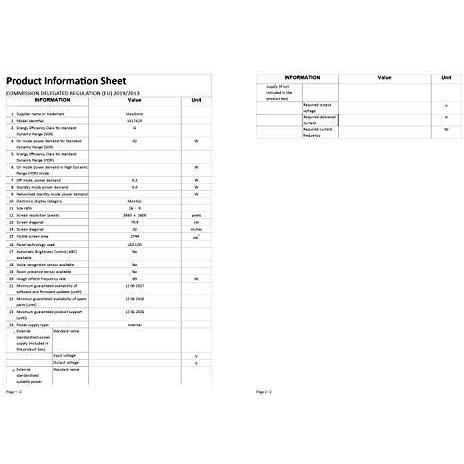
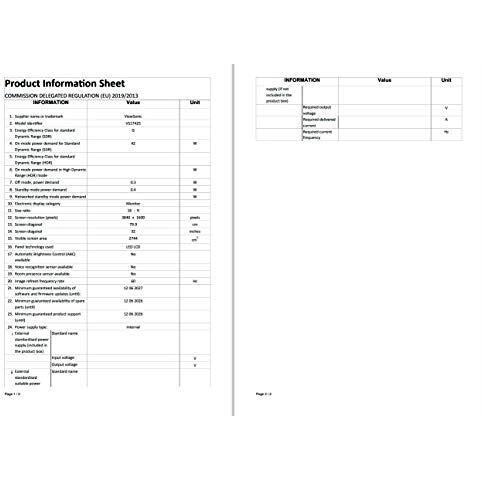
Energy consumption (SDR) per 1000 hours The total amount of electrical energy a product consumes during 1,000 operating hours, expressed in kilowatt‑hours (kWh). This metric allows comparison of energy efficiency across devices regardless of their typical usage patterns.
|
42 kWh |
|
Energy efficiency class (SDR) The energy efficiency class indicates the relative performance of a product, expressed with letters ranging from A+++ (most efficient) to G (least efficient). It allows consumers to compare expected operating costs and environmental impact across similar items.
|
G |
|
Energy efficiency scale The energy efficiency scale indicates the relative performance of a product, expressed with letters ranging from A+++ (most efficient) to G (least efficient). It allows consumers to compare expected operating costs and environmental impact across similar items.
|
A to G |
|
Environmental The environmental conditions under which the product is designed to operate safely and reliably, expressed as a temperature range in degrees Celsius and a relative humidity range in percent. Values are typically formatted like "0 °C to 40 °C – 10 % to 90 %" or similar.
|
, Operating Temperature 0 to 40°C - Humidity 20 to 90% |
|
HD type The pixel dimensions of a product’s screen, expressed as width by height (e.g., 1920x1080). It indicates the total number of pixels that compose the display and is used to assess image sharpness and clarity across devices such as monitors, TVs, laptops, and cameras.
|
4096x2160 |
| HDMI ports | 2 x HDMI |
|
Headphone connectivity Indicates the types of headphone or earphone connections available on a product, such as wired jacks (e.g., 3.5 mm), USB‑C, Lightning, or wireless Bluetooth. The value may list one or more connection types separated by commas.
|
3.5 mm |
|
High Dynamic Range (HDR) technology The level of contrast and color detail that a display or image can reproduce, indicating the ability to show darker shadows and brighter highlights with greater fidelity. It is typically expressed as a standard name such as HDR10, Dolby Vision, or DisplayHDR 400, and helps consumers compare visual performance across devices.
|
High Dynamic Range 10 (HDR10) |
|
Market positioning A classification that indicates the target audience or use case for a product, such as Business, Gaming, Home & Office, Education, etc. It helps customers quickly identify which products are best suited to their needs.
|
Home |
|
Native aspect ratio The proportion between the width and height of a screen or image, expressed as two numbers separated by a colon (e.g., 16:9). It indicates whether content is designed for widescreen, square, or other aspect ratios and helps users match devices to their media formats.
|
16:9 |
|
NTSC coverage (typical) The percentage of the National Television System Committee (NTSC) color spectrum that a display or video device can reproduce, relative to the full NTSC standard. Values close to 100 % indicate that the product can render almost all colors defined by NTSC, providing accurate and vibrant visual output.
|
95% |
|
Operating relative humidity The range of relative humidity (in percentage) within which the product is designed to operate reliably. Values are expressed as a minimum–maximum interval such as "20 - 80 %" and indicate the acceptable environmental moisture level for optimal performance.
|
20 - 90 % |
|
Panel mounting interface The pair of horizontal and vertical dimensions in millimetres that a product supports for VESA mounting (e.g., "100 × 100 mm"). This value indicates the exact hole spacing required by a mounting bracket to secure the device. It is used for monitors, TVs, projectors and other display equipment that can be wall‑mounted or attached to stands.
|
100x100 |
|
Panel type The specific technology used to construct the display panel, such as IPS, TN, VA, OLED, or LCD. It indicates how pixels are controlled and affects image quality, color accuracy, viewing angles, and power consumption.
|
VA |
| Power consumption | 50 W |
| RGB colour space | NTSC |
|
RMS rated power The root‑mean‑square (RMS) power rating of a device, expressed in watts (W). It represents the average electrical power that the product can deliver or consume under normal operating conditions.
|
5 W |
|
Screen Dimensions The overall size of a display, expressed as the diagonal measurement and optionally the width and height. The diagonal is given in inches or centimeters, while the width and height are provided in centimeters. This attribute helps users compare screen sizes and verify compatibility with mounting or viewing spaces.
|
32in (Diagonal) |
| Screen shape | Flat |
| Specification | No |
|
Tilt angle range The minimum and maximum angles, expressed in degrees, that a monitor can be tilted or adjusted vertically while maintaining acceptable performance or usability. It indicates the tilt limits for displays such as monitors, stands, or other adjustable equipment.
|
-5 - 13° |
|
View angle The maximum angular extent that a user can see across a display or screen, expressed as two values: the horizontal field of view in degrees followed by the vertical field of view in degrees. It indicates how far left‑to‑right and up‑to‑down one can look while maintaining acceptable visual quality.
|
178° (Horizontal - Max) x 178° (Vertical - Max) |
|
Viewable size horizontal The width of the display area that a user can see without distortion, measured in a physical unit such as centimeters or inches. It represents the actual horizontal span of the screen that is visible when looking straight at it.
|
69.8 cm |
|
Viewable size vertical The maximum vertical dimension of the visible area on a display screen, expressed as a linear measurement (e.g., centimeters or inches). It indicates how tall the portion of the screen that can be seen by a user is, which helps compare monitors and other visual devices.
|
39.3 cm |
|
Width without stand The horizontal measurement of a product excluding any attached stand or base, expressed in a linear unit such as millimetres or inches. It indicates how wide the item is from one side to the other and is used for sizing, fitting, and compatibility purposes.
|
73 cm |

Viewsonic is a brand of computer monitors, projectors, and other electronics. It was founded in 1987 and is now a subsidiary of TPV Technology.


