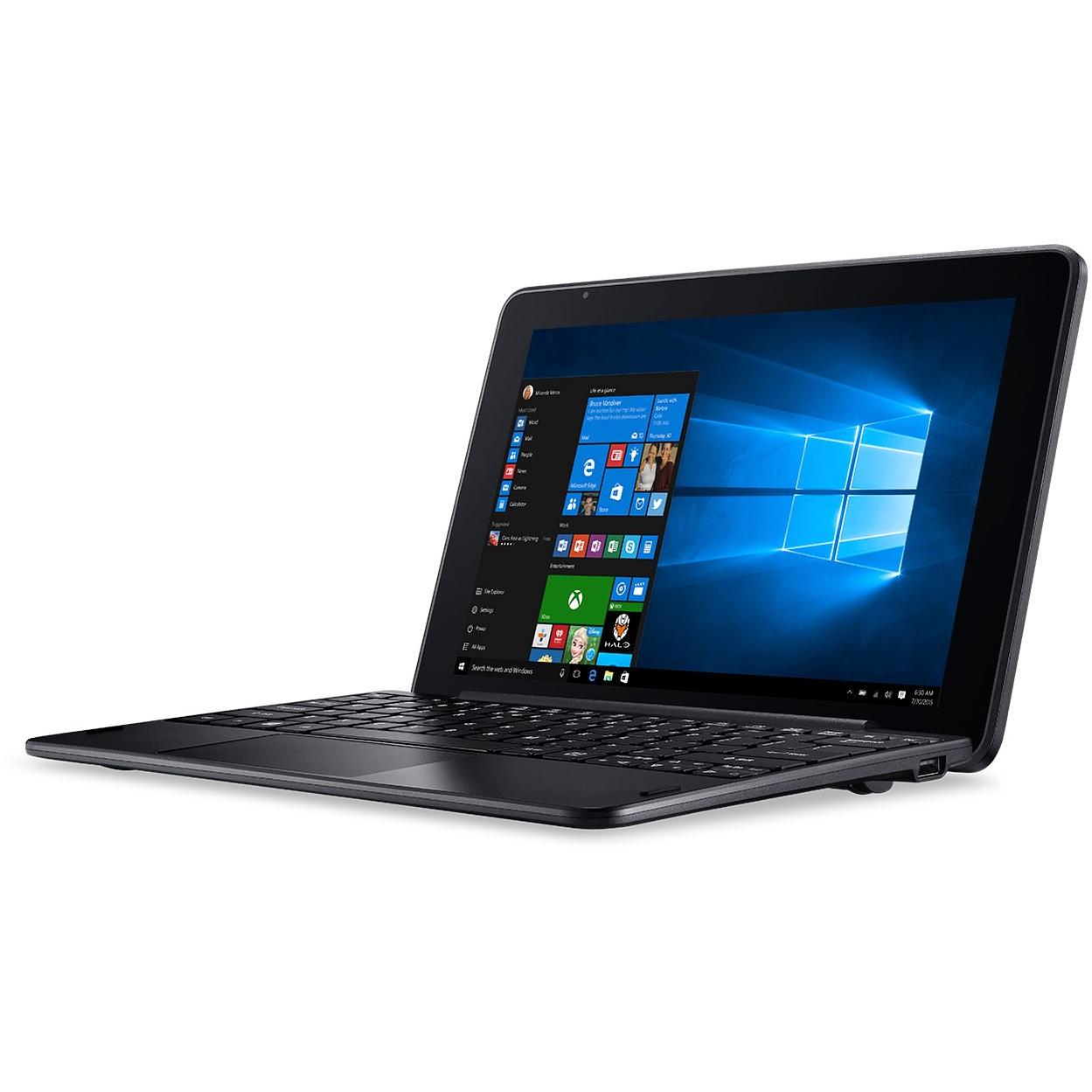
Acer One 10 S1003 Detachable Notebook - Multi-touch WXGA Display Version


Sponsored This site contains affiliate links for which we may receive compensation. More information

Find other available options:

| Identifiers | |
|---|---|
| Model | Acer NT.LCQEK.001 |
| MPN | Acer NT.LCQEK.001 |
| Dimensions / Weight | |
| Key Features | |
|
3D Indicates whether the product has built‑in support for 3‑dimensional (3D) content or displays. A value of "Yes" means the device can render or display 3D images, videos, or games; a value of "No" means it does not have native 3D capability.
|
No |
|
3G Indicates whether the product is capable of connecting to 3G mobile networks (UMTS). A value of "Yes" means the device includes a 3G radio and can use 3G data services; "No" indicates it does not support 3G connectivity.
|
No |
|
4G Indicates whether the product is capable of connecting to a 4G cellular network for data or voice services.
|
No |
|
AC adapter frequency The operating frequency of the alternating current supplied to an AC adapter, expressed in hertz (Hz). It indicates the mains frequency range that the charger can handle and ensures proper operation with the connected device.
|
50/60 Hz |
|
AC adapter included Indicates whether the product comes with an AC power adapter included in the package. A value of "Yes" means a charger is supplied, while "No" indicates that no charger is provided and the user must obtain one separately.
|
Yes |
| AC adapter power | 10 W |
|
Accelerometer Indicates whether the device is equipped with an accelerometer sensor, which measures acceleration forces along one or more axes.
|
Yes |
|
Aspect ratio The proportion between the width and height of a display, image or video, expressed as two numbers separated by a colon (e.g., 16:9). It indicates whether content is designed for widescreen, square, or other aspect ratios.
|
16:10 |
|
Battery capacity The total amount of electrical energy a battery can store, expressed as a numeric value with an appropriate unit such as mAh or Ah. It indicates how long the device can operate between charges and allows users to compare power supplies across products.
|
7920 mAh |
|
Battery cells The count of individual electrochemical cells that make up a battery pack. This number indicates how many separate cells are connected in series or parallel to provide the required voltage and capacity for the device.
|
2 |
|
Battery technology The chemical composition or classification of a battery, such as lithium‑ion, lithium‑polymer, nickel‑metal hydride, sealed lead acid, alkaline, zinc‑air, etc. It indicates the type of electrochemical reaction that stores and delivers energy in the device.
|
Lithium Polymer (LiPo) |
| Bluetooth | Yes |
|
Bluetooth version The specific version of the Bluetooth standard supported by a product, expressed as a numeric value (e.g., 4.2, 5.0) or with additional descriptors such as "+HS" or feature lists. This attribute indicates the capabilities and compatibility for wireless communication.
|
4 |
|
Built-in microphone Indicates whether the product includes at least one built‑in microphone. A value of "Yes" means that the device has an integrated microphone, while "No" indicates it does not.
|
Yes |
|
Cables included A list of the cable types that are supplied with the product, such as USB, HDMI, VGA, DisplayPort, LAN (RJ‑45), SATA, audio or other relevant connectors.
|
AC |
|
Card reader integrated Indicates whether the device includes a built‑in card reader that can read removable memory cards such as SD, microSD, MMC or similar formats.
|
Yes |
|
Charging port type The physical connector used to charge the device, such as USB Type‑C, DC‑in jack, Micro‑USB, or proprietary connectors. It indicates the type of port that supplies power to the product and helps users identify compatible chargers or accessories.
|
DC-in jack |
|
Colour The colour or combination of colours that a product is available in, expressed as common names such as "Black", "Silver" or comma‑separated lists like "Black, White". It indicates the visual appearance of the item for consumers.
|
Black |
|
Compatible memory cards List of the memory card types that a device can read or write, such as MicroSD (TransFlash), SD, MMC, CompactFlash, and others. Each value represents a format that the device’s slot or reader supports for storage expansion.
|
MicroSD (TransFlash),MicroSDHC |
|
Conflict free processor Indicates whether the processor in the device is certified as conflict‑free, meaning it has been tested and confirmed to operate without conflicts or incompatibilities with other system components. A value of "Yes" means the processor meets the conflict‑free standard; "No" indicates it does not.
|
Yes |
|
Depth The linear measurement of an object from front to back or top to bottom, expressed in a physical unit such as millimeters, centimeters, inches, etc. It indicates how deep the item is and can be used for fitting, compatibility, or spatial planning.
|
173.5 mm |
|
Discrete graphics adapter Indicates whether the product includes a dedicated graphics adapter (discrete GPU) separate from any integrated graphics. A value of "Yes" means a discrete GPU is present, while "No" indicates only integrated graphics are available.
|
No |
| Discrete graphics adapter model | Not available |
| Display diagonal | 10.1" |
|
Display Diagonal The measurement of a display’s diagonal, expressed in inches or centimeters. It represents the overall visual area available for content and is commonly used to compare monitors, televisions, laptops, tablets, and other electronic devices.
|
25.6 cm (10.1") |
|
Display resolution The pixel dimensions of a display or image, expressed as width by height (e.g., 1920x1080). It indicates how many pixels are used to render visual content and is commonly used for monitors, TVs, smartphones, cameras, and digital images.
|
1280x800 |
| Docking connector | Yes |
|
DVI port Indicates how many DVI connectors are present on the product. The value is a simple integer representing the total count of DVI ports, regardless of type or version.
|
No |
|
Embedded options available Indicates whether the product includes embedded options such as firmware features, hardware modules or configuration settings that are built into the device and available for use without external accessories.
|
No |
|
Ethernet LAN Indicates whether the product includes an Ethernet LAN interface for wired network connectivity, allowing data transmission over RJ‑45 or compatible cables.
|
No |
|
Execution units Represents the count of independent execution units within a processor or similar component. The value is an integer without any unit of measure, indicating how many discrete execution cores or threads are available for parallel processing.
|
12 |
|
Fingerprint reader Indicates whether the device includes a built‑in fingerprint reader for biometric authentication. A value of "Yes" means the device has a functional fingerprint reader; "No" indicates it does not.
|
No |
|
Flash memory The total amount of internal flash memory available in a device, expressed as a data size (e.g., megabytes or gigabytes). This attribute indicates how much data can be stored on the device’s built‑in flash storage and is useful for comparing storage capacity across products.
|
32768 MB |
|
Form factor Specifies the physical configuration or design of a product, such as ATX, Micro‑ATX, Mini‑ITX, tower, case with cover, etc. It describes how the device is built and what mounting or expansion options it supports.
|
Convertible (Detachable) |
|
Front camera Indicates whether the product is equipped with a front-facing camera. The value can be "Yes" or "No", representing the presence or absence of this camera.
|
Yes |
|
HD type The pixel dimensions of a product’s screen, expressed as width by height (e.g., 1920x1080). It indicates the total number of pixels that compose the display and is used to assess image sharpness and clarity across devices such as monitors, TVs, laptops, and cameras.
|
1280x720 |
|
Height The vertical dimension of a product measured from its lowest to highest point. It is expressed in a physical unit such as millimetres, centimetres or inches and applies to any item where height is relevant, including books, electronics, furniture and other objects.
|
20.7 mm |
|
Intel 64 Indicates whether the processor is compatible with the Intel® 64 architecture, enabling it to run operating systems and applications designed for x86‑64 processors.
|
Yes |
|
Intel Identity Protection Technology version Indicates the specific version number of Intel’s Identity Protection Technology that a product supports or implements. The value is typically a numeric string such as "1.00" or "0.00", representing the major and minor revision of the feature set.
|
1.00 |
|
Intel® AES New instructions Indicates whether the product’s processor supports the Intel® Advanced Encryption Standard (AES) instruction set, which enables faster and more efficient cryptographic operations.
|
Yes |
|
Intel® Identity Protection Technology Indicates whether the product incorporates Intel® Identity Protection Technology, a security feature that protects user identities and credentials by providing secure authentication and credential management.
|
Yes |
|
Intel® Wireless Display Indicates whether the product can stream video and audio wirelessly to a compatible display or receiver using technologies such as Miracast, Intel Wi‑Display, or similar protocols. A value of "Yes" means the device has the necessary hardware and software support; "No" means it does not.
|
No |
|
Internal memory The total amount of internal memory available in a device, expressed as a data size such as megabytes (MB) or gigabytes (GB). It indicates how much information the component can hold for active processes and affects multitasking performance.
|
2048 MB |
|
Internal memory type The type of memory physically installed inside a device, such as DDR4 SDRAM, LPDDR3, or other RAM variants. It indicates the architecture and generation of the internal memory modules that the product uses or supports.
|
DDR3L-SDRAM |
|
LED backlight The illumination source used behind a display panel, such as LED, WLED, CCFL or LCD. It determines the brightness, energy efficiency and color accuracy of the screen.
|
Yes |
|
Manual Indicates whether a user manual—physical or digital—is provided with the product. A value of "Yes" means that a manual is included, while a value of "No" indicates that no manual is supplied.
|
Yes |
|
Maximum number of PCI Express lanes The total count of PCI Express lanes available on a device or component, indicating the maximum number of high‑speed data channels that can be used simultaneously for peripherals such as graphics cards, storage controllers, and networking adapters.
|
1 |
|
MIC port Indicates how many microphone input connectors are available on the product. The value is a simple integer representing the total count of MIC ports, regardless of type or version.
|
Yes |
|
Numeric keypad Indicates whether the product includes a numeric keypad area on its keyboard, typically found in full-size or laptop keyboards with an integrated numeric section.
|
No |
|
On-board graphics adapter The model name or number of the integrated graphics adapter built into a device, such as a laptop, desktop, or motherboard. It identifies the specific GPU variant used for rendering and video processing, allowing users to compare visual performance and compatibility across products.
|
Yes |
|
On-board graphics adapter base frequency The clock speed at which the integrated graphics processor runs under normal conditions, expressed in hertz (Hz). It indicates how many cycles per second the GPU performs and is useful for comparing visual performance across devices that use an on‑board graphics solution.
|
200 MHz |
| On-board graphics adapter burst frequency | 500 MHz |
|
On-board graphics adapter model The model name or number of the integrated graphics adapter built into a device, such as a laptop or motherboard. It identifies the specific GPU variant used for rendering and video processing, allowing users to compare visual performance and compatibility across products.
|
Intel® HD Graphics |
|
Operating system architecture The architecture of the operating system installed on a device, indicating whether it is 32‑bit or 64‑bit (or other variants). This attribute helps users determine compatibility with hardware and software that requires a specific OS architecture.
|
64-bit |
|
Optical drive type The type of optical drive included in a device, such as DVD‑RW, DVD‑Writer, Blu‑Ray RW, or no optical drive. This attribute indicates whether the product can read or write optical media and specifies the particular model or capability when available.
|
No |
|
Panel type The underlying display panel technology used in a visual device, such as IPS, TN, VA, OLED, AMOLED, or other variants. It indicates the type of liquid crystal arrangement or organic light‑emitting structure that determines image quality, color accuracy, viewing angles and power consumption.
|
IPS |
|
PCI Express configurations A textual description of how PCI Express lanes are distributed across the available slots or interfaces in a device. The value typically lists groups of lanes separated by commas, where each group may contain a number of lanes and optional ‘+’ signs to indicate combined lanes that share the same speed (e.g., "1x16", "2x8", "1x8+2x4"). This attribute helps users understand the bandwidth capacity and compatibility of expansion slots.
|
1x1 |
|
PCI Express slots version The version of the PCI Express specification supported by a device or component. It indicates the maximum bandwidth and compatibility with PCIe devices such as graphics cards, storage controllers, and expansion cards. The value is typically expressed as a numeric revision (e.g., 2.0, 3.0, 4.0) but may also include descriptive labels for specific generations.
|
2.0 |
|
Pointing device The type of pointing device integrated into or used with the product, such as a touchpad, clickpad, trackpoint, or mouse. The value is a free‑text label that identifies the specific form factor or mechanism the user interacts with to move the cursor or select items.
|
Touchpad |
|
Power cord included Indicates whether a power cord is supplied with the product. A value of "Yes" means that a power cable is included in the package, while "No" indicates it is not provided and must be purchased separately.
|
Yes |
|
Processor ARK ID The Processor ARK ID is a numeric identifier assigned by Intel to each processor model. It uniquely distinguishes one CPU from another and can be used to look up detailed specifications, compatibility information, or firmware updates for that specific chip.
|
87383 |
|
Processor boost frequency The maximum operating frequency that a processor can reach when its turbo or boost feature is active, expressed in hertz (Hz). This value indicates the peak performance capability of the CPU under load and helps users compare how fast a processor can run beyond its base clock speed.
|
1.84 GHz |
|
Processor cache type The type or level of the internal cache memory in a processor, such as L1, L2, L3, or Smart Cache. This attribute indicates the hierarchical structure and naming convention used by the CPU manufacturer to describe its cache organization.
|
Smart Cache |
|
Processor code A unique identifier that represents the specific model or variant of a computer processor. The code is typically an alphanumeric string (e.g., "SR2ZU", "SR3LA") used by manufacturers to distinguish between different CPU models, generations, and configurations. It can be entered as free text and may appear in product listings, technical specifications, or inventory records.
|
SR29Z |
| Processor codename | Cherry Trail |
|
Processor family The processor family identifies the group or series of CPU models that share a common architecture, design, and performance characteristics. It helps users compare processors across brands and generations by indicating the underlying technology used in the chip.
|
Intel Atom® |
|
Processor frequency The fundamental operating frequency of a processor, expressed in hertz (Hz). It indicates the speed at which the CPU runs under normal conditions and is typically reported in gigahertz (GHz) or megahertz (MHz). This value helps users compare performance potential across different models.
|
1.44 GHz |
|
Processor lithography The lithography process defines the minimum feature size that can be etched onto a semiconductor chip, expressed in nanometers (nm). It indicates the manufacturing technology generation and influences performance, power consumption, and integration density of the processor.
|
14 nm |
|
Processor manufacturer The company that designs and produces the central processing unit (CPU) used in a device. This value identifies the brand of the processor, such as Intel, AMD, Qualcomm, or ARM Holdings, allowing users to assess compatibility, performance expectations, and support resources.
|
Intel |
|
Processor model Identifies the exact model of the central processing unit used in a device, including brand and numeric designation such as "Intel Core i5-8250U" or "AMD Ryzen 7 3700X". This value allows users to distinguish between different processor families, generations, and performance levels.
|
x5-Z8300 |
|
Processor package size The overall dimensions of a processor’s physical package, expressed as length × width × height in millimetres or inches. It indicates the size that must fit within a motherboard socket or mounting area and helps users compare compatibility across different CPU models.
|
17 mm |
|
Processor series The processor series identifies the family or generation of a CPU, such as "Intel Xeon E5-2600" or "AMD Ryzen 5000". It is used to group models that share similar architecture, performance characteristics and compatibility features.
|
Intel Atom x5 series |
|
Processor socket The physical connector used by a processor to attach to a motherboard or other compatible platform. Common examples include LGA 1151, BGA 1440, Socket AM4, and LGA 1200. This attribute indicates the exact socket designation required for proper CPU installation and compatibility.
|
BGA 592 |
|
Product Type Indicates the general classification or type of an item, such as "laptop", "projector", "router" or "paint". It helps users quickly identify the nature of the product and compare similar items across categories.
|
Hybrid (2-in-1) |
|
Rear camera Indicates whether the product is equipped with a rear-facing camera. The value can be "Yes" or "No", representing the presence or absence of this camera.
|
Yes |
|
Stepping The processor stepping code identifies the specific revision of a CPU model, indicating changes in manufacturing that may affect performance, power consumption or compatibility. It is used to distinguish between different silicon revisions within the same product line.
|
C0 |
|
Storage media The type of storage medium used in the product, such as SSD, HDD, eMMC, Flash, or hybrid combinations. It indicates whether the device uses solid‑state, magnetic, or other forms of memory and helps users understand the underlying technology.
|
Flash |
|
Tjunction Die maximale Temperatur, bei der ein Produkt sicher betrieben werden kann. Der Wert wird in Grad Celsius angegeben und gibt an, bis zu welcher Hitze das Gerät ohne Gefahr für Funktionsstörungen oder Schäden arbeiten darf.
|
90 °C |
|
Touch technology The method by which a device’s touch-sensitive display detects user input, such as multi‑touch, single‑touch, capacitive, resistive, infrared or optical. This attribute indicates the specific interaction technology employed in the screen.
|
Multi-touch |
|
Touchscreen Indicates whether a device has a touchscreen interface that can detect touch input. The value is "Yes" if the device includes a functional touchscreen, and "No" otherwise.
|
Yes |
|
TVI port Represents how many TVI (Television Interface) connectors are present on the product. The value is a simple integer indicating the total count of TVI ports, regardless of version or configuration.
|
No |
|
Weight The mass of the product expressed in a standard unit such as grams or kilograms. It represents how heavy the item is and can be used for shipping calculations, handling instructions, or consumer information.
|
1.27 kg |
|
Wi-Fi Indicates whether the product has built‑in Wi‑Fi capability, allowing it to connect to wireless networks without requiring external adapters or dongles.
|
Yes |
|
Wi-Fi standards A list of the wireless networking protocols and frequency bands that a device can connect to, such as 802.11a, 802.11b, 802.11g, Wi‑Fi 4 (802.11n), Wi‑Fi 5 (802.11ac) or Wi‑Fi 6 (802.11ax). The values are typically separated by commas and may include both the technical name and a consumer‑friendly label.
|
802.11b,802.11g,Wi-Fi 4 (802.11n) |
|
Width The horizontal measurement of a product, expressed in a linear unit such as millimetres or inches. It indicates how wide the item is from one side to the other and is used for sizing, fitting, and compatibility purposes.
|
262 mm |
|
Windows keys The total count of individual key switches present on a keyboard or similar input device, including all standard, function, and special keys. This value indicates how many separate keys are available for typing, gaming, shortcuts, or other functions, regardless of layout or branding.
|
Yes |

Acer is a Taiwanese multinational hardware and electronics corporation, specializing in the production of personal computers, tablet computers, smartphones, and servers. Acer's products include desktop PCs, laptop PCs, tablets, servers, storage devices, displays, and smartphones.


