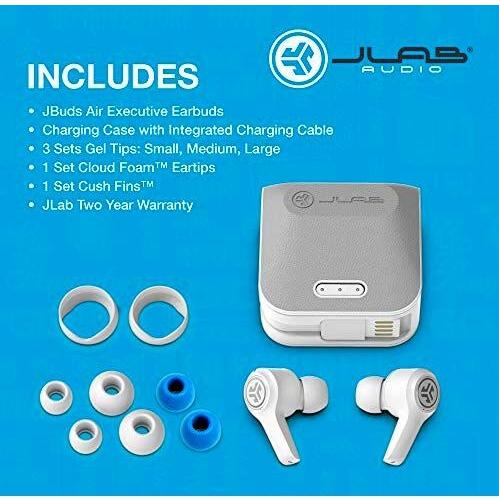
JBuds Air Executive Bluetooth Earbuds


Sponsored This site contains affiliate links for which we may receive compensation. More information
Find other available options:

| Identifiers | |
|---|---|
| MPN | JLAB EBJBUDSAIREXECRWHT82 |
| Dimensions / Weight | |
| Key Features | |
| Battery recharge time | 1.5 h |
|
Battery technology The chemical composition or classification of a battery, such as lithium‑ion, lithium‑polymer, nickel‑metal hydride, sealed lead acid, alkaline, zinc‑air, etc. It indicates the type of electrochemical reaction that stores and delivers energy in the device.
|
Lithium Polymer (LiPo) |
| Bluetooth profiles | A2DP,AVRCP,HFP,HSP |
|
Bluetooth version The specific version of the Bluetooth standard supported by a product, expressed as a numeric value (e.g., 4.2, 5.0) or with additional descriptors such as "+HS" or feature lists. This attribute indicates the capabilities and compatibility for wireless communication.
|
5.0 |
|
Charging source The type of source that supplies power to the device for charging, such as a mains adapter (AC), a USB port, a solar panel, or a battery pack. It indicates which external supply can be used to charge the product and helps users determine compatibility with their available chargers.
|
DC |
|
Colour The colour or combination of colours that a product is available in, expressed as common names such as "Black", "Silver" or comma‑separated lists like "Black, White". It indicates the visual appearance of the item for consumers.
|
Black |
|
Ear coupling The type of ear attachment used by a headset or earphones, indicating how the device fits around or inside the ear. Common values include "Intraaural", "Circumaural", "Supraaural" and "On‑ear". This attribute helps users choose a model that matches their preferred fit and comfort.
|
Intraaural |
|
Headphone frequency The span of audio frequencies that a product can accurately reproduce or respond to, expressed in hertz (Hz). It indicates the lowest and highest frequencies the device can handle, helping users assess suitability for music playback, communication, or signal processing applications.
|
20 - 20000 Hz |
|
Headphone sensitivity The sensitivity of a headphone expressed in decibels (dB), indicating how much sound pressure the headphones can produce or detect for a given electrical input level. Values may be positive, negative, or zero and are typically measured at 1 kHz. This attribute helps users compare the loudness performance of different headphones.
|
103 dB |
|
Headset type The general classification of a headset based on how it delivers audio to the user, such as binaural (two‑channel), monaural (single‑channel), or other configurations. This attribute helps buyers understand whether the device provides stereo sound, single‑speaker output, or specialized listening modes.
|
Binaural |
|
International Protection IP code The IP (Ingress Protection) code indicates a product’s resistance to solids and liquids. It follows the standard two‑digit format (e.g., IP20, IP67), where the first digit represents protection against solid particles and the second against liquids. The code may include an ‘X’ to denote unknown protection for that category or multiple codes separated by commas for products offering different levels of protection in various configurations.
|
IP55 |
|
Intraaural headphones type The general classification of a headphone or earbud product, such as earbuds, in‑ear monitors, or other intraaural styles. It indicates the form factor that determines how the device fits into or around the ear.
|
In-ear monitors |
|
Microphone sensitivity The acoustic sensitivity of a microphone, expressed in decibels (dB). It indicates how effectively the microphone converts sound pressure into an electrical signal; lower (more negative) values mean higher sensitivity and better performance at low sound levels.
|
4.8 dB |
| Microphone Type | Built-in |
|
Recommended usage A brief statement of the intended or most suitable use cases for a product, such as the type of environment (indoor, outdoor), activity (gaming, office work, music listening) or general application category. It helps customers quickly determine whether the item fits their needs.
|
Calls/Music |
|
Wearing style A textual description of the way a product is worn or fitted on the body, such as "headband", "earhook", "neck‑band", "over‑the‑ear", or "in‑ear". This attribute helps users understand how the item will be positioned and secured during use.
|
In-ear |
|
Wireless range The maximum distance over which a device can maintain a reliable wireless connection to another device or network. It is expressed in linear units such as meters or feet and indicates the effective coverage area for Wi‑Fi, Bluetooth, RF, or other radio technologies.
|
9 m |
JLAB


