Netgear 24‑Port Smart Ethernet Switch with PoE+


Sponsored This site contains affiliate links for which we may receive compensation. More information
Find other available options:

| Identifiers | |
|---|---|
| MPN | NETGEAR GS728TPP-100EUS |
| Model | NETGEAR GS728TPP-100EUS |
| Dimensions / Weight | |
| Key Features | |
|
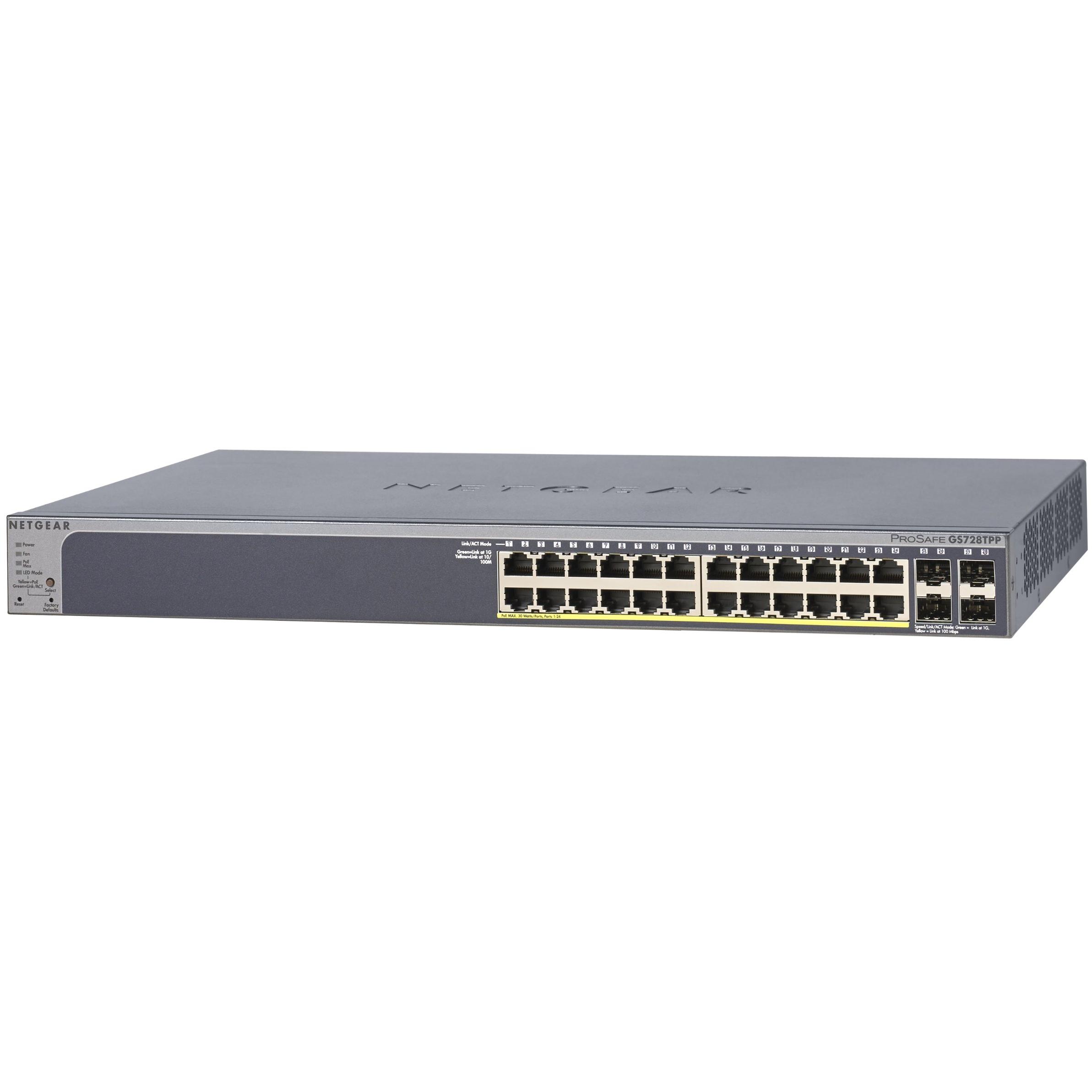
Basic switching RJ-45 Ethernet ports quantity Indicates the total count of physical RJ‑45 Ethernet connectors available on a device for wired network connectivity. The value is an integer representing how many separate ports can be used to connect Ethernet cables.
|
24 |
|
Broadcast storm control Indicates whether a network device includes a feature that limits the amount of broadcast traffic to prevent network congestion and potential outages caused by excessive broadcast packets.
|
Yes |
|
Cables included A list of the cable types that are supplied with the product, such as USB, HDMI, VGA, DisplayPort, LAN (RJ‑45), SATA, audio or other relevant connectors.
|
AC |
|
Copper ethernet cabling technology A comma‑separated list of the copper Ethernet standards supported by a device, such as 10BASE‑T, 100BASE‑TX, or 1000BASE‑T. Each entry indicates a specific speed and physical specification that the product can transmit over its RJ‑45 ports.
|
1000BASE-T,100BASE-T,10BASE-T |
|
Depth The linear measurement of an object from front to back or top to bottom, expressed in a physical unit such as millimeters, centimeters, inches, etc. It indicates how deep the item is and can be used for fitting, compatibility, or spatial planning.
|
257 mm |
|
DHCP features A comma‑separated list of the DHCP roles and options that a device can provide or use, such as server, client, relay, snooping, option 82 support, and IPv6 variants. The value may contain multiple items for a single product.
|
DHCP client |
| Electromagnetic compatibility | CE, FCC, Class A EN 55022, Class A C-Tick, EN 50082-1, EN 55024, CCC |
|
Fiber ethernet cabling technology The type of fiber‑optic Ethernet cabling supported by the product, such as 1000BASE‑X, 10GBASE‑LR, or 40GBASE‑SR4. It indicates which standardized fiber media and transceiver combinations are compatible with the device.
|
1000BASE‑LX,1000BASE‑SX |
| Fiber optic connector | SX |
|
Firmware upgradeable Indicates whether the device can receive firmware updates, allowing improvements in functionality and security fixes through downloads from the manufacturer.
|
Yes |
|
Full Duplex Indicates whether a device can transmit and receive data simultaneously on two channels, allowing bidirectional communication without delay. A value of "Yes" means the device supports full‑duplex operation; a value of "No" indicates it operates only in half‑duplex mode.
|
Yes |
|
Heat dissipation The amount of thermal energy a product can dissipate, expressed in a standard unit such as BTU per hour or watts. It indicates the cooling requirement and helps compare how much heat the device generates during operation.
|
1650.67 BTU/h |
|
Height The vertical dimension of a product measured from its lowest to highest point. It is expressed in a physical unit such as millimetres, centimetres or inches and applies to any item where height is relevant, including books, electronics, furniture and other objects.
|
44 mm |
| IGMP snooping | Yes |
| Jumbo frames support | Yes |
|
LED indicators A list of the functions or statuses that an LED indicator on a device can display, such as power status, activity, link, and other operational signals.
|
Yes |
|
MAC address filtering Indicates whether the device supports filtering network traffic based on MAC addresses. When enabled, the device can allow or block communication for specific devices identified by their MAC address.
|
Yes |
|
MAC address table The total count of unique MAC addresses that the device can store in its forwarding table. This value indicates how many devices can be simultaneously connected before the switch must start discarding or aging out older entries.
|
8000 entries |
|
Management protocols A list of network protocols that a device can use for configuration, monitoring and remote management, such as SNMP, HTTP/HTTPS, Telnet, SSH or other standard interfaces. Each protocol is represented by its common name and may be separated by commas or slashes in the source data.
|
IGMP, SNMP v1/v2/v3, RMON 1/2/3/9, SSL/HTTPS & TLS v1.0 |
|
Multicast support Indicates whether the device can send or receive IP multicast traffic, allowing it to participate in group communications such as streaming media, IPTV, and certain network protocols that rely on multicast distribution.
|
Yes |
|
Networking standards A list of the networking protocols and standards that a device can support or comply with, such as IEEE 802.11 variants for wireless, IEEE 802.3 for Ethernet, or other relevant networking specifications. The values are typically separated by commas and may include both technical identifiers and consumer‑friendly labels.
|
IEEE 802.1ab,IEEE 802.1p,IEEE 802.1Q,IEEE 802.3ad,IEEE 802.3ae,IEEE 802.3af,IEEE 802.3x,IEEE 802.3z |
|
Number of static routes The total count of manually configured static routing entries present in a networking device such as a router or switch. It indicates how many distinct destination networks are explicitly defined by the administrator, independent of dynamic routing protocols.
|
32 |
|
Operating altitude The range of altitudes (in meters) at which a product or component can operate reliably without performance degradation due to changes in atmospheric pressure, temperature, or other altitude‑related effects.
|
0 - 3000 m |
|
Packet buffer memory The amount of temporary storage that a device allocates in its internal memory for buffering data before processing or forwarding it. Expressed as a digital capacity (e.g., kilobytes, megabytes), this value indicates how much information the hardware can hold at once and influences performance when handling high‑throughput or bursty traffic.
|
8 MB |
|
Port mirroring Indicates whether the device supports port mirroring, a feature that allows one or more ports to copy traffic from another port for monitoring or analysis purposes.
|
Yes |
| Power LED | Yes |
|
Rack mounting Indicates whether a product is designed to be mounted in a rack system. The value can be "Yes" or "No", or it may specify the height occupied by the device using rack units (U) such as "1U", "2U", or a numeric measurement with unit, e.g., "61.25 mm".
|
Yes |
|
Rate limiting Indicates whether the device supports rate limiting, a feature that restricts the maximum data transfer speed or bandwidth to prevent network congestion or ensure fair usage among connected devices. A value of "Yes" means the device can enforce such limits, while "No" indicates it does not provide this capability.
|
Yes |
|
Safety A list of safety and regulatory certifications that a product complies with, such as CE, UL, FCC, or other regional standards.
|
CE, CSA, UL |
|
SFP module slots quantity The total count of Small Form‑factor Pluggable (SFP) ports available on a networking device, such as switches or routers. Each port can accept an SFP transceiver module for fiber or copper connections, allowing the device to support additional network interfaces.
|
4 |
|
Spanning Tree Protocol Indicates whether the device implements the Spanning Tree Protocol (STP), a network protocol that prevents loops in Ethernet topologies by dynamically blocking and forwarding paths to maintain a loop‑free logical topology.
|
Yes |
|
Supported network protocols A list of network communication protocols that a device can use or support, such as TCP/IP, HTTP, HTTPS, FTP, DHCP, DNS, and various wireless standards. Each protocol is represented by its standard name and may be separated by commas or slashes in the source data.
|
IPv4, IPv6, TFTP, SNTP, TACACS+ |
|
Switch layer The network layer(s) that a device can operate at, expressed as a string such as "L2", "L3" or combinations like "L2/L3". This attribute indicates the protocol stack level supported by the hardware or firmware.
|
L3 |
|
Switch type The classification of a network switch based on its management capabilities, such as Managed or Unmanaged. This attribute indicates whether the device can be configured and monitored remotely (Managed) or operates with fixed settings without remote configuration (Unmanaged). It helps users choose a switch that matches their networking expertise and control requirements.
|
Managed |
|
Switching capacity The maximum data transfer rate that the device can handle, expressed as a numeric value with an appropriate unit such as Gbit/s or Mbit/s. This attribute indicates how quickly data can be transmitted through the device and helps users compare networking performance across products.
|
1 Gbit/s |
|
User guide The mass of the product expressed in a standard unit such as grams or kilograms. It represents how heavy the item is and can be used for shipping, handling, or user information purposes.
|
Yes |
|
VLAN support Indicates whether the device can configure and manage Virtual LANs (VLANs) for network segmentation and traffic isolation. A value of "Yes" means the product supports VLAN tagging, creation, and management; a value of "No" indicates it does not provide this capability.
|
Yes |
|
Web-based management Indicates whether the product can be configured and monitored through a web interface accessible via a browser, allowing remote administration over a local or internet connection.
|
Yes |
|
Weight The mass of the product expressed in a standard unit such as grams or kilograms. It represents how heavy the item is and can be used for shipping calculations, handling instructions, or consumer information.
|
4.36 kg |
|
Width The horizontal measurement of a product, expressed in a linear unit such as millimetres or inches. It indicates how wide the item is from one side to the other and is used for sizing, fitting, and compatibility purposes.
|
440 mm |

NETGEAR is a brand of networking equipment, including routers, switches and wireless access points. The company was founded in 1996 and is headquartered in San Jose, California.

