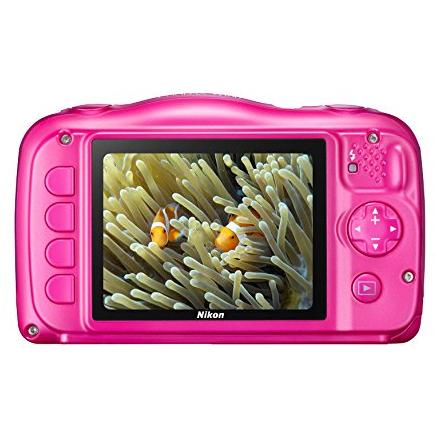
Nikon Coolpix W100 Rose Waterproof Compact Digital Camera and Bag Set


Sponsored This site contains affiliate links for which we may receive compensation. More information
Find other available options:

| Identifiers | |
|---|---|
| Model | Nikon VQA012E1 |
| MPN | Nikon VQA012E1 |
| Dimensions / Weight | |
| Key Features | |
|
Auto focusing AF modes A list of the available autofocus modes that a camera or imaging device can use, such as continuous autofocus, single-shot autofocus, face detection, tracking autofocus, contrast‑detection autofocus, servo‑autofocus, AI focus, and other manufacturer‑specific combinations. Each mode is represented by a free‑text string.
|
Contrast Detection Auto Focus |
|
Battery technology The chemical composition or classification of a battery, such as lithium‑ion, lithium‑polymer, nickel‑metal hydride, sealed lead acid, alkaline, zinc‑air, etc. It indicates the type of electrochemical reaction that stores and delivers energy in the device.
|
Lithium-Ion (Li-Ion) |
| Bluetooth | Yes |
|
Bluetooth version The specific version of the Bluetooth standard supported by a product, expressed as a numeric value (e.g., 4.2, 5.0) or with additional descriptors such as "+HS" or feature lists. This attribute indicates the capabilities and compatibility for wireless communication.
|
4 |
|
Built-in microphone Indicates whether the product includes a built‑in stereo microphone, i.e., a single integrated microphone that captures sound from two channels for higher audio fidelity. A value of "Yes" means such a microphone is present; "No" indicates it is absent.
|
Yes |
|
Camera shutter speed The duration that a camera’s shutter remains open to expose the sensor or film, expressed in seconds or fractions of a second (e.g., 1/2000 s). It determines how motion is captured and affects exposure; shorter times freeze action while longer times allow more light for low‑light situations.
|
2000 s |
| Camera shutter type | Electronic, Mechanical |
|
Camera type The general classification of a camera, such as compact, single‑lens reflex (SLR), mirrorless interchangeable lens camera (MILC), bridge, or video camera. It indicates the form factor and primary use case of the device.
|
Nikon Coolpix W100 |
|
Carrying Case The primary way a product is carried or supported, such as by hand, shoulder strap, backpack, belt, or other carrying mechanisms. This attribute helps users understand how the item can be transported and what accessories are required.
|
Yes |
|
Colour The colour or combination of colours that a product is available in, expressed as common names such as "Black", "Silver" or comma‑separated lists like "Black, White". It indicates the visual appearance of the item for consumers.
|
Roze |
|
Colours A colour is a visual attribute that describes the hue or shade of an object or surface. It can be a single dominant colour, a combination of colours, or a range such as "Black, White". The value may be expressed in common names (e.g., Black, Silver) or descriptive terms (e.g., One Colour, Assorted).
|
Pink |
|
Compatible memory cards List of the memory card types that a device can read or write, such as MicroSD (TransFlash), SD, MMC, CompactFlash, and others. Each value represents a format that the device’s slot or reader supports for storage expansion.
|
Eye-Fi,SD,SDHC,SDXC |
|
Depth The linear measurement of an object from front to back or top to bottom, expressed in a physical unit such as millimeters, centimeters, inches, etc. It indicates how deep the item is and can be used for fitting, compatibility, or spatial planning.
|
38 mm |
|
Digital zoom Represents the multiplier that indicates how many times an image or field of view is enlarged by digital zoom. The value is expressed as a number without units, such as "4x" or "1.5x", where the numeric part indicates the factor of increase.
|
2 x |
| Display | TFT |
| Display diagonal | 2.7" |
|
Display resolution The pixel dimensions of a display or image, expressed as width by height (e.g., 1920x1080). It indicates how many pixels are used to render visual content and is commonly used for monitors, TVs, smartphones, cameras, and digital images.
|
230000 pixels |
|
Dust-resistant Indicates whether the product is designed to resist dust accumulation on its exterior or interior components, helping maintain performance and appearance under normal use conditions.
|
Yes |
|
Flash range The minimum and maximum distance, expressed in meters, at which a camera’s flash can effectively illuminate a subject or scene. This range indicates the effective reach of the flash for proper exposure.
|
0.3 - 3.1 m |
|
Flash range (tele) The maximum distance at which the camera’s flash can effectively illuminate a subject, expressed as a numeric range in meters (e.g., "1 - 3 m"). This attribute indicates how far the flash light reaches under typical shooting conditions.
|
0.6 - 1.7 m |
|
Focus adjustment Specifies whether the camera’s focusing system operates automatically or requires manual adjustment. Common values include "Auto", "Manual", and combinations such as "Auto/Manual".
|
Auto |
|
GPS Indicates whether the product includes built‑in GPS functionality, allowing it to determine geographic location without external devices.
|
No |
|
HDMI A list of the HDMI ports available on the product, each entry indicating the number of ports and their specific HDMI version or additional features (e.g., "2 x HDMI 2.0b", "1 x HDMI 1.4 with CEC"). This attribute helps users understand both the quantity and capabilities of the HDMI connections.
|
Yes |
| HDMI connector type | Micro |
|
Height The vertical dimension of a product measured from its lowest to highest point. It is expressed in a physical unit such as millimetres, centimetres or inches and applies to any item where height is relevant, including books, electronics, furniture and other objects.
|
67 mm |
|
Image formats supported A list of the file extensions and codecs that a product can read, display, or record. Each value represents a valid format such as JPG, PNG, BMP, GIF, HEIF, WebP, RAW, etc., and may include both the extension and the associated codec name.
|
JPG |
|
Image sensor size The diagonal measurement of the image sensor in a camera or imaging device, expressed in inches or millimeters. It indicates the overall active area available for capturing light and is commonly used to compare sensor sizes such as 1/2.3", 1/1.7", APS‑C, Full‑Frame, etc.
|
3.1" |
|
Internal memory The total amount of internal memory available in a device, expressed as a data size such as megabytes (MB) or gigabytes (GB). It indicates how much information the component can hold for active processes and affects multitasking performance.
|
22 MB |
|
International Protection IP code The IP (Ingress Protection) code indicates a product’s resistance to solids and liquids. It follows the standard two‑digit format (e.g., IP20, IP67), where the first digit represents protection against solid particles and the second against liquids. The code may include an ‘X’ to denote unknown protection for that category or multiple codes separated by commas for products offering different levels of protection in various configurations.
|
IPX8 |
|
ISO Sensitivity The ISO sensitivity setting of a camera, indicating the sensor’s sensitivity to light. Values are typically numeric (e.g., 100, 200, 400) and may include an "Auto" option where the camera selects the appropriate ISO automatically.
|
1600 |
|
Lens structure The aspect ratio describes the proportional relationship between the width and height of a lens’s image circle or sensor coverage, expressed as a simple fraction (e.g., 12/9). It indicates how wide or tall the captured image will be relative to its other dimension. This value helps users compare lenses for compatibility with camera sensors and desired framing.
|
6/5 |
|
Light exposure control A set of selectable camera settings that determine how the sensor is exposed to light. Each value represents a mode such as Auto, Aperture priority, Shutter priority, Manual or combinations thereof, controlling shutter speed, aperture, ISO and other exposure parameters.
|
Program AE |
|
Maximum aperture number The highest f‑number (aperture value) that a camera lens can achieve when fully wide open. It indicates the maximum light‑gathering capability of the lens and is expressed as an integer or decimal without units.
|
5 |
|
Maximum image resolution The highest pixel dimensions of an image or display that a product can output, capture, or support, expressed as width by height (e.g., 1920x1080). It indicates the maximum resolution available for visual content on the device.
|
4160x3120 |
|
Maximum video resolution The highest pixel dimensions that a device can output or support for video playback or recording, expressed as width by height (e.g., 1920x1080). It indicates the maximum resolution available for visual content on the product.
|
1920x1080 |
|
Megapixel The total number of megapixels that a camera sensor can capture, expressed as a numeric value without units. Higher values generally indicate greater detail and image quality.
|
13.2 MP |
|
Memory slots The number of physical memory slots that are present and available for installing RAM modules in a device. This count indicates how many separate memory sticks can be installed or upgraded.
|
1 |
|
Minimum aperture number The total count of openings, such as holes or ports, present in a product. This value indicates how many separate apertures are available for access, ventilation, or connection purposes.
|
3 |
|
Near field communication Indicates whether the product supports Near‑Field Communication (NFC), a short‑range wireless technology that allows data exchange between devices when they are in close proximity.
|
Nee |
|
Photographer type The skill or experience level of the photographer, indicating whether they are a beginner, advanced, expert, or other proficiency category. This attribute helps buyers understand the expected expertise behind the product and can guide them in selecting equipment suitable for their own skill level.
|
Beginner |
|
Power source type The main electrical supply that powers the device, such as mains electricity (AC), battery, USB power, PoE, or a combination of these options.
|
Battery |
|
Resolución The number of megapixels captured by a camera’s sensor, expressed as a single numeric value (e.g., 12.3 MP). This metric indicates the overall detail and clarity that the camera can record in still images or video frames.
|
14.17 MP |
|
Slowest camera shutter speed The longest duration that a camera’s shutter remains open during exposure, expressed in seconds or fractions of a second (e.g., 30 s, 0.5 s). This value indicates the maximum time the sensor is exposed to light for each frame and helps users understand how long a camera can capture motion before freezing it.
|
25 s |
|
Touch screen Indica se un dispositivo dispone di una interfaccia touch screen che rileva l’input tattile. Il valore è "Sì" (o equivalente) quando il dispositivo include uno schermo touch e "No" altrimenti.
|
N |
|
USB connector The physical interface of the main USB port on a device, such as USB‑A, USB‑B, USB‑C, Micro‑USB or Mini‑USB. It indicates the shape and electrical characteristics that determine compatibility with cables, adapters and peripherals.
|
Micro-USB |
|
Video formats supported A list of video file formats that the product can play or record, including both the compression codec and the file extension. Each value represents a valid combination of technology and format supported by the device’s hardware or software.
|
AVC,H.264,MPEG4 |
|
Video function Represents the primary video capability of a product, such as the resolution or format it can capture or display (e.g., "4K", "Full-HD"). The value is a free‑text label that describes the supported video mode.
|
Standard Resolution |
|
Video recording Indicates whether the product has the capability to record video. A value of "Yes" means the device can capture video, while a value of "No" indicates that it cannot.
|
Yes |
|
Viewfinder The type or presence of a viewfinder on the camera. It indicates whether the device has a built‑in optical or electronic viewfinder, and if so, what kind it is (e.g., real image finder, electronic viewfinder, etc.). Values can be "Yes" for a standard viewfinder, "No" when none is available, or a descriptive string that specifies the viewfinder model or feature.
|
No |
| Waterproof up to | 10 m |
|
Wi-Fi Indicates whether the product has built‑in Wi‑Fi capability, allowing it to connect to wireless networks without requiring external adapters or dongles.
|
Yes |
|
Wi-Fi standards A list of the wireless networking protocols and frequency bands that a device can connect to, such as 802.11a, 802.11b, 802.11g, Wi‑Fi 4 (802.11n), Wi‑Fi 5 (802.11ac) or Wi‑Fi 6 (802.11ax). The values are typically separated by commas and may include both the technical name and a consumer‑friendly label.
|
IEEE 802.11b,IEEE 802.11g |
|
Width The horizontal measurement of a product, expressed in a linear unit such as millimetres or inches. It indicates how wide the item is from one side to the other and is used for sizing, fitting, and compatibility purposes.
|
109.5 mm |

Nikon is a Japanese company that produces cameras, lenses, binoculars, microscopes, and other optical equipment. It was founded in 1917 as a manufacturer of optical glass and instruments. Nikon entered the camera market in 1948, and has been a leading producer of digital cameras since the release of the Nikon D1 in 1999. Nikon is also a major supplier of camera components to other camera manufacturers.

