SonicWall 01-SSC-0217 SOHO VPN Firewall

Sponsored This site contains affiliate links for which we may receive compensation. More information
Find other available options:

| Identifiers | |
|---|---|
| Model | SONICWALL 01-SSC-0217 |
| MPN | SONICWALL 01-SSC-0217 |
| Dimensions / Weight | |
| Key Features | |
|
AC input frequency The frequency of the alternating current supplied to a power supply or charger, expressed in hertz (Hz). It indicates the acceptable operating range for the electrical mains that powers the device, ensuring proper functionality and safety.
|
50 - 60 Hz |
|
Connectivity technology The network and data interface technologies supported by the product, such as Wired, Wireless, USB, Bluetooth, or combinations thereof. Each value represents a distinct technology that can be used for communication or power delivery.
|
Wired |
|
DHCP client Indicates whether the device supports the DHCP client function, meaning it can automatically request an IP address and related network settings from a DHCP server.
|
Yes |
|
DHCP server Indicates whether the device supports acting as a DHCP server, allowing it to assign IP addresses and network configuration settings to clients on the network.
|
Yes |
|
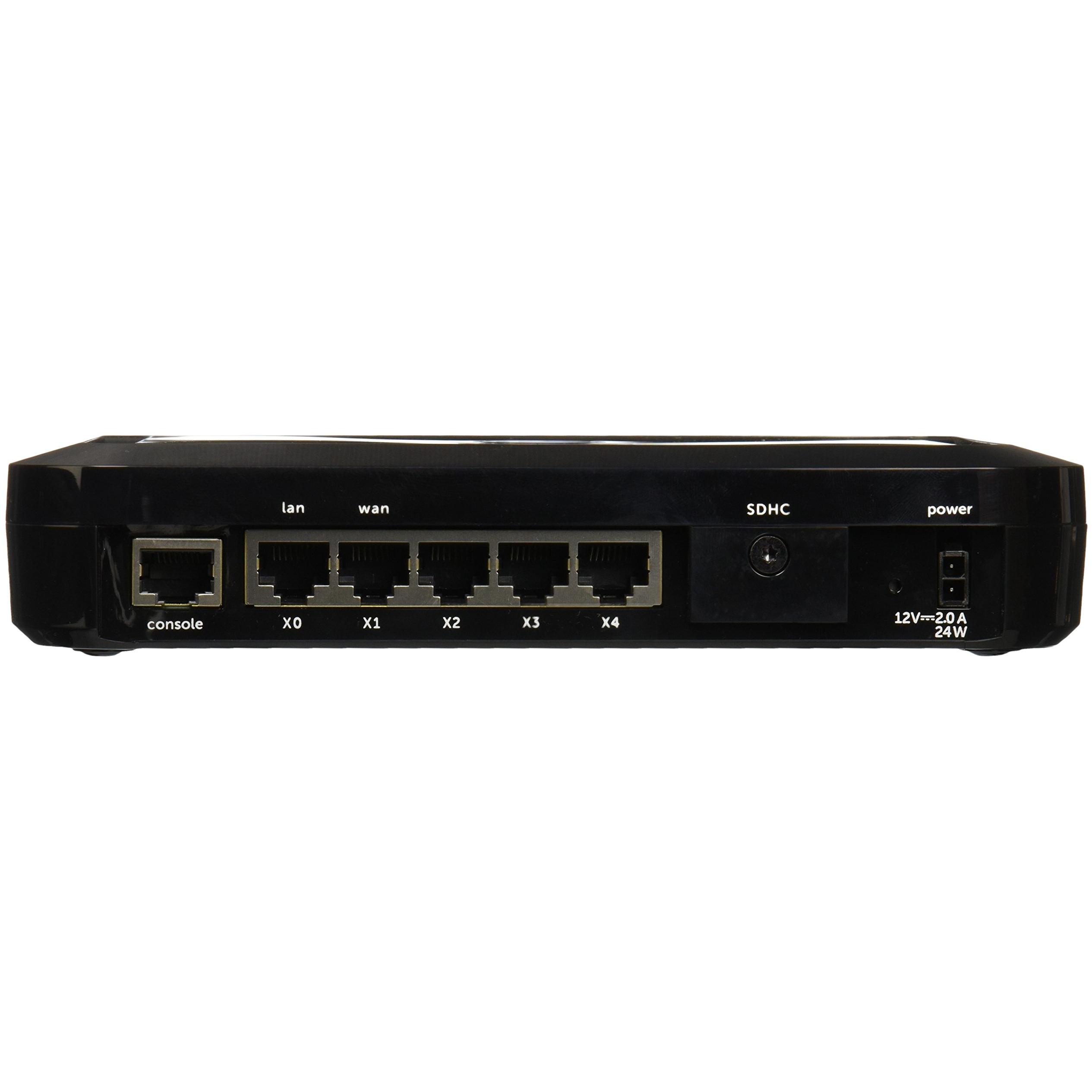
Ethernet LAN ports Represents the total count of Ethernet LAN (RJ‑45) interfaces available on a product. The value is an integer indicating how many physical Ethernet ports are present, regardless of speed or generation.
|
5 |
|
Firewall throughput The maximum rate at which a firewall can process or transmit network traffic, expressed in megabits per second (Mbits/s). It indicates the capacity of the device to handle data flow without bottlenecks.
|
300 Mbit/s |
|
Flash memory The total amount of internal flash memory available in a device, expressed as a data size (e.g., megabytes or gigabytes). This attribute indicates how much data can be stored on the device’s built‑in flash storage and is useful for comparing storage capacity across products.
|
32 MB |
|
Input current The electrical current drawn by a device when powered, expressed in amperes (A). It indicates how much current the product consumes from its power source during normal operation and can be used to assess compatibility with power supplies or USB ports.
|
1 A |
|
Internal memory The total amount of internal memory available in a device, expressed as a data size such as megabytes (MB) or gigabytes (GB). It indicates how much information the component can hold for active processes and affects multitasking performance.
|
512 MB |
|
Maximum data transfer rate The highest theoretical speed at which a device can send or receive data, expressed in bits per second (bps) or its multiples such as kbps, mbps, gbps, etc. This value represents the upper bound of throughput under optimal conditions and is useful for comparing performance across devices and interfaces.
|
1000 Mbit/s |
|
Multicast support Indicates whether the device can send or receive IP multicast traffic, allowing it to participate in group communications such as streaming media, IPTV, and certain network protocols that rely on multicast distribution.
|
Yes |
|
Number of Users The total number of individual users that can be supported or accessed by the product or service. It represents a count of distinct user accounts, connections, or licenses and is expressed as an integer value.
|
250 user(s) |
|
Operating relative humidity The range of relative humidity (in percentage) within which the product is designed to operate reliably. Values are expressed as a minimum–maximum interval such as "20 - 80 %" and indicate the acceptable environmental moisture level for optimal performance.
|
5 - 95 % |
|
Port forwarding Indicates whether the device supports configuring port forwarding rules to allow external traffic to reach specific internal services or devices. The value can be a simple yes/no, or a list of supported features such as Virtual Server, UPnP, DMZ, Port Triggering, ALG, etc.
|
Yes |
| Power consumption | 7.9 W |
|
Power supply The electrical power consumption or output of the product, expressed in watts (W). It indicates how much energy the device uses during operation or how much power it can deliver to connected equipment.
|
24 W |
|
Processor cores The total number of physical processing units in a single central processing unit (CPU). This value indicates how many independent tasks the CPU can handle simultaneously, influencing multitasking and parallel performance.
|
2 |
|
Quality of Service support Indicates whether a product supports Quality of Service (QoS) features, which allow prioritization and management of network traffic to ensure optimal performance for critical applications.
|
Yes |
|
Routing protocols A list of routing protocols that a device can use to forward network traffic, such as OSPF, RIP, BGP, EIGRP, IS‑IS, and VRRP. Each protocol is represented by its standard name and may be separated by commas or slashes in the source data.
|
BGP,OSPF,RIP-1,RIP-2 |
|
Security algorithms A list of cryptographic and authentication methods that a device can use for secure communication or data protection. Each entry represents a distinct algorithm or protocol, such as encryption ciphers (e.g., AES, WEP), authentication mechanisms (e.g., RADIUS, WPA‑PSK), or network security protocols (e.g., HTTPS, SSL/TLS). The values are typically separated by commas and may include both technical identifiers and consumer‑friendly labels.
|
128-bit AES,192-bit AES,256-bit AES,MD5,SHA-1 |
|
Storage media type The type of physical storage medium that a product uses or supports, such as flash memory, hard disk drive (HDD), solid‑state drive (SSD), eMMC, or combinations thereof. It indicates the underlying technology for data persistence and helps users compare devices based on their storage capabilities.
|
Flash |
| VLANs | 25 |
|
VPN throughput The maximum rate at which a VPN device can process or transmit encrypted network traffic, expressed in megabits per second (Mbits/s). It indicates the capacity of the VPN appliance to handle secure data flow without bottlenecks.
|
100 Mbit/s |
|
VPN tunnels quantity Represents the count of virtual private network (VPN) tunnels that a device or service can establish simultaneously. This value indicates how many independent secure connections are supported for remote access, site‑to‑site links, or other encrypted communications.
|
10 |
|
Wi-Fi standards A list of the wireless networking protocols and frequency bands that a device can connect to, such as 802.11a, 802.11b, 802.11g, Wi‑Fi 4 (802.11n), Wi‑Fi 5 (802.11ac) or Wi‑Fi 6 (802.11ax). The values are typically separated by commas and may include both the technical name and a consumer‑friendly label.
|
802.11a,Wi-Fi 4 (802.11n) |

SONICWALL is a brand of network security appliances that provide firewall, intrusion prevention, anti-virus, and anti-spyware protection. The company was founded in 1991 and is headquartered in San Jose, California.