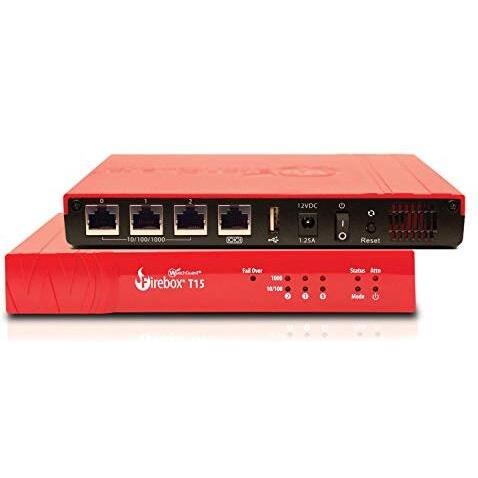
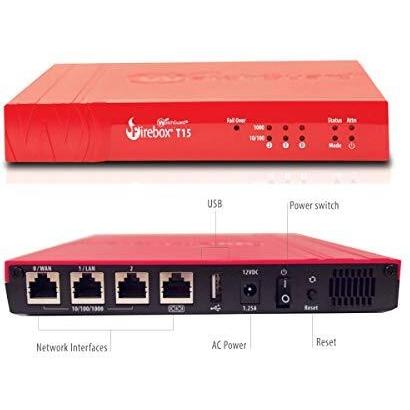
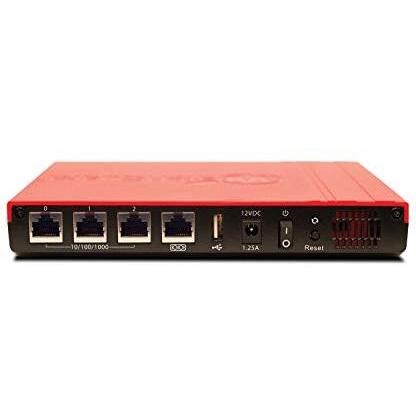
WatchGuard Firebox WGT15083-WW 400 Mbps Hardware Firewall


Sponsored This site contains affiliate links for which we may receive compensation. More information
Find other available options:

| Identifiers | |
|---|---|
| MPN | WatchGuard WGT15083-WW |
| Dimensions / Weight | |
| Key Features | |
|
Concurrent connections The highest count of simultaneous sessions or links that a device can handle without performance degradation. This value indicates how many concurrent connections—such as network sockets, user sessions, or data streams—can be active at the same time.
|
100000 |
|
DHCP client Indicates whether the device supports the DHCP client function, meaning it can automatically request an IP address and related network settings from a DHCP server.
|
Yes |
|
Ethernet LAN ports Represents the total count of Ethernet LAN (RJ‑45) interfaces available on a product. The value is an integer indicating how many physical Ethernet ports are present, regardless of speed or generation.
|
3 |
| Firewall security | DoS, HTTP, HTTPS, SMTP, FTP, DNS, TCP, POP3, SIP, H.323 |
|
Firewall throughput The maximum rate at which a firewall can process or transmit network traffic, expressed in megabits per second (Mbits/s). It indicates the capacity of the device to handle data flow without bottlenecks.
|
400 Mbit/s |
|
Gigabit Ethernet copper ports quantity Represents the count of physical Gigabit Ethernet (10/100/1000 Mbps) copper interfaces available on a device. The value is an integer indicating how many separate RJ‑45 connectors support Gigabit speeds, regardless of other port types or generations.
|
4 |
|
Input current The electrical current drawn by a device when powered, expressed in amperes (A). It indicates how much current the product consumes from its power source during normal operation and can be used to assess compatibility with power supplies or USB ports.
|
1.25 A |
|
Management protocols A list of network protocols that a device can use for configuration, monitoring and remote management, such as SNMP, HTTP/HTTPS, Telnet, SSH or other standard interfaces. Each protocol is represented by its common name and may be separated by commas or slashes in the source data.
|
SNMP v2/v3 |
| Mean time between failures | 129955 h |
|
Number of Users The total number of individual users that can be supported or accessed by the product or service. It represents a count of distinct user accounts, connections, or licenses and is expressed as an integer value.
|
200 user(s) |
|
Operating relative humidity The range of relative humidity (in percentage) within which the product is designed to operate reliably. Values are expressed as a minimum–maximum interval such as "20 - 80 %" and indicate the acceptable environmental moisture level for optimal performance.
|
10 - 85 % |
|
Security algorithms A list of cryptographic and authentication methods that a device can use for secure communication or data protection. Each entry represents a distinct algorithm or protocol, such as encryption ciphers (e.g., AES, WEP), authentication mechanisms (e.g., RADIUS, WPA‑PSK), or network security protocols (e.g., HTTPS, SSL/TLS). The values are typically separated by commas and may include both technical identifiers and consumer‑friendly labels.
|
3DES,128-bit AES,192-bit AES,256-bit AES,802.1x RADIUS,DES,MD5,SHA-1,SSL/TLS |
|
Serial ports Represents how many serial communication connectors (e.g., RS‑232, RS‑485) are physically present on the product. The value is a simple integer indicating the total count of serial ports, regardless of specific model or configuration.
|
1 |
|
Storage temperature The range of temperatures in which a device can safely operate without risk of damage or performance degradation. Values are expressed in degrees Celsius (°C) and may represent a single temperature, a minimum–maximum interval, or an average operating point.
|
-40 - 70 °C |
|
Supported network protocols A list of network communication protocols that a device can use or support, such as TCP/IP, HTTP, HTTPS, FTP, DHCP, DNS, and various wireless standards. Each protocol is represented by its standard name and may be separated by commas or slashes in the source data.
|
IPv6 |
| VLANs | 10 |
|
VPN Support A list of the VPN protocols that a device can establish, such as PPTP, L2TP, IPSec, OpenVPN, and related pass‑through or server modes. The values are typically separated by commas and may include variations like "IPSec Pass‑Through" or "OpenVPN Server" to indicate specific capabilities.
|
IPSec, SSL, L2TP |
|
VPN throughput The maximum rate at which a VPN device can process or transmit encrypted network traffic, expressed in megabits per second (Mbits/s). It indicates the capacity of the VPN appliance to handle secure data flow without bottlenecks.
|
150 Mbit/s |
|
WAN connection The type of network interface used to connect a device to the wide‑area network (WAN). It specifies the physical connector and protocol, such as Ethernet (RJ‑45), ADSL (RJ‑11), or mobile cellular (SIM/USB). This attribute helps users identify the required cables, adapters, or SIM cards for external connectivity.
|
Ethernet (RJ-45) |

WatchGuard is a brand of network security appliances that provide firewall, intrusion prevention, and VPN services. The company was founded in 1996 and is headquartered in Seattle, Washington.
